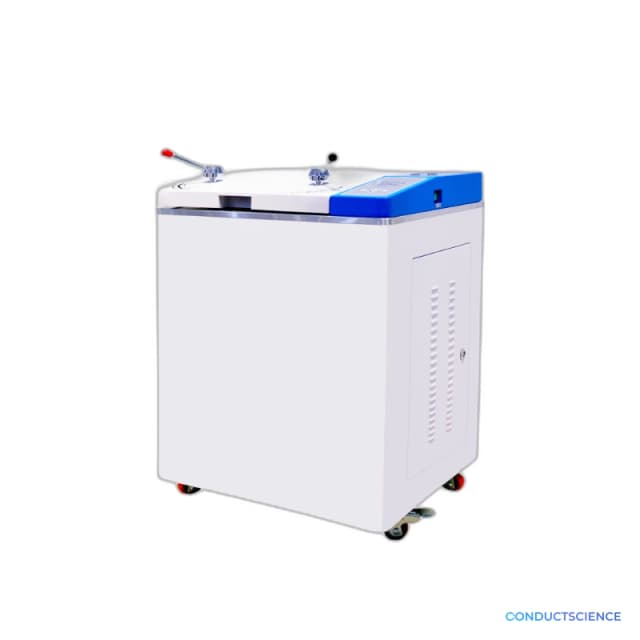
Online Residual Chlorine Electrode
Electrochemical sensor for continuous monitoring of residual chlorine (0-20 mg/L) in industrial water systems with pH compensation and T90 response under 120 seconds.

Louise Corscadden, PhD
Director of Science · ConductScience
Ask Louise about Online Residual Chlorine Electrode fit, setup, configuration, or quote prep.
Already working with us? Sign in to connect this with My Scientist.
Key Specifications
Full details →- Model fit
- Configured during quote
- SKU family
- CS-LH-IND007
- Shipping box
- 15.0 x 5.0 x 5.0 cm
- Ordering
- Online checkout and quote request available
- Category
- Industrial Sensors
- Build notes
- Confirm accessories, station layout, and support needs before purchase
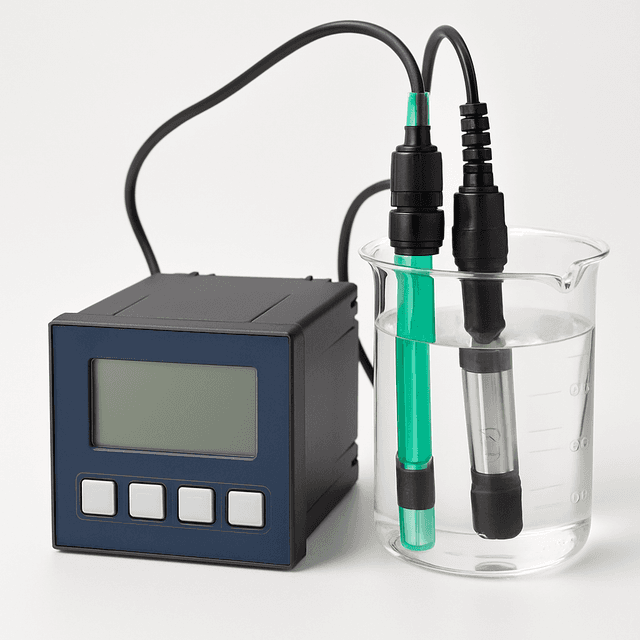
The Online Residual Chlorine Electrode is an electrochemical sensor designed for continuous monitoring of free chlorine concentrations in water systems. This amperometric electrode employs a three-electrode configuration with a gold cathode, silver/silver chloride anode, and reference electrode housed within an electrolyte chamber. The sensor membrane selectively permits hypochlorous acid passage while preventing electrolyte leakage and contaminant infiltration, ensuring measurement integrity in industrial water treatment applications.
The electrode operates on the principle of measuring current proportional to hypochlorous acid concentration, with integrated pH compensation to provide accurate residual chlorine readings across varying water chemistry conditions. With a measuring range of 0-20 mg/L and response time under 120 seconds (T90), this sensor enables real-time chlorine monitoring in water treatment facilities, cooling systems, and process water applications where chlorine disinfection efficacy must be continuously verified.
How It Works
The electrode operates on amperometric principles, where the current generated is directly proportional to the concentration of electroactive species. The gold cathode reduces hypochlorous acid (HOCl) and hypochlorite ions (OCl-) present in the sample, while the silver/silver chloride anode provides a stable reference potential. The electrochemical reaction at the cathode produces electrons proportional to the chlorine concentration, generating a measurable current signal.
A selective membrane isolates the internal electrolyte from the sample while allowing hypochlorous acid to diffuse through. This membrane prevents interference from other dissolved species and maintains electrode stability. The pH compensation feature accounts for the equilibrium between HOCl and OCl- species, which shifts with pH changes, ensuring accurate total chlorine measurements across the specified pH range of 4-8.
The electrode's response time (T90 < 120 seconds) reflects the time required for membrane equilibration and signal stabilization. Flow-through design with recommended flow rates ≤20 L/H ensures adequate sample renewal while preventing membrane damage from excessive turbulence.
Features & Benefits
Measuring range
- 0-20mg/L
Lower limit
- 0.05mg/L
Ph range
- 4-8
Repeatability
- 0.05mg/L or 5% larger as the standard
Respinse time
- T90ï¼120S
Velocity of flow
- â¥20L/H
Product Name
- Quantity Sold
Residual Chlorine Test Strip 0-10ppm
- 3000+
Residual Chlorine Analyzer 0-10ppm
- 500+
Residual Chlorine Kit
- 2000+
Automation Level
- semi-automated
Brand
- ConductScience
Accuracy
- ±10%ï¼DPDï¼
Research Domain
- Environmental Monitoring
- Food Science
- Industrial Hygiene
- Materials Science
- Microbiology
- Pharmaceutical QC
Shipping weight
- 0.26 lb
Shipping box
- L: 15.0 cm
- W: 5.0 cm
- H: 5.0 cm
| Feature | This Product | Typical Alternative | Advantage |
|---|---|---|---|
| Measuring Range | 0-20 mg/L with 0.05 mg/L detection limit | Entry-level sensors often limited to 0-5 mg/L range | Extended range accommodates both low-level residual monitoring and high-dose disinfection applications without sensor changes. |
| Response Time | T90 < 120 seconds | Basic electrodes may require 3-5 minutes for stabilization | Faster response enables timely process adjustments and reduces lag time in control loops. |
| pH Compensation | Integrated compensation for pH 4-8 range | Manual pH correction or limited pH range operation | Automatic compensation eliminates calculation errors and maintains accuracy across varying water conditions. |
| Flow Rate Tolerance | ≤20 L/H maximum flow specification | Rigid flow requirements or flow-sensitive measurements | Flexible flow requirements simplify integration into existing sampling systems. |
| Calibration Reference | DPD-traceable accuracy specification | Factory calibration without field verification standards | Traceable accuracy enables regulatory compliance documentation and quality assurance protocols. |
This electrode offers extended measurement range and rapid response with integrated pH compensation, providing operational flexibility for diverse water treatment applications. DPD-traceable accuracy specifications support quality assurance requirements while continuous operation eliminates reagent costs associated with colorimetric methods.
Practical Tips
Use fresh DPD standards prepared according to standard methods and verify standard concentrations with independent analytical methods.
Why: Standard degradation or preparation errors directly affect calibration accuracy and subsequent measurements.
Clean membrane surface weekly with soft brush and deionized water to remove biofilm and particulate accumulation.
Why: Membrane fouling increases response time and reduces measurement accuracy by limiting chlorine diffusion.
Install electrode downstream of chemical injection points with adequate mixing time to ensure representative sampling.
Why: Poor mixing leads to measurement variability and inadequate process control of disinfection systems.
If readings drift high, check for air bubbles in sample line or flow cell that can cause measurement artifacts.
Why: Air bubbles alter the electrochemical environment and can cause false positive readings or signal instability.
Record sample temperature and pH during calibration and operation to identify trends affecting measurement accuracy.
Why: Temperature and pH variations influence electrode performance and chlorine chemistry beyond compensation range.
Ensure proper grounding of electrode housing and associated instrumentation to prevent electrical interference.
Why: Electrical noise can affect sensitive electrochemical measurements and cause erratic signal behavior.
Perform two-point calibration using zero and mid-range standards rather than single-point adjustments.
Why: Two-point calibration corrects both offset and slope errors, improving accuracy across the full measurement range.
Store electrode in deionized water when not in use to maintain membrane hydration and electrolyte stability.
Why: Dry storage can damage the membrane and require extended conditioning time before accurate measurements resume.
Setup Guide
What’s in the Box
- Online residual chlorine electrode (typical)
- Protective electrode cap (typical)
- Connection cable with terminations (typical)
- Mounting hardware (typical)
- Calibration certificate (typical)
- Installation and operation manual (typical)
Warranty
ConductScience provides standard one-year manufacturer warranty covering electrode defects and performance specifications. Technical support includes calibration guidance and troubleshooting assistance for optimal measurement performance.
Compliance
How does pH variation affect chlorine measurements and compensation accuracy?
The electrode includes pH compensation for the 4-8 range to account for HOCl/OCl- equilibrium shifts. At lower pH, more chlorine exists as HOCl (higher biocidal activity), while higher pH favors OCl- formation. The compensation algorithm adjusts readings based on pH input to provide total available chlorine measurements.
What interfering species affect electrode performance in complex water matrices?
The selective membrane minimizes interference from most dissolved species, though strong oxidants like ozone, permanganate, or high bromine levels may cause positive bias. Consult product datasheet for complete interference data and correction factors for specific applications.
How frequently should calibration be performed for reliable measurements?
Calibration frequency depends on application conditions but typically ranges from weekly to monthly. Systems with stable water quality may extend intervals, while variable conditions or critical applications require more frequent verification using DPD reference standards.
Can the electrode measure combined chlorine or chloramines?
This electrode primarily responds to free available chlorine (HOCl/OCl-). Combined chlorine measurement requires different analytical approaches. Consult product datasheet for specific response to chloramine species if present in your application.
What sample conditioning is required for accurate measurements?
Sample temperature should be stable, pH within 4-8 range, and flow rate ≤20 L/H. Remove large particulates that could foul the membrane. Temperature compensation may be required for applications with significant thermal variation.
How does the electrode compare to colorimetric DPD methods for accuracy?
The electrode is calibrated against DPD standards with ±10% accuracy specification. Electrochemical measurement provides continuous monitoring without reagent consumption, while DPD offers point-in-time verification with different potential interferences.
What is the expected electrode lifetime and replacement indicators?
Electrode lifetime varies with application conditions but typically ranges from 1-2 years. Replace when calibration drift exceeds specifications, response time increases significantly, or membrane damage is observed. Consult product datasheet for specific lifetime expectations.
Have a question about this product?
Have a question? Just ask.
Send it over and we'll email you a personalized answer — no call, no scheduling.
Prefer to talk it through?
Accessories
Enhance your setup with compatible accessories
Frequently Bought Together