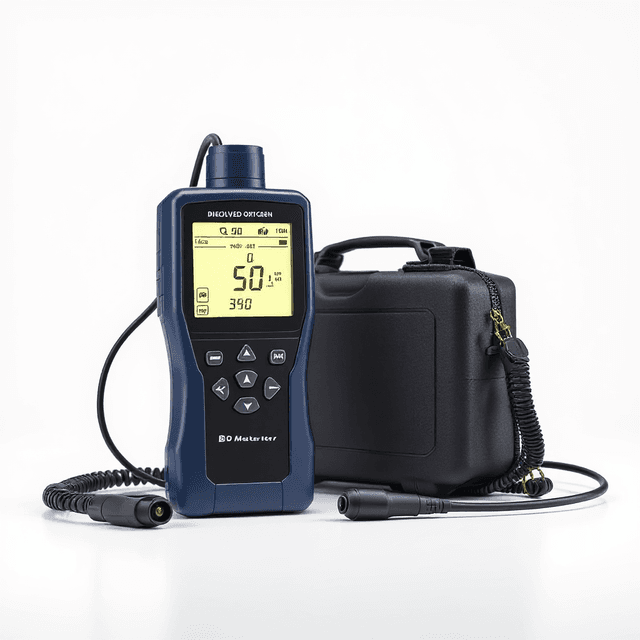
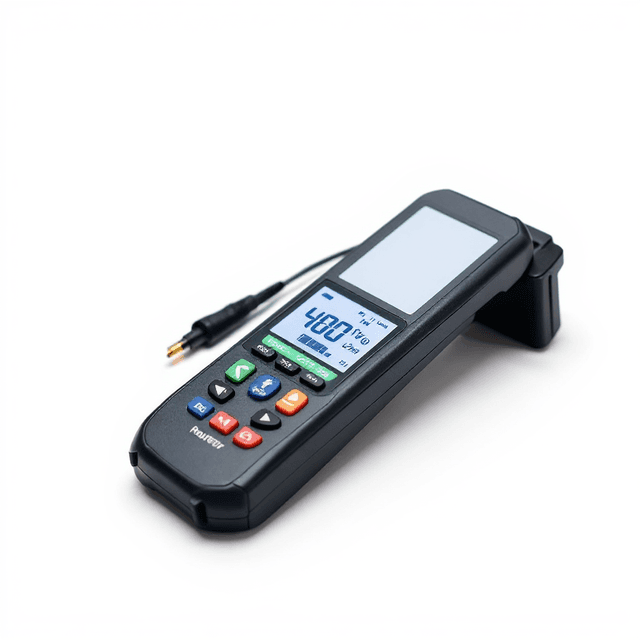
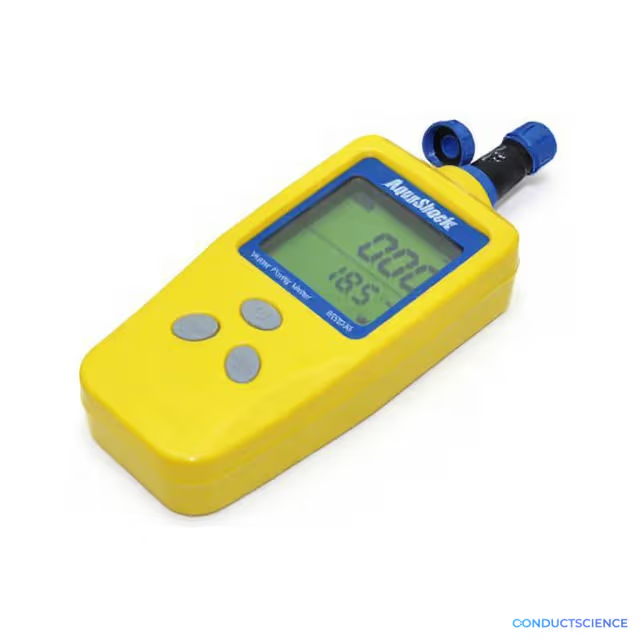
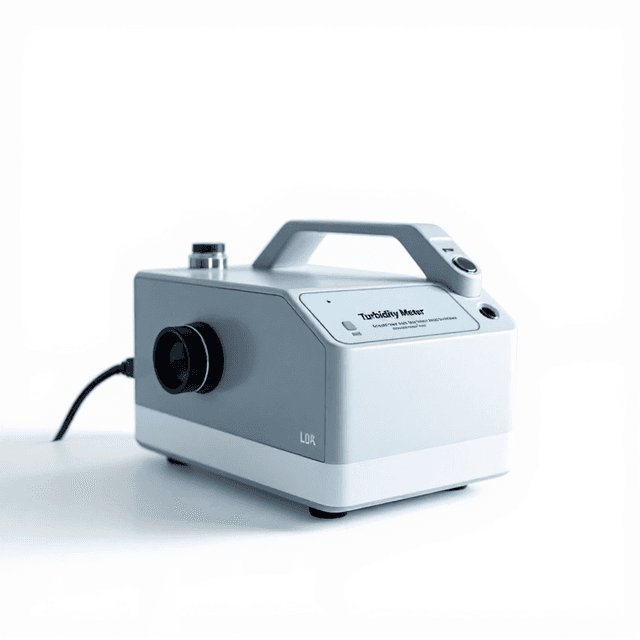
Portable Turbidity and Total Suspended Solids Meter
Portable dual-parameter analyzer measuring turbidity (0-1000 NTU) and total suspended solids (0-1000 mg/L) using 90°/180° optical detection with near-infrared light source for chromatic interference elimination.

Louise Corscadden, PhD
Director of Science · ConductScience
Ask Louise about Portable Turbidity and Total Suspended Solids Meter fit, setup, configuration, or quote prep.
Already working with us? Sign in to connect this with My Scientist.
Key Specifications
Full details →- Model fit
- Configured during quote
- SKU family
- CS-LH-NTU005
- Shipping box
- 6.69 x 2.83 x 1.73 cm
- Ordering
- Online checkout and quote request available
- Category
- Portable Analyzers
- Build notes
- Confirm accessories, station layout, and support needs before purchase
The Portable Turbidity Total Suspended Solids Meter CS-LH-NTU005 employs dual optical detection methodology combining scattered light and transmitted light measurements with near-infrared illumination to eliminate chromatic interference. The instrument utilizes 90° and 180° detectors to simultaneously quantify both turbidity (0-1000 NTU) and total suspended solids concentration (0-1000 mg/L) through ratiometric analysis of scattered to transmitted light intensity.
This dual-parameter analyzer addresses the fundamental relationship between particle suspension and optical properties in aqueous samples. The near-infrared light source minimizes color-related measurement artifacts commonly encountered with visible light turbidimeters, while the dual-detector configuration provides enhanced measurement reliability across varying particle size distributions and concentrations.
How It Works
The instrument operates on the principle of optical light scattering and transmission analysis using near-infrared radiation. When light encounters suspended particles in solution, it undergoes both scattering and absorption phenomena. The 90° detector measures Rayleigh and Mie scattering, where smaller particles predominantly exhibit Rayleigh scattering (intensity inversely proportional to wavelength⁴) while larger particles produce Mie scattering patterns. The 180° detector captures transmitted light that has passed through the sample without significant interaction.
Turbidity measurements are derived from the 90° scattered light intensity, following nephelometric principles where light scattering is proportional to particle concentration and size distribution. Total suspended solids determination utilizes the ratio of scattered to transmitted light intensities, providing a correlation-based measurement of particulate matter concentration. The near-infrared light source (typically 850-880 nm) minimizes interference from dissolved organic compounds that absorb visible light, ensuring measurement accuracy across diverse sample matrices.
The dual-detector configuration enables simultaneous quantification of both parameters from a single sample aliquot, with internal algorithms compensating for particle size effects and optical path variations. Calibration standards establish the relationship between optical signals and gravimetric reference measurements for both turbidity and suspended solids concentrations.
Features & Benefits
Place of Origin
- Zhejiang, China
Brand Name
- Lohand
Range
- 0~1000NTU turbidity;0~1000mg/L total suspended solids
Indication error
- ±0.3NTU or ±8% turbidity;±0.3mg/L or ±8% total suspended solids
Repeatability
- <10NTU,â¦Â±0.1NTU;>10NTU,â¦Â±1% turbidity;<10mg/L,â¦Â±0.1mg/L; >10mg/L,â¦Â±1%total suspended solids
Calibration
- Up to 8 points calibration (optional calibration solution) turbidity;One point calibration total suspended solids
Zero drift
- â¦Â±0.3%FS/30min
Working temperature
- 5 - 40â
Storage temperature
- -10 - 55â
Humidity
- 0-80%RH
IP grade
- IP65
Research Domain
- Analytical Chemistry
- Environmental Monitoring
- Food Science
- Industrial Hygiene
Automation Level
- semi-automated
Brand
- ConductScience
Power/Voltage
- lithium battery(Optional dry battery)
Size
- 170*72*44mm
Weight
- 290g
Shipping weight
- 0.24 lb
Shipping box
- L: 6.69 cm
- W: 2.83 cm
- H: 1.73 cm
| Feature | This Product | Typical Alternative | Advantage |
|---|---|---|---|
| Measurement Parameters | Simultaneous turbidity (0-1000 NTU) and total suspended solids (0-1000 mg/L) | Most portable units measure only turbidity or require separate instruments for TSS | Dual-parameter capability reduces analysis time and sample volume requirements for comprehensive water quality assessment. |
| Optical Configuration | Dual 90° and 180° detectors with near-infrared light source | Single detector systems often use visible light wavelengths | Near-infrared wavelength eliminates chromatic interference while dual detectors improve measurement reliability across particle size ranges. |
| Calibration Capability | Up to 8-point turbidity calibration with single-point TSS calibration | Entry-level models typically offer 2-4 calibration points | Extended calibration range provides enhanced accuracy across full measurement span for demanding quality control applications. |
| Environmental Protection | IP65 rating for dust and water jet protection | Basic portable units often provide limited environmental protection | Robust environmental sealing enables reliable field operation in challenging outdoor conditions without performance degradation. |
| Measurement Precision | ≤±0.1 NTU repeatability for low turbidity, ≤±1% for high concentrations | Standard portable units typically achieve ±2-5% repeatability | Higher precision supports critical drinking water monitoring applications where low NTU accuracy is essential. |
The CS-LH-NTU005 distinguishes itself through dual-parameter measurement capability, near-infrared optical design for colored sample compatibility, and enhanced calibration flexibility. The combination of high precision, environmental protection, and comprehensive measurement range addresses requirements from drinking water monitoring to industrial process control.
Practical Tips
Perform zero calibration with fresh distilled water at measurement temperature and verify zero stability over 30 minutes before sample analysis.
Why: Temperature-matched calibration eliminates thermal effects on optical components and ensures measurement accuracy within specification.
Use calibration standards spanning your expected measurement range rather than relying solely on manufacturer presets.
Why: Sample-specific calibration improves correlation between optical response and actual suspended solids concentration for your particle types.
Clean optical windows with lens tissue and appropriate solvents, checking for scratches that could affect light transmission.
Why: Optical surface integrity directly impacts measurement precision and long-term calibration stability.
Store the instrument in controlled humidity conditions and monitor battery charge levels for field deployment readiness.
Why: Humidity control prevents condensation on internal optics while battery maintenance ensures uninterrupted field operation.
Mix samples gently before measurement but avoid creating air bubbles that interfere with optical path transmission.
Why: Representative sampling requires homogeneous particle distribution while air bubbles create scattering artifacts that compromise accuracy.
Record sample temperature, pH, and other matrix parameters alongside turbidity and TSS measurements.
Why: Matrix parameters affect particle behavior and optical properties, supporting data interpretation and correlation validation.
If readings drift during measurement, verify sample temperature stability and absence of settling or flotation.
Why: Particle movement due to temperature gradients or density effects causes measurement instability requiring sample equilibration.
Establish correlation coefficients between optical measurements and gravimetric TSS analysis for your specific sample types.
Why: Particle size, shape, and density variations affect optical response, requiring matrix-specific calibration for quantitative accuracy.
Setup Guide
What’s in the Box
- Turbidity/TSS analyzer main unit
- Sample cell and holder (typical)
- Lithium battery pack
- Calibration standards set (typical)
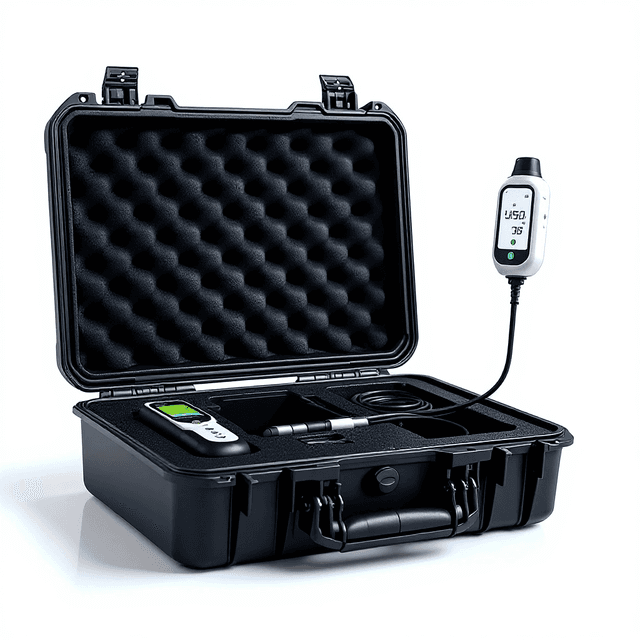
- Carrying case (typical)
- User manual and quick reference guide (typical)
- USB cable for data transfer (typical)
- Lens cleaning kit (typical)
Warranty
ConductScience provides a standard one-year manufacturer warranty covering defects in materials and workmanship, with technical support for calibration procedures and operational guidance. Extended service plans are available for critical monitoring applications.
Compliance
References
Background reading relevant to this product:
What is the difference between turbidity and total suspended solids measurements?
Turbidity measures light scattering from particles and is expressed in NTU, while total suspended solids represents actual mass concentration (mg/L) derived from the scattered-to-transmitted light ratio. The instrument provides both parameters simultaneously but they measure different physical properties of particle suspensions.
How does the near-infrared light source improve measurement accuracy?
Near-infrared wavelengths minimize interference from dissolved organic compounds that strongly absorb visible light, particularly in colored water samples. This selective wavelength approach isolates scattering contributions from suspended particles while reducing matrix effects from dissolved constituents.
What calibration frequency is recommended for field applications?
Daily zero calibration with distilled water and weekly multi-point calibration using certified standards are recommended for field deployment. The zero drift specification of ±0.3% full scale per 30 minutes indicates stable performance between calibration cycles.
Can this instrument measure samples with high color or dissolved organics?
Yes, the near-infrared light source specifically addresses this limitation of conventional visible-light turbidimeters. However, extremely high color samples may still require dilution or sample pretreatment to stay within linear response range.
What is the relationship between turbidity and suspended solids measurements?
The correlation varies with particle size, shape, and composition. This instrument measures both parameters to provide comprehensive characterization, as TSS correlation with turbidity can become non-linear above 40 NTU depending on particle characteristics.
How should samples be prepared for optimal measurement accuracy?
Samples should be at measurement temperature (5-40°C), thoroughly mixed if settling has occurred, and measured promptly to prevent particle aggregation. Clean sample cells between measurements and avoid air bubbles in the optical path.
What maintenance is required for field deployment?
Regular cleaning of optical windows, verification of zero drift within specification, and protection of sample cell from scratches are essential. The IP65 rating allows field use but optical components require careful handling for measurement precision.
How does this compare to laboratory filtration methods for suspended solids?
This optical method provides immediate results compared to gravimetric filtration requiring hours for drying and weighing. However, correlation coefficients should be established against gravimetric methods for the specific particle types and size distributions in your samples.
Have a question about this product?
Have a question? Just ask.
Send it over and we'll email you a personalized answer — no call, no scheduling.
Prefer to talk it through?
Accessories
Enhance your setup with compatible accessories
Frequently Bought Together