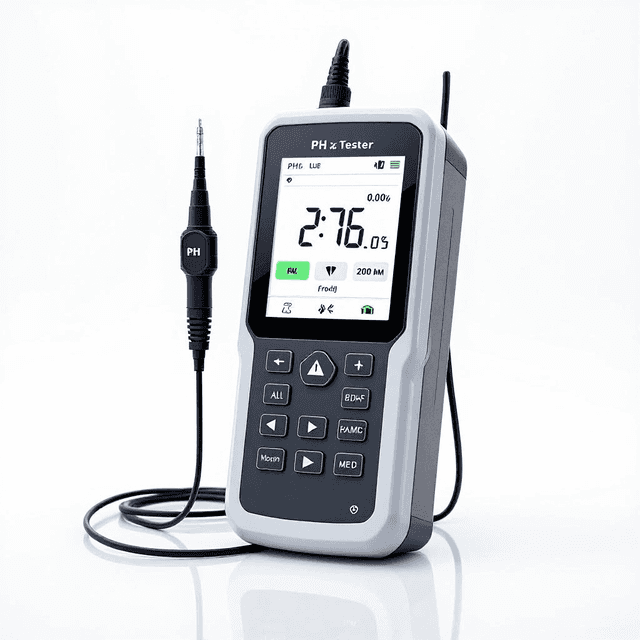
Portable Water Hardness Meter
Portable photometric water hardness meter using acidic cadmium lanthanum K method with 0-5 mg/L range and 5-minute measurement time.

Louise Corscadden, PhD
Director of Science · ConductScience
Ask Louise about Portable Water Hardness Meter fit, setup, configuration, or quote prep.
Already working with us? Sign in to connect this with My Scientist.
Key Specifications
Full details →- Model fit
- 1 selectable configurations
- SKU family
- BIO-0369
- Shipping box
- 7.5 x 22.0 x 10.0 cm
- Ordering
- Online checkout and quote request available
- Category
- pH Meters
- Build notes
- Confirm accessories, station layout, and support needs before purchase
The Portable Water Hardness Meter (BIO-0369) is a colorimetric photometer designed for field and laboratory determination of water hardness using the acidic cadmium lanthanum K photometric method. This portable instrument measures total hardness in the range of 0-5 mg/L with an indication error of ±8% and repeatability of ±3%.
The system employs colorimetric tube technology with optical stability of ±0.001A/10min, providing reliable measurements within 5 minutes. With data storage capacity for over 5,000 records and user-defined calibration capability, this meter supports systematic water quality monitoring protocols. The lithium battery-powered design enables field deployment in environmental monitoring and quality control applications where rapid hardness assessment is required.
How It Works
The Portable Water Hardness Meter operates using the acidic cadmium lanthanum K photometric method, a colorimetric technique that measures total hardness through light absorption analysis. The method involves the formation of colored complexes between calcium and magnesium ions in the sample and specific reagents under acidic conditions with cadmium and lanthanum as interferent masking agents.
The instrument uses colorimetric tube technology where the sample and reagents are combined in a controlled optical path. A stable light source passes through the sample, and the optical system measures the absorption at the specific wavelength characteristic of the colored complex. The degree of light absorption correlates directly with the concentration of hardness-causing minerals (primarily calcium and magnesium) in the sample.
The photometric detection system maintains optical stability within ±0.001A/10min, ensuring consistent baseline performance throughout the 5-minute measurement cycle. The microprocessor converts the optical signal to concentration units and stores the data in the internal memory system capable of holding over 5,000 measurement records.
Features & Benefits
Shipping weight
- 0.5 lb
Shipping box
- L: 7.5 cm
- W: 22.0 cm
- H: 10.0 cm
| Feature | This Product | Typical Alternative | Advantage |
|---|---|---|---|
| Measurement Method | Acidic cadmium lanthanum K photometric method | Many portable meters use EDTA titration or ion-selective electrode methods | Photometric detection provides consistent results with minimal operator technique variation compared to manual titration endpoints. |
| Measurement Range | 0-5 mg/L | Entry-level meters often cover 0-50 mg/L or broader ranges | Optimized low-range sensitivity provides better resolution for ultrapure water and treated water applications. |
| Analysis Time | 5 minutes | Manual titration methods typically require 15-30 minutes per sample | Rapid measurement cycle enables higher sample throughput in quality control laboratories. |
| Data Storage | Over 5,000 records | Basic models often have limited or no data storage capability | Extensive memory capacity supports field surveys and batch analysis without immediate data transfer requirements. |
| Optical Stability | ≤0.001A/10min | Varies by model and detection technology | High optical stability ensures consistent baseline performance throughout extended measurement sessions. |
| Power System | Lithium battery (DC 5V, 10W) | Some models require AC power or have shorter battery life | Portable lithium battery operation enables field deployment without external power infrastructure. |
This photometric hardness meter offers specialized low-range sensitivity (0-5 mg/L) with rapid 5-minute analysis time and extensive data storage capabilities. The acidic cadmium lanthanum K method provides consistent photometric detection with high optical stability for quality control applications.
Practical Tips
Perform multi-point calibration using at least three certified standards distributed across the 0-5 mg/L range.
Why: Multiple calibration points improve measurement accuracy across the full analytical range.
Allow samples to equilibrate to room temperature within the 5-40°C operating range before analysis.
Why: Temperature affects reagent kinetics and optical properties, impacting measurement accuracy.
Clean optical surfaces weekly and verify optical stability using blank measurements.
Why: Maintaining the ±0.001A/10min optical stability specification ensures consistent baseline performance.
Run duplicate measurements on 10% of samples to monitor analytical precision.
Why: Duplicate analysis verifies that the system maintains the ±3% repeatability specification.
If readings appear unstable, check colorimetric tube installation and reagent expiration dates.
Why: Proper tube seating and fresh reagents are critical for accurate photometric detection.
Operate only within the ≤85% relative humidity specification to prevent condensation in optical components.
Why: Moisture in the optical path can cause measurement drift and damage sensitive electronics.
Store calibration standards in a temperature-controlled environment and verify concentrations periodically.
Why: Standard degradation over time can introduce systematic errors in hardness measurements.
Document measurement conditions including temperature, humidity, and sample source for quality control records.
Why: Environmental conditions affect measurement performance and are required for regulatory compliance documentation.
Setup Guide
What’s in the Box
- Portable Water Hardness Meter (main unit)
- Lithium battery
- Colorimetric tubes (typical)
- Calibration standards (typical)
- USB data cable (typical)
- User manual and calibration certificate
- Carrying case (typical)
Warranty
ConductScience provides a standard one-year manufacturer warranty covering defects in materials and workmanship. Technical support is available for calibration procedures, measurement protocols, and troubleshooting assistance.
Compliance
What is the detection limit and linear range for water hardness measurement?
The instrument measures hardness from 0-5 mg/L with ±8% indication error and ±3% repeatability. For specific detection limits, consult the product datasheet.
How does the acidic cadmium lanthanum K method compare to EDTA titration?
The photometric method provides faster results (5 minutes vs 15-30 minutes for titration) with digital readout and data storage, while EDTA titration offers broader range capability but requires more manual manipulation.
What calibration standards are required for accurate measurements?
The system supports user-defined calibration requiring certified hardness standards within the 0-5 mg/L range. Multiple point calibration is recommended for optimal accuracy across the measurement range.
Can the meter analyze samples with high dissolved solids content?
The acidic cadmium lanthanum K method includes masking agents to minimize interference, but high TDS samples may require dilution or pretreatment. Consult the operating manual for specific interference data.
What is the shelf life and storage requirements for colorimetric tubes?
Colorimetric tube stability depends on storage conditions and reagent formulation. Store according to manufacturer specifications and check expiration dates before use to ensure measurement accuracy.
How is data exported from the internal storage system?
The system stores over 5,000 records with data export capabilities. Specific data formats and transfer protocols should be verified in the technical documentation.
What maintenance is required for the optical system?
Regular cleaning of optical surfaces and periodic calibration verification maintain the ±0.001A/10min optical stability specification. Follow the maintenance schedule in the user manual.
Have a question about this product?
Have a question? Just ask.
Send it over and we'll email you a personalized answer — no call, no scheduling.
Prefer to talk it through?