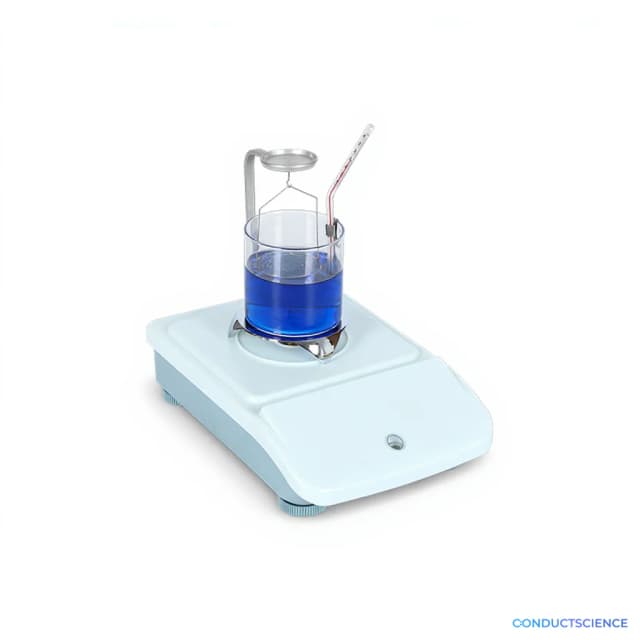
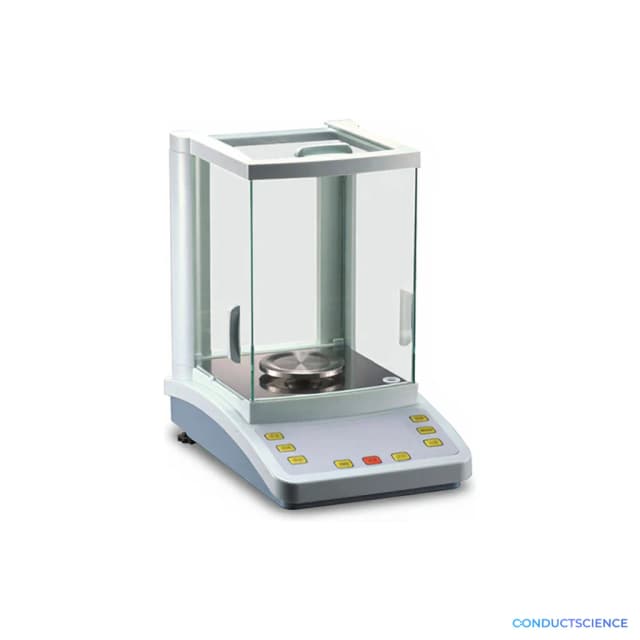
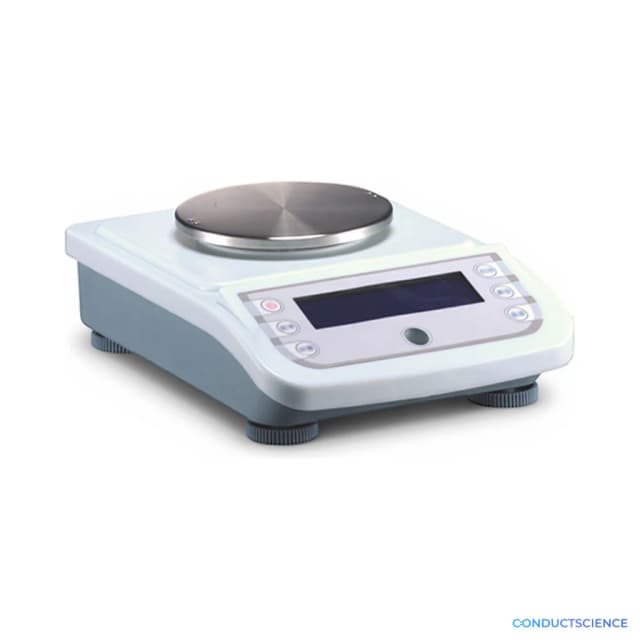
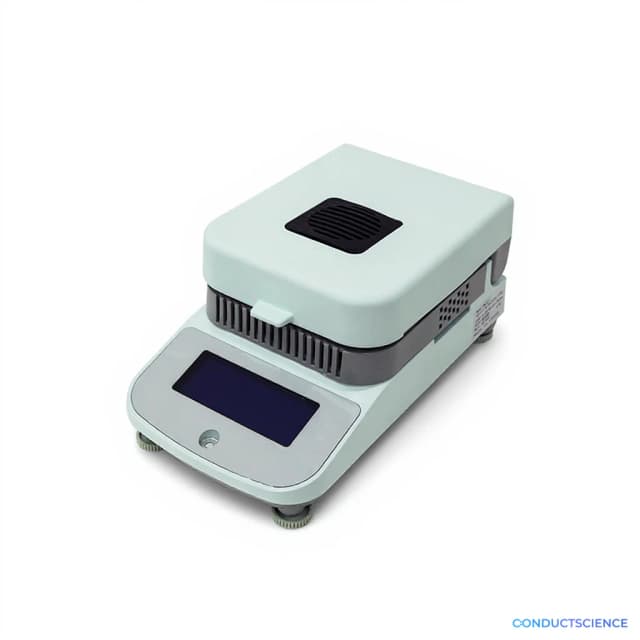
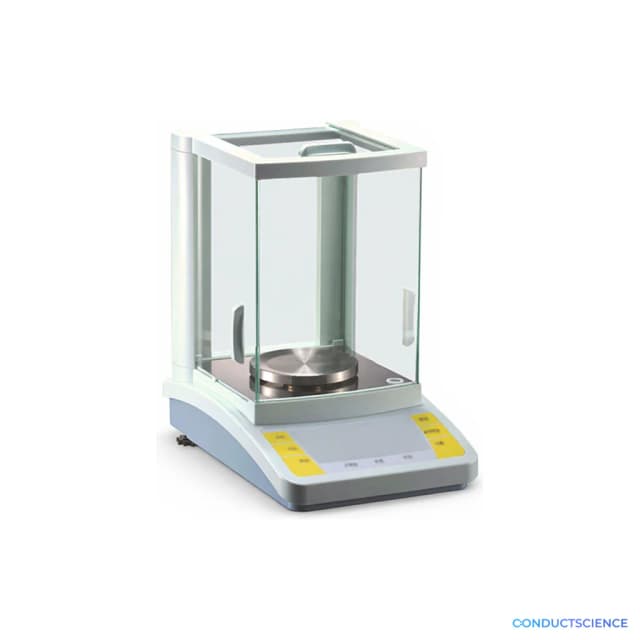
Rapid Moisture Meter
Laboratory balance with integrated moisture analysis capability for rapid determination of water content in research samples.

Louise Corscadden, PhD
Director of Science · ConductScience
Ask Louise about Rapid Moisture Meter fit, setup, configuration, or quote prep.
Already working with us? Sign in to connect this with My Scientist.
Key Specifications
Full details →- Model fit
- Configured during quote
- SKU family
- BIO-0343
- Shipping box
- 41.0 x 52.0 x 38.0 cm
- Ordering
- Online checkout and quote request available
- Category
- Balances
- Build notes
- Confirm accessories, station layout, and support needs before purchase
The Rapid Moisture Meter is a laboratory balance designed for efficient moisture content determination in research samples. This analytical instrument combines precision weighing capabilities with moisture analysis functionality, enabling researchers to obtain both sample mass and moisture content measurements in a single workflow. The compact design measures 41 cm × 52 cm × 38 cm, making it suitable for benchtop installation in laboratory environments where space efficiency is important.
The instrument addresses the need for rapid moisture analysis in quality control protocols, sample preparation workflows, and material characterization studies. Researchers use moisture meters to ensure sample integrity, validate storage conditions, and determine water content as a critical parameter in experimental protocols. The system provides quantitative moisture measurements that support data quality and experimental reproducibility across various research applications.
How It Works
Moisture meters utilize thermogravimetric analysis principles to determine water content through controlled heating and mass measurement. The instrument heats the sample to a predetermined temperature, causing water to evaporate while continuously monitoring sample mass with high-precision load cell technology. The moisture content is calculated from the mass difference between the initial wet sample and the final dried sample, expressed as a percentage of the original sample mass.
The heating system provides uniform temperature distribution across the sample chamber, ensuring consistent evaporation rates and accurate moisture determination. Integrated temperature sensors monitor the heating profile and maintain thermal stability throughout the measurement cycle. The weighing system records mass changes in real-time, allowing researchers to track moisture loss kinetics and determine endpoint criteria for complete drying.
Digital processing algorithms convert raw mass and temperature data into moisture content values, applying correction factors for environmental conditions and sample characteristics. The system stores measurement parameters and results for documentation and traceability requirements in regulated research environments.
Features & Benefits
Automation Level
- semi-automated
Research Domain
- Analytical Chemistry
- Environmental Monitoring
- Food Science
- Materials Science
- Microbiology
- Pharmaceutical QC
Shipping weight
- 5.8 lb
Shipping box
- L: 41.0 cm
- W: 52.0 cm
- H: 38.0 cm
| Feature | This Product | Typical Alternative | Advantage |
|---|---|---|---|
| Form Factor | Compact 41×52×38 cm benchtop design | Basic models often require separate heating ovens and analytical balances | Integrated design reduces measurement errors from sample transfer and saves laboratory bench space |
| Weighing Stability | 5.8 kg total weight provides measurement stability | Lighter portable units may exhibit reduced stability | Heavier construction minimizes vibration effects and improves measurement repeatability |
| Analysis Integration | Combined weighing and moisture determination in single workflow | Entry-level systems require separate weighing and drying steps | Streamlined workflow reduces analysis time and eliminates sample handling errors |
| Space Requirements | Self-contained unit with 52 cm width footprint | Traditional methods require multiple instruments and larger bench space | Compact integration allows efficient use of limited laboratory workspace |
This moisture meter combines precision weighing with controlled heating in a compact benchtop format. The integrated design eliminates sample transfer steps while providing stable measurement conditions through appropriate instrument mass and thermal control systems.
Practical Tips
Perform calibration verification daily using certified reference weights before beginning sample analysis.
Why: Temperature fluctuations and mechanical drift can affect weighing accuracy over time.
Clean the sample chamber and heating surfaces weekly with appropriate solvents to remove residue buildup.
Why: Sample residues can affect heat distribution and contaminate subsequent measurements.
Allow 30-minute thermal equilibration after power-on before performing critical measurements.
Why: Thermal stability ensures consistent heating profiles and measurement reproducibility.
Use representative sample sizes and ensure uniform sample distribution in the heating chamber.
Why: Even heat distribution is critical for complete moisture removal and accurate results.
Run duplicate measurements for critical samples and document any significant variations.
Why: Sample heterogeneity can cause measurement variability requiring statistical evaluation.
If measurements drift over time, check for air currents around the instrument and verify level adjustment.
Why: Environmental disturbances can affect both weighing accuracy and temperature stability.
Ensure adequate ventilation around the heating chamber during operation with volatile samples.
Why: Heated samples may release vapors requiring proper laboratory ventilation systems.
Setup Guide
What’s in the Box
- Rapid Moisture Meter main unit (typical)
- Power adapter and power cord (typical)
- Sample holders and accessories (typical)
- Calibration weights (typical)
- User manual and quick start guide (typical)
- USB data cable (typical)
- Calibration certificate (typical)
Warranty
ConductScience provides a standard one-year manufacturer warranty covering parts and labor, with technical support available for installation guidance and troubleshooting assistance. Extended warranty options and service contracts may be available for high-usage research environments.
Compliance
What sample sizes are compatible with the heating chamber?
Consult product datasheet for specific sample capacity and chamber dimensions. The 38 cm height suggests accommodation for various sample container types, but maximum sample mass and volume limits should be verified for your specific applications.
How accurate are the moisture content measurements?
Measurement accuracy depends on sample type, heating parameters, and environmental conditions. The product datasheet provides precision specifications and recommended validation procedures using certified reference materials.
What data output formats are available?
Digital data output capabilities should be confirmed in the technical specifications. Many moisture meters provide USB connectivity and data logging functions, but specific software compatibility and file formats require verification.
How long does a typical moisture analysis take?
Analysis time varies based on sample characteristics, moisture content, and heating temperature. Complete drying cycles typically range from minutes to hours depending on sample matrix and moisture levels.
What maintenance is required for accurate operation?
Regular calibration verification with certified weights, cleaning of sample chambers, and temperature sensor validation are essential. Specific maintenance intervals and procedures should be followed according to the user manual.
Can the system handle volatile or thermally sensitive samples?
Temperature control capabilities allow adjustment for different sample types, but maximum and minimum temperature ranges should be verified in specifications. Some volatile compounds may require modified procedures.
What environmental conditions are required for operation?
Stable temperature, low humidity, and vibration-free installation are typically required. Specific operating environment specifications including temperature and humidity ranges are detailed in the product documentation.
Have a question about this product?
Have a question? Just ask.
Send it over and we'll email you a personalized answer — no call, no scheduling.
Prefer to talk it through?
Accessories
Enhance your setup with compatible accessories