Small Rice Husker Tester
Dehusk 50 g rice samples in ~40 s with ≥97% hulling rate and <3% breakage. Adjustable 0–3 mm roller gap. 220 V AC / 12 V DC compatible.

Louise Corscadden, PhD
Director of Science · ConductScience
Ask Louise about Small Rice Husker Tester fit, setup, configuration, or quote prep.
Already working with us? Sign in to connect this with My Scientist.
Key Specifications
Full details →- Model fit
- Configured during quote
- SKU family
- AGR-0051
- Sizing
- Model-specific dimensions confirmed from the selected configuration
- Ordering
- Quote-reviewed before fulfillment
- Category
- Agriculture & Food Science
- Build notes
- Confirm accessories, station layout, and support needs before purchase
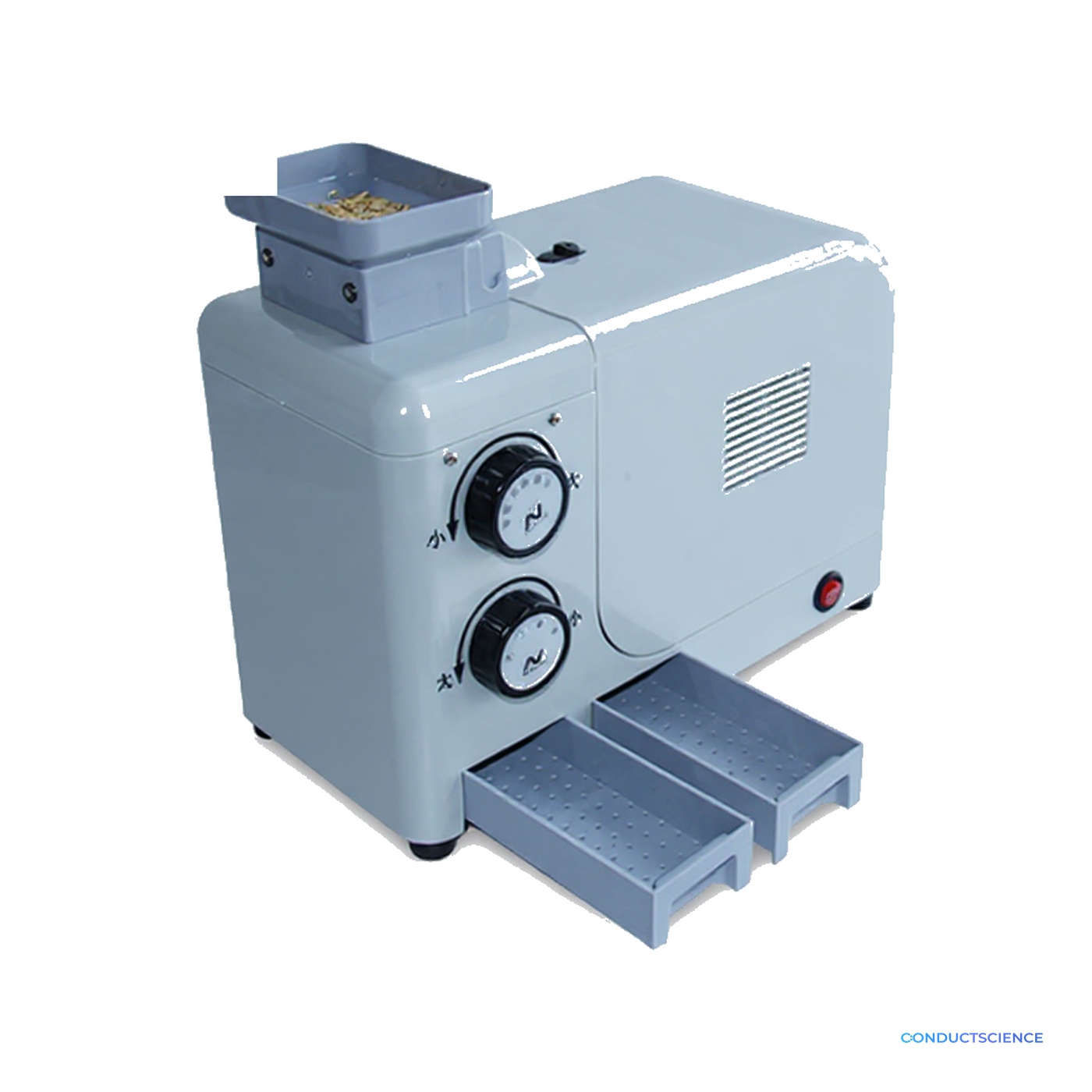
The Small Size Rice Husker Tester is a compact laboratory instrument designed to remove the outer husk from rough rice (paddy) while preserving the integrity of the brown rice kernel beneath. By passing a rice sample between adjustable rubber rollers, it separates the husk from the grain with minimal breakage, making it the standard tool for evaluating the hulling characteristics of rice varieties in breeding programs, quality control labs, and grain research stations.
The central performance metric researchers compare across rice samples is hulling rate — the proportion of grains successfully dehusked in a single pass. This instrument achieves a hulling rate of ≥ 97% while keeping broken rice below 3%, giving analysts a reliable, reproducible basis for comparing varietal differences in husk adhesion, kernel hardness, and grain geometry.
Each 50 g sample is processed in approximately 40 seconds, enabling rapid throughput when screening multiple accessions or replicate samples. Rubber roller spacing is continuously adjustable from 0 to 3 mm to accommodate different grain sizes and moisture levels, and the rollers operate at 2,800 r/min. Separate collection boxes for brown rice (120 g capacity) and husk material (60 g capacity) keep fractions cleanly partitioned after each run.
At 7.5 kg and a footprint of 320 × 280 × 165 mm, the instrument fits comfortably on a laboratory bench or can be transported to field-adjacent processing facilities. It runs on 220 V AC and is also compatible with a 12 V DC power supply, extending its usability in locations where mains power is unavailable.
Hulling Rate
- ≥ 97%
Broken Rice Rate
- < 3%
Sample Shelling Time
- ~40 s per 50 g sample
Rubber Roller Speed
- 2,800 r/min
Rubber Roller Adjustable Spacing
- 0 – 3 mm
Brown Rice Collection Box Capacity
- 120 g
Husk Collection Box Capacity
- 60 g
Motor Power
- 120 W
Working Voltage
- 220 V AC (also compatible with 12 V DC)
Dimensions (L × W × H)
- 320 × 280 × 165 mm
Machine Weight
- 7.5 kg
What hulling performance can I expect, and how is it measured?
The instrument is rated for a hulling rate of ≥ 97%, meaning at least 97 out of every 100 grains in a sample are successfully dehusked. Broken rice rate is specified at less than 3%. These figures are determined from a standard 50 g test sample processed in approximately 40 seconds, giving you a fast, quantitative basis for comparing varieties or lots.
Can the roller gap be adjusted to suit different rice varieties?
Yes. The rubber roller spacing is continuously adjustable from 0 to 3 mm, allowing you to match the gap to the specific grain size and husk thickness of the variety being tested. Finer adjustment helps reduce both under-hulling and kernel breakage when working with grains of different dimensions or moisture content.
What sample size does the instrument accept, and how long does each run take?
The standard test sample is 50 g of rough rice. Each hulling cycle takes approximately 40 seconds. The brown rice collection box holds up to 120 g and the husk collection box up to 60 g, so the compartments can accommodate back-to-back runs before emptying is needed.
What power supply does it require, and is it suitable for field use?
The instrument's primary working voltage is 220 V AC, with a motor rated at 120 W. It is also compatible with a 12 V DC power supply, which extends its use to field stations or locations without reliable mains power. The compact dimensions (320 × 280 × 165 mm) and 7.5 kg weight make it straightforward to transport.
Is this instrument suitable for research applications beyond routine quality control?
Yes. In addition to grain quality control, the instrument is widely used in rice breeding programs to screen varietal accessions for hulling efficiency and kernel integrity. Its adjustable roller gap and separate collection compartments allow researchers to recover both the brown rice fraction and the husk fraction cleanly for further analysis, such as milling yield studies or compositional testing of the husk material.
Have a question about this product?
Have a question? Just ask.
Send it over and we'll email you a personalized answer — no call, no scheduling.
Prefer to talk it through?
Frequently Bought Together