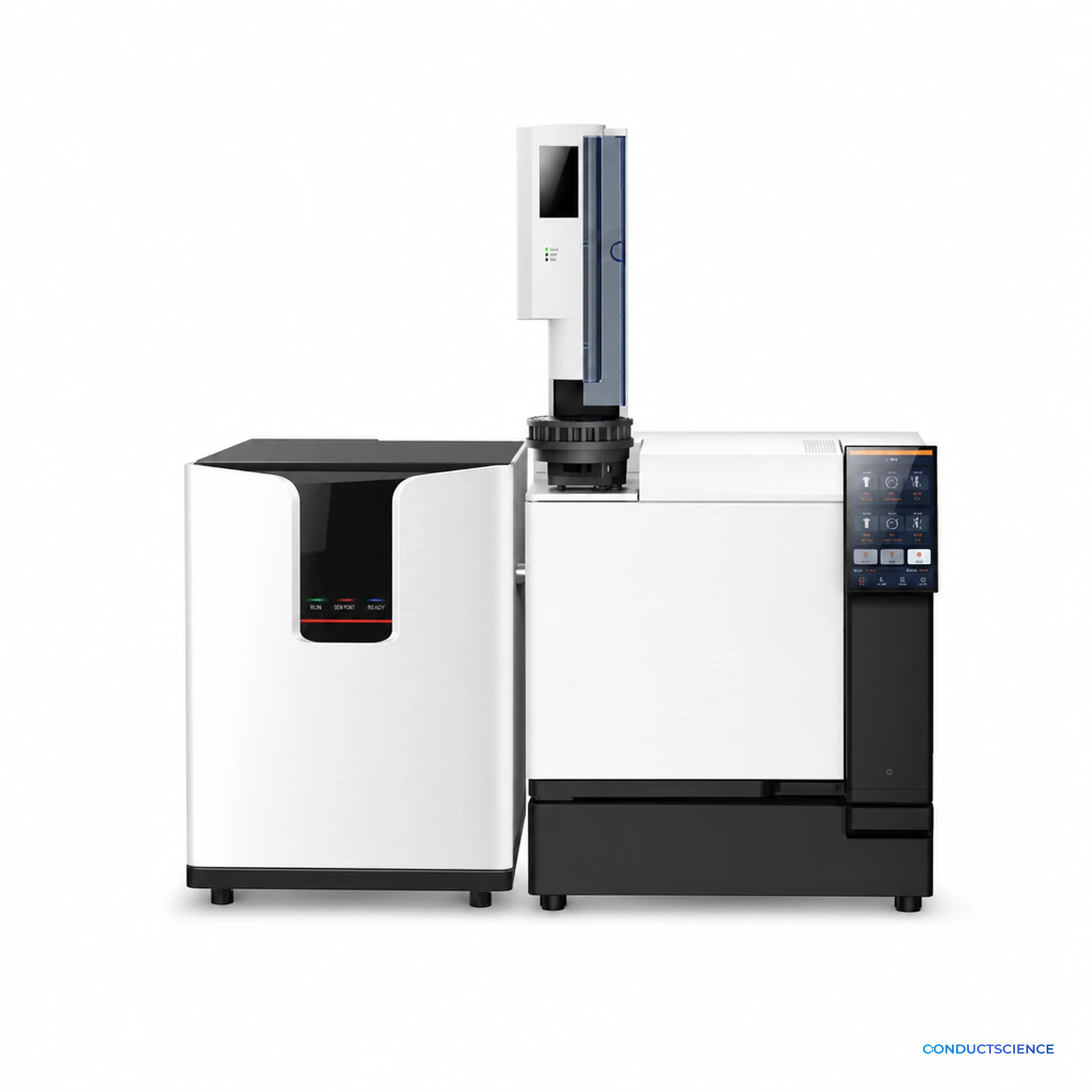
Triple Quadrupole GC-MS/MS System
Tandem GC-MS/MS with an axially accelerating collision cell for pesticide residue analysis.

Louise Corscadden, PhD
Director of Science · ConductScience
Ask Louise about Triple Quadrupole GC-MS/MS System fit, setup, configuration, or quote prep.
Already working with us? Sign in to connect this with My Scientist.
Key Specifications
Full details →- Model fit
- Configured during quote
- SKU family
- CS-ANL-00010
- Sizing
- Model-specific dimensions confirmed from the selected configuration
- Ordering
- Quote-reviewed before fulfillment
- Category
- Chromatography
- Build notes
- Confirm accessories, station layout, and support needs before purchase
A tandem gas chromatography mass spectrometer with a no-cold-spot transfer path from column to ion source. The axially accelerating collision cell raises scan speed while suppressing ion-pair cross-talk, the combination that makes large pesticide-residue panels tractable in botanical matrices.
Key features
- Excellent chromatogram stability
- Intelligent instrumant control, for easy and convenient use
- Adopting the EI ion source to ensure efficient sample transmission and ionization efficiency.
- The patented closed-loop adaptive adjustment technology of dual-channel RF power supply improves the stability of quadrupole RF power supply.
- Pure molybdenum quadrupole has the best material stability to ensure the stability of the quality axis.
- Be able to analyze more target compounds in a single run for more efficient use of instrument analysis.
Applications
Built for pesticide residue and traditional-medicine testing laboratories.
- Food safety: Detection of food additives,food residues, contaminants, illegal additives.
- Environmental monitoring: Monitoring and analysis of environmental pollutants.
- Biomedicine: Detection of Chinese herbal medicines, synthetic APIs, proprietary Chinese medicines, and synthetic drugs.
- Forensic and toxicology: Detection of illegal drugs and poison.
- agricultural residues
Choosing the right configuration
Choose the inlet or autosampler, column format, detector or ion source, carrier or source gases, vacuum hardware, and data workflow around the analytes and expected sample throughput. ConductScience confirms the complete configuration during method and site review.
Features & Benefits
Operating temperature
- 18-25 ℃
Operating humidity
- 20 ~ 60% RH
Power supply
- five sets of single-phase (220 ± 20) V AC, 10A, 50 Hz
Maximum oven temperature
- 450 ℃
Maximum oven heating rate
- 120 ℃/min
Typical oven heating rate
- 50 ℃/min
Oven program
- 32 steps and 33 stages
Oven-program reproducibility
- better than 0.5%
Oven cooling
- 5 min from 450 ℃ to 50 ℃
Oven temperature-control accuracy
- ±0.1 ℃
Column capacity
- up to 3 capillary columns
Maximum injection-port temperature
- 450 ℃
Injection-port flow control
- 0-500 mL/min (N₂); 0-1,000mL/min (He, H₂)
Injection-port pressure control
- 0-100.00 psi (689.5 kPa)
Injection-port control accuracy
- ±0.001 psi
Electronic gas-control capacity
- up to 18 channels
Autosampler capacity
- 16-position or 110-position
Injection volume
- 0.1μL-250μL (16-position) or 500 μL (110-position)
Sampling accuracy
- ±0.01%
Injection precision
- RSD <0.5%
EI ionization energy
- 10-300eV
EI ion-source temperature
- 150 ℃-350 ℃
Interface temperature
- 50-400 ℃
Mass analyzer
- triple quadrupole
Collision gas
- nitrogen, purity ≥99.999%
Resolution
- 0.4-3.0amu, adjustable
Mass stability
- <±0.1amu/24 hours
Scanning speed
- up to 20,000 amu/s
MRM acquisition
- 100 channels/s
Mass range
- m/z 5-1,100amu
Sensitivity
- EI MRM, 100fg/µL OFN, 1µL injection, ≥15000:1
Vacuum system
- 250 + 450L/s dual-inlet turbomolecular pump
Mechanical-pump speed
- 65m³/h
What does this instrument measure, and who is it for?
It measures trace organic compounds in complex matrices using targeted tandem mass-spectrometry acquisition. It is built for pesticide residue and traditional-medicine testing laboratories. It is intended for continuous laboratory duty, with a plumbed gas supply, a sited vacuum pump and a defined solvent-waste route.
What measurement principle does it use?
The gas chromatograph separates the mixture, an electron-ionisation source forms ions, and two mass filters with a collision cell between them isolate precursor-to-product transitions for targeted quantitation in complex matrices.
Which specifications are confirmed?
The specification table lists thirty-three confirmed ordering parameters for this instrument. Use them to compare the operating range, utilities, and analytical performance required by the method. They include Operating temperature at 18-25 ℃, Operating humidity at 20 ~ 60% RH and Maximum oven temperature at 450 ℃.
What should be confirmed before ordering?
Confirm carrier and collision gas supply, siting and noise of the vacuum pump, solvent handling and waste routing, and the column and ion-source selection your method needs. These are configured and quoted per installation, so raise anything unusual about the site during quote review rather than after delivery.
What else is needed to run it?
Carrier and collision gas of the specified purity, a vacuum pump sited for its noise and heat, and the consumables your method consumes. These are not yet listed as products; specify them during quote review.
How is it supplied?
This instrument is configured and quoted per installation rather than sold at a list price. Request a quote and we will confirm the configuration, the site requirements and the lead time before anything is ordered.
Have a question about this product?
Have a question? Just ask.
Send it over and we'll email you a personalized answer — no call, no scheduling.
Prefer to talk it through?