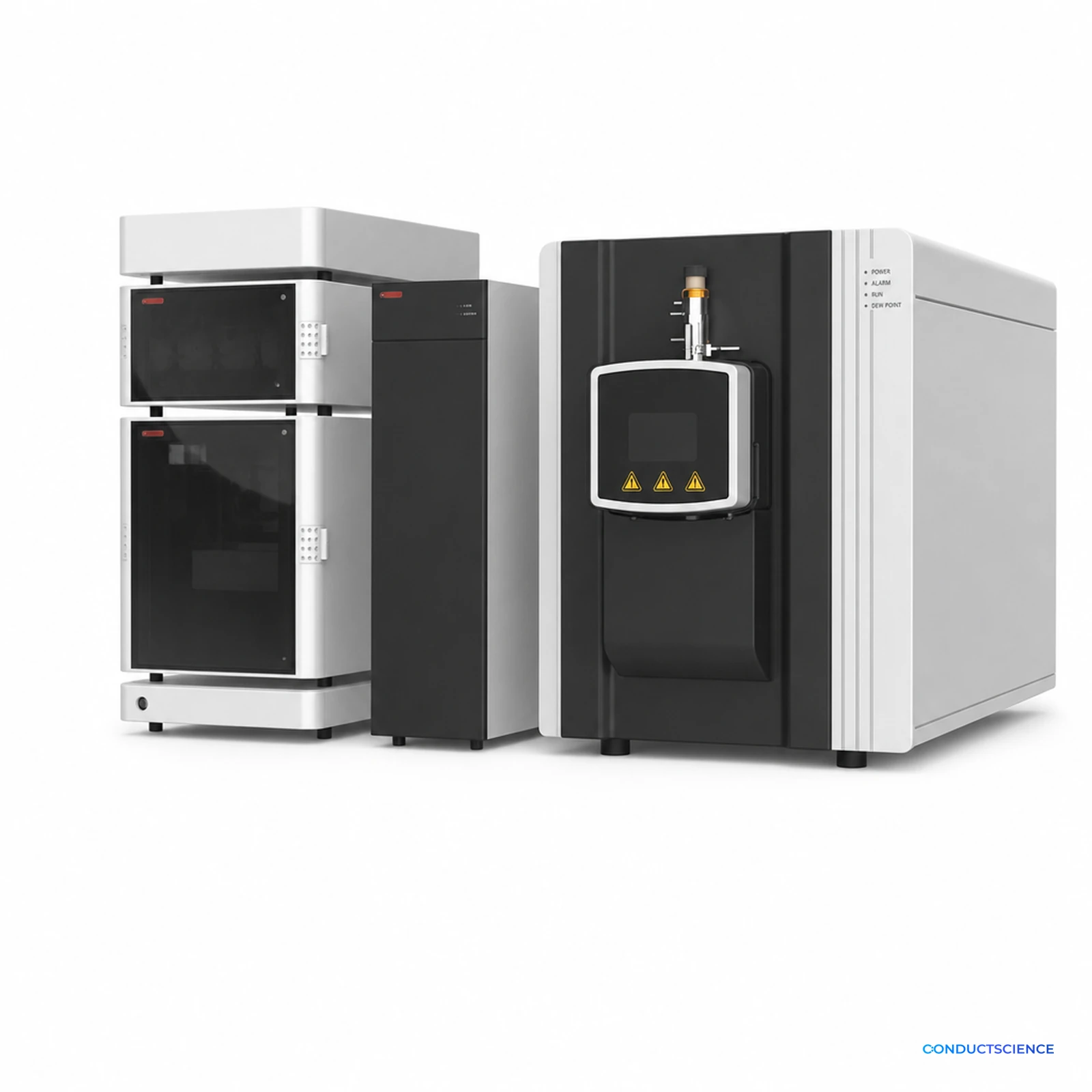
Triple Quadrupole LC-MS/MS System
Tandem liquid chromatography mass spectrometer for trace organic quantitation in complex matrices.

Louise Corscadden, PhD
Director of Science · ConductScience
Ask Louise about Triple Quadrupole LC-MS/MS System fit, setup, configuration, or quote prep.
Already working with us? Sign in to connect this with My Scientist.
Key Specifications
Full details →- Model fit
- Configured during quote
- SKU family
- CS-ANL-00009
- Sizing
- Model-specific dimensions confirmed from the selected configuration
- Ordering
- Quote-reviewed before fulfillment
- Category
- Chromatography
- Build notes
- Confirm accessories, station layout, and support needs before purchase
A triple quadrupole tandem mass spectrometer coupled to liquid chromatography, built around a biorthogonal electrospray source and an axially accelerated collision cell. Intended for trace organic quantitation where matrix suppression and cross-talk normally set the detection limit.
Key features
- Superb stability
- Excellent sensitivity
- Exceptional Sensitivity, Ultra-Low Noise: Advanced Step Scan and pulse-counting detection deliver crisp signals even at trace levels.
- Next-Gen Ion Source for Clean, Stable Signals: Dual orthogonal E-spray with enhanced desolvation ensures low background and high matrix tolerance.
- High-Efficiency Collision Cell, Minimal Carryover: Axial acceleration enables fast, clean ion transitions with superior collision performance.
- Intuitive Software, Smarter Operation: All-new platform with one-click autotune and fully customizable workflows.
- Engineered for Stability and Safety: Intelligent closed-loop system and independent vacuum control ensure robust, worry-free operation.
- Unique design of biorthogonal ion source and double 3Q ion optical
Applications
Built for environmental, food-safety and pharmaceutical testing laboratories.
- Food safety
- Environmental monitoring
- Biomedicine
- Medical diagnostics
- environmental testing, medical testing and food safety
- Detection of sulfonamides in pork
- Detection of carbamate pesticides in water
- Detection of perfluorinated compounds in environmental media
Choosing the right configuration
Choose the inlet or autosampler, column format, detector or ion source, carrier or source gases, vacuum hardware, and data workflow around the analytes and expected sample throughput. ConductScience confirms the complete configuration during method and site review.
Features & Benefits
Operating temperature
- 18-25 ℃
Operating humidity
- 20 ~ 60% RH
Power supply
- five sets of single-phase (220 ± 20) V AC, 10A, 50 Hz
Pump flow range
- 1-4,000 µL/min
Maximum pump pressure
- ≥18,850psi
Flow-rate accuracy
- ≤1%
Flow-rate precision
- ≤0.075% RSD
Injection modes
- full loop injection, partial loop injection and microliter pickup
Injection repeatability
- full loop <0.3% RSD; partial loop <0.3% RSD; microliter pickup <1.0% RSD
Injection cross-contamination
- <0.05%
Maximum sample capacity
- 384 positions; 96 positions for standard liquid injection
Column-oven temperature range
- room temperature +5 ℃ - 90 ℃
Maximum column capacity
- six 250mm columns
Atomizing-nitrogen flow
- 0-2 L/min
Desolvation-nitrogen flow
- 0-15 L/min
Maximum spray voltage
- 6kV
Blowback-gas flow
- 0-5L/min
Maximum vacuum-interface temperature
- 110 ℃
Mass analyzer
- triple quadrupole
Collision gas
- nitrogen, purity ≥99.999%
Mass resolution
- 0.4-2 amu, adjustable
Mass stability
- better than 0.1amu/24 hours
Scanning speed
- ≥20,000 amu/s
MRM acquisition
- 100 channels/s
Mass range
- m/z 5 - 1,000amu
Dynamic range
- 6 orders of magnitude
Sensitivity
- ESI+ 1pg reserpine S/N≥100000:1; ESI- 1pg chloramphenicol S/N≥100,000:1
Polarity-switching time
- ≤50ms
Nitrogen-generator capacity
- 24L/min at 116psi
What does this instrument measure, and who is it for?
It measures trace organic compounds in matrices where suppression normally sets the detection limit. It is built for environmental, food-safety and pharmaceutical testing laboratories. It is intended for continuous laboratory duty, with a plumbed gas supply, a sited vacuum pump and a defined solvent-waste route.
What measurement principle does it use?
Liquid chromatography separates the mixture; an electrospray source ionises it; two quadrupoles with a collision cell between them select a precursor ion and measure a product ion, which is what gives tandem mass spectrometry its selectivity in a dirty matrix.
Which specifications are confirmed?
The specification table lists twenty-nine confirmed ordering parameters for this instrument. Use them to compare the operating range, utilities, and analytical performance required by the method. They include Operating temperature at 18-25 ℃, Operating humidity at 20 ~ 60% RH and Pump flow range at 1-4,000 µL/min.
What should be confirmed before ordering?
Confirm carrier and collision gas supply, siting and noise of the vacuum pump, solvent handling and waste routing, and the column and ion-source selection your method needs. These are configured and quoted per installation, so raise anything unusual about the site during quote review rather than after delivery.
What else is needed to run it?
Carrier and collision gas of the specified purity, a vacuum pump sited for its noise and heat, and the consumables your method consumes. These are not yet listed as products; specify them during quote review.
How is it supplied?
This instrument is configured and quoted per installation rather than sold at a list price. Request a quote and we will confirm the configuration, the site requirements and the lead time before anything is ordered.
Have a question about this product?
Have a question? Just ask.
Send it over and we'll email you a personalized answer — no call, no scheduling.
Prefer to talk it through?


