Vacuum Drying Oven 25L 50L 25L 50L
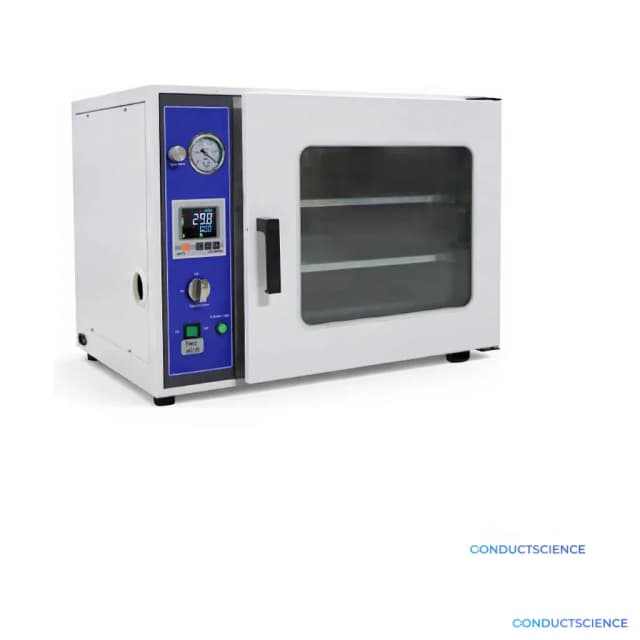
Vacuum drying oven for heat-sensitive materials, available in 25 L and 50 L capacities with either 201 or 304 stainless steel chamber.
Microcomputer PID with intelligent color LCD display; temperature range RT+10°C to 250°C, vacuum degree below 133 Pa. Silicone gasket door sealing maintains vacuum with easy opening.

Louise Corscadden, PhD
Director of Science · ConductScience
Ask Louise about Vacuum Drying Oven 25L 50L 25L 50L fit, setup, configuration, or quote prep.
Already working with us? Sign in to connect this with My Scientist.
Key Specifications
Full details →- Model fit
- 4 selectable configurations
- SKU family
- BIO-0250
- Shipping box
- 27.5 x 30.0 x 30.0 cm
- Ordering
- Online checkout and quote request available
- Category
- Drying Ovens
- Build notes
- Confirm accessories, station layout, and support needs before purchase
The ConductScience vacuum drying oven (BJPX-ZK series) provides oxygen-free, low-pressure drying ideal for heat-sensitive compounds, pharmaceutical powders, and bioengineering samples. Microcomputer PID control with an intelligent color LCD display supports precise temperature targeting from near-ambient to 250°C; the silicone gasket door seal achieves vacuum below 133 Pa while remaining easy to open. Two chamber material options: 201 stainless steel (A models) or 304 stainless steel (B models).
Technical Specifications
| Parameter | BJPX-ZK25A | BJPX-ZK50A | BJPX-ZK25B | BJPX-ZK50B |
|---|---|---|---|---|
| Capacity | 25 L | 50 L | 25 L | 50 L |
| Chamber Material | 201 stainless steel | 201 stainless steel | 304 stainless steel | 304 stainless steel |
| Temperature Range | RT+10°C to 250°C | |||
| Temperature Resolution | 0.1°C | |||
| Vacuum Degree | <133 Pa | |||
| Power Consumption | 600 W | 1400 W | 600 W | 1400 W |
| Power Supply | AC 220V, 50/60 Hz (standard); 110V optional | |||
| Internal Dimensions | 300×300×275 mm | 415×370×345 mm | 300×300×275 mm | 415×370×345 mm |
| External Dimensions | 595×455×455 mm | 720×555×535 mm | 595×455×455 mm | 720×555×535 mm |
| Net Weight | 40 kg | 59 kg | 40 kg | 59 kg |
| Gross Weight | 45 kg | 65 kg | 45 kg | 65 kg |
Key Features
- Microcomputer PID control with intelligent color LCD display
- Choice of 201 (standard) or 304 (premium) stainless steel chamber
- Silicone gasket door seal achieves vacuum below 133 Pa
- Double-layer glass door for internal observation
- Rounded inner chamber corners for easy cleaning
- Electrostatic-sprayed cold-rolled steel exterior
- Precise temperature regulation, timing, and over-temperature alarm
How It Works
Vacuum drying operates on the principle that reducing atmospheric pressure lowers the boiling point of water and volatile solvents, enabling moisture removal at temperatures well below normal evaporation points. The system creates a low-pressure environment through mechanical vacuum pumps while maintaining precise temperature control via resistive heating elements distributed throughout the chamber walls.
Heat transfer occurs primarily through conduction from the heated chamber walls and shelves to sample containers, supplemented by minimal convective transfer in the reduced-pressure environment. The 201 stainless steel construction provides uniform thermal conductivity while the vacuum system continuously removes water vapor, preventing reabsorption and driving the drying process to completion.
Temperature regulation through PID control maintains the setpoint within 0.1°C, while vacuum monitoring ensures consistent sub-atmospheric conditions. This dual control enables optimization of drying kinetics while protecting thermolabile compounds from degradation through reduced-temperature processing.
Features & Benefits
Brand
- ConductScience
Research Domain
- Analytical Chemistry
- Cell Biology
- Environmental Monitoring
- Food Science
- Materials Science
- Pharmaceutical QC
Shipping weight
- 40.0 lb
Shipping box
- L: 27.5 cm
- W: 30.0 cm
- H: 30.0 cm
| Feature | This Product | Typical Alternative | Advantage |
|---|---|---|---|
| Temperature Range | RT+10°C to 250°C | Many entry-level models limited to 200°C maximum | Higher temperature capability enables processing of materials requiring elevated drying temperatures. |
| Temperature Resolution | 0.1°C precision | Standard models often provide 1°C resolution | Precise temperature control enables optimization of thermal processes for sensitive compounds. |
| Vacuum Performance | <133Pa achievable vacuum | Entry-level units may only reach 500-1000Pa | Deep vacuum levels enable efficient drying at reduced temperatures for better product quality. |
| Chamber Material | 201 stainless steel construction | Some models use aluminum or coated steel chambers | Stainless steel provides superior chemical compatibility and thermal uniformity. |
| Power Options | Dual voltage compatibility (220V/110V) | Many units available in single voltage configurations only | Global laboratory compatibility without voltage conversion requirements. |
| Capacity Options | 25L and 50L models available | Fixed capacity offerings common in this category | Scalable capacity selection matches laboratory throughput requirements and bench space constraints. |
This vacuum drying oven provides precise temperature control with 0.1°C resolution and deep vacuum capability below 133Pa in a chemically compatible stainless steel chamber. The dual-capacity offering and global voltage compatibility provide flexibility for diverse laboratory environments and processing requirements.
| Model | SKU | Listed price | Status | Shipping box |
|---|---|---|---|---|
| BJPX-ZK50B | BIO-0250 | $1,899.00 | Available | 27.5 x 30.0 x 30.0 cm |
| BJPX-ZK25B | BIO-0250 | $1,529.00 | Available | 27.5 x 30.0 x 30.0 cm |
| BJPX-ZK50A | BIO-0250 | $1,399.00 | Available | 27.5 x 30.0 x 30.0 cm |
| BJPX-ZK25A | BIO-0250 | $1,099.00 | Available | 27.5 x 30.0 x 30.0 cm |
Practical Tips
Verify temperature accuracy quarterly using calibrated thermocouples placed at multiple chamber locations.
Why: Temperature uniformity and accuracy are critical for reproducible drying protocols and regulatory compliance.
Clean chamber surfaces with isopropanol after processing samples containing organic residues.
Why: Residue buildup can cause contamination and affect heat transfer uniformity in subsequent runs.
Pre-dry containers and tools under vacuum before sample loading to minimize initial moisture load.
Why: Reducing total system moisture accelerates primary drying and improves final dryness levels.
Always vent chamber slowly to atmospheric pressure before opening to prevent rapid pressure changes.
Why: Sudden pressurization can cause sample splashing and potential exposure to dried materials.
Monitor both temperature and vacuum continuously throughout drying cycles for process validation.
Why: Complete process records are essential for analytical method validation and regulatory documentation.
Check door seal integrity if vacuum levels are difficult to achieve or maintain.
Why: Door seal leaks are the most common cause of poor vacuum performance and extended drying times.
Use shallow sample containers with maximum 15mm depth for optimal moisture removal efficiency.
Why: Thin sample layers provide shorter diffusion paths for moisture migration and more uniform drying.
Setup Guide
What’s in the Box
- Vacuum drying oven main unit
- Two adjustable stainless steel shelves
- Vacuum tubing and fittings
- Temperature/vacuum controller unit
- Power cord
- User manual and operating instructions
- Calibration certificate (typical)
Warranty
ConductScience provides a one-year manufacturer warranty covering defects in materials and workmanship, with technical support for installation and operation guidance.
Compliance
What vacuum levels can be achieved and how do they affect drying efficiency?
The system achieves vacuum levels below 133Pa (approximately 1 torr). Lower pressure reduces water boiling point, enabling moisture removal at temperatures 50-80°C below atmospheric drying requirements, protecting thermolabile compounds while maintaining efficient drying kinetics.
How uniform is temperature distribution within the chamber?
The 201 stainless steel construction and wall-mounted heating elements provide uniform heat distribution. Temperature variation across the working volume is typically within ±2°C at steady state, though actual uniformity should be verified through mapping studies for critical applications.
Can the system handle organic solvents and corrosive vapors?
The 201 stainless steel chamber construction is compatible with most organic solvents and mildly corrosive vapors. For highly aggressive chemicals, consult compatibility charts and consider additional vapor treatment equipment to protect the vacuum system.
What sample containers and volumes are recommended?
Standard laboratory glassware including beakers, flasks, and petri dishes work well. Sample depth should not exceed 10-15mm for efficient drying. Total sample volume should not exceed 60-70% of chamber capacity to allow adequate vapor flow.
How does vacuum drying compare to conventional hot-air drying?
Vacuum drying operates at lower temperatures (often 40-60°C reduction) while maintaining comparable drying rates, making it ideal for heat-sensitive materials. Processing times are typically similar or slightly longer, but thermal degradation is significantly reduced.
What maintenance is required for optimal performance?
Regular cleaning of chamber surfaces, annual temperature calibration verification, vacuum system leak checks, and replacement of vacuum pump oil (if using optional pump) are recommended. Door seal inspection should be performed quarterly.
Can the unit be used for freeze-drying applications?
This unit is designed for vacuum drying at elevated temperatures, not freeze-drying. The temperature range starts at RT+10°C, which is incompatible with sublimation-based freeze-drying processes requiring sub-zero temperatures.
Have a question about this product?
Have a question? Just ask.
Send it over and we'll email you a personalized answer — no call, no scheduling.
Prefer to talk it through?
Accessories
Enhance your setup with compatible accessories