Vacuum Drying Oven(BOV-V/VL)
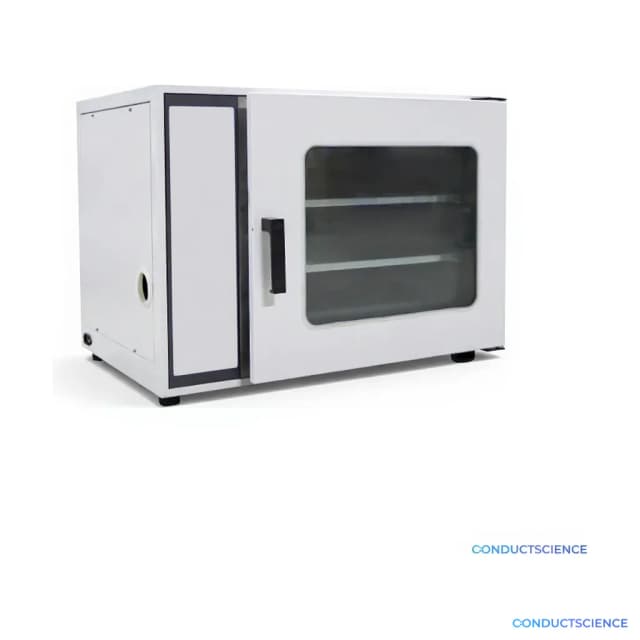
Vacuum drying oven for oxygen-sensitive and heat-sensitive materials, available in 23–213 L capacities across six models including standard (V) and extended-operation (VL) variants.
PID microprocessor temperature control with LED display; vacuum degree below 133 Pa; separate shelf heater control for improved efficiency. Parameter memory with automatic operation resumption.

Louise Corscadden, PhD
Director of Science · ConductScience
Ask Louise about Vacuum Drying Oven(BOV-V/VL) fit, setup, configuration, or quote prep.
Already working with us? Sign in to connect this with My Scientist.
Key Specifications
Full details →- Model fit
- 6 selectable configurations
- SKU family
- BIO-0254
- Shipping box
- 27.0 x 29.6 x 30.0 cm
- Ordering
- Online checkout and quote request available
- Category
- Drying Ovens
- Build notes
- Confirm accessories, station layout, and support needs before purchase
The ConductScience vacuum drying oven (BOV-V/VL series) provides low-pressure, oxygen-free drying across a broad capacity range from 23 L to 213 L. PID microprocessor control with LED display maintains precise temperature; separate temperature control for the shelf heater improves heating efficiency. The integral molded silicone rubber door seal and toughened bulletproof double-glazed door ensure reliable vacuum integrity. VL-series models share chamber dimensions with V-series but are optimized for extended continuous operation.
Technical Specifications
| Parameter | BOV-30V | BOV-50V | BOV-90V | BOV-215V | BOV-90VL | BOV-215VL |
|---|---|---|---|---|---|---|
| Capacity | 23 L | 53 L | 91 L | 213 L | 91 L | 213 L |
| Temperature Range | RT+10–200°C | RT+10–250°C | RT+10–200°C | RT+10–250°C | RT+10–200°C | RT+10–200°C |
| Temperature Fluctuation | ±1°C | |||||
| Vacuum Degree | <133 Pa | |||||
| Timing Range | 0–9999 min | |||||
| Power Consumption | 500 W | 1400 W | 1600 W | 2200 W | 1600 W | 2200 W |
| Power Supply | AC 220V, 50/60 Hz (standard); 110V optional | |||||
| Internal Dimensions | 296×300×270 mm | 416×370×346 mm | 450×450×450 mm | 556×600×640 mm | 450×450×450 mm | 556×600×640 mm |
| Net Weight | 55 kg | 67 kg | 145 kg | 208 kg | 145 kg | 208 kg |
Key Features
- PID microprocessor temperature control with LED display
- Separate temperature control for shelf heater — improved heating efficiency
- Integral molded silicone rubber door seal for superior air tightness
- Toughened bulletproof double-glazed door
- Parameter memory with automatic operation resumption after power restoration
- Standard (V) and extended-operation (VL) variants available
How It Works
Vacuum drying operates on the principle that reducing atmospheric pressure lowers the boiling point of water and other solvents. As pressure decreases, the vapor pressure required for liquid-to-gas phase transition reduces proportionally, enabling moisture removal at temperatures well below 100°C. This relationship follows the Clausius-Clapeyron equation, where vapor pressure and temperature maintain an exponential relationship that shifts dramatically under vacuum conditions.
The BOV-V/VL creates vacuum conditions below 133Pa (approximately 1 Torr) within the heated chamber. At this reduced pressure, water vaporizes at temperatures as low as room temperature, though controlled heating accelerates the process while remaining gentle on thermolabile materials. The combination of mild heating and reduced pressure creates optimal conditions for moisture migration from within sample matrices to the surface, where it rapidly vaporizes and is removed by the vacuum system.
Temperature control maintains uniform heating across the chamber volume while the vacuum system continuously removes water vapor and other volatile compounds. The timing function allows extended processing cycles necessary for complete moisture removal from dense or thick samples, with vacuum monitoring ensuring consistent conditions throughout the drying process.
Features & Benefits
Research Domain
- Analytical Chemistry
- Cell Biology
- Environmental Monitoring
- Food Science
- Materials Science
- Pharmaceutical QC
Brand
- ConductScience
Shipping weight
- 55.0 lb
Shipping box
- L: 27.0 cm
- W: 29.6 cm
- H: 30.0 cm
| Feature | This Product | Typical Alternative | Advantage |
|---|---|---|---|
| Vacuum Level Achievement | Below 133Pa with monitoring | Entry-level models often achieve 1000-500Pa range | Deeper vacuum enables lower temperature drying and better preservation of heat-sensitive compounds. |
| Temperature Stability | ±1°C fluctuation control | Basic models typically offer ±3-5°C stability | Precise temperature control ensures consistent drying conditions and prevents thermal damage to sensitive materials. |
| Capacity Options | Four sizes available (23L to 213L) | Many manufacturers offer single size options | Allows researchers to select optimal chamber size for their typical sample volumes without over- or under-sizing. |
| Timing Range | Up to 9999 minutes | Standard models often limited to shorter timing cycles | Extended timing capability accommodates materials requiring long, gentle drying cycles without operator intervention. |
| Vacuum Monitoring | Both analog and digital display options | Basic units typically include only simple pressure gauges | Multiple monitoring options provide flexibility for different operational preferences and documentation requirements. |
| Control Modes | Manual and automatic differential pressure control | Entry-level systems often manual-only operation | Automatic control maintains consistent vacuum conditions without constant operator attention during long drying cycles. |
The BOV-V/VL series offers comprehensive vacuum drying capabilities with deep vacuum achievement, precise temperature control, and multiple capacity options. The combination of automated and manual control modes provides operational flexibility while maintaining the consistent conditions necessary for reliable moisture removal from heat-sensitive materials.
| Model | SKU | Listed price | Status | Shipping box |
|---|---|---|---|---|
| BOV-215VL | BIO-0254 | $8,999.00 | Available | 27.0 x 29.6 x 30.0 cm |
| BOV-90VL | BIO-0254 | $5,799.00 | Available | 27.0 x 29.6 x 30.0 cm |
| BOV-215V | BIO-0254 | $6,699.00 | Available | 27.0 x 29.6 x 30.0 cm |
| BOV-90V | BIO-0254 | $3,599.00 | Available | 27.0 x 29.6 x 30.0 cm |
| BOV-50V | BIO-0254 | $1,779.00 | Available | 27.0 x 29.6 x 30.0 cm |
| BOV-30V | BIO-0254 | $1,479.00 | Available | 27.0 x 29.6 x 30.0 cm |
Practical Tips
Verify vacuum gauge accuracy periodically using a calibrated reference gauge, particularly before critical sample processing.
Why: Accurate vacuum measurement ensures consistent drying conditions and process repeatability.
Inspect and clean door seals regularly, applying vacuum grease as needed to maintain proper vacuum integrity.
Why: Compromised seals prevent achievement of specified vacuum levels and extend drying times.
Pre-dry samples at atmospheric pressure briefly to remove bulk moisture before vacuum processing of heat-sensitive materials.
Why: Reduces vacuum pump load and prevents rapid outgassing that can compromise vacuum stability.
Allow chamber to return to atmospheric pressure gradually before opening to prevent sudden pressure changes that might disturb samples.
Why: Controlled pressure release maintains sample integrity and prevents damage to delicate dried materials.
Record initial sample weights and monitor weight loss throughout drying cycles to determine optimal processing times for specific materials.
Why: Weight loss tracking provides quantitative feedback for optimizing drying parameters and ensuring complete moisture removal.
If vacuum levels are not achieved, check all connections and seals systematically, starting with the most accessible joints.
Why: Vacuum systems are sensitive to small leaks that can significantly impact performance and drying effectiveness.
Position samples to allow adequate vapor flow paths and avoid overloading the chamber beyond recommended capacity.
Why: Proper sample arrangement ensures uniform drying and prevents localized high vapor concentrations that can impede vacuum maintenance.
Replace or service vacuum pump oil according to manufacturer specifications, particularly when processing samples with organic solvents.
Why: Clean pump oil maintains optimal vacuum performance and prevents contamination of subsequent samples.
Setup Guide
What’s in the Box
- Vacuum drying oven main unit
- Removable shelf system (typical)
- Vacuum gauge assembly
- Power cable
- Vacuum connection tubing (typical)
- Operating manual and calibration certificate (typical)
Warranty
ConductScience provides a standard one-year manufacturer warranty covering defects in materials and workmanship, with technical support available for troubleshooting and maintenance guidance throughout the warranty period.
Compliance
What vacuum pump requirements are needed for optimal operation?
The system requires vacuum pumps capable of achieving and maintaining pressures below 133Pa. Rotary vane pumps with appropriate displacement for the chamber volume are typically recommended, though specific pump sizing should be confirmed based on sample outgassing characteristics and desired cycle times.
How do I determine appropriate drying temperature and time for unknown samples?
Begin with conservative conditions using low temperature (50-60°C) and monitor moisture removal rate through sample weight loss. Gradually increase temperature if needed while maintaining vacuum integrity. Extended timing capability to 9999 minutes allows thorough drying without thermal stress.
Can the system handle organic solvents other than water?
Yes, the vacuum environment enables removal of various organic solvents at reduced temperatures. However, ensure vacuum pump and exhaust systems are compatible with specific solvents being removed, and consider cold traps if necessary to protect vacuum pumps from solvent vapors.
What maintenance procedures are required for consistent vacuum performance?
Regular inspection of door seals, vacuum connections, and gauge calibration ensures optimal performance. Vacuum pump oil should be changed according to manufacturer specifications, and the chamber should be cleaned between different sample types to prevent cross-contamination.
How uniform is temperature distribution across different chamber sizes?
Temperature uniformity depends on proper sample loading and air circulation within the vacuum environment. Larger chambers may require longer equilibration times, and sample placement should allow adequate spacing for even heat distribution throughout the drying cycle.
What data logging capabilities are available for documentation?
Consult product datasheet for specific data recording features. Manual logging of temperature, vacuum readings, and timing parameters provides documentation for quality control purposes, with digital display models potentially offering enhanced monitoring capabilities.
Are there limitations on sample types or containers that can be processed?
Samples should be in vacuum-compatible containers that allow vapor escape while preventing material loss. Avoid sealed containers or materials that might outgas rapidly and overwhelm the vacuum system. Glass and metal containers are generally preferred over plastics for vacuum service.
How does this compare to freeze-drying for heat-sensitive materials?
Vacuum drying at controlled temperatures offers faster processing than freeze-drying while providing gentler conditions than atmospheric drying. It represents a middle ground between freeze-drying's ultra-gentle but slow process and conventional heating's speed but potential for thermal damage.
Have a question about this product?
Have a question? Just ask.
Send it over and we'll email you a personalized answer — no call, no scheduling.
Prefer to talk it through?
Accessories
Enhance your setup with compatible accessories