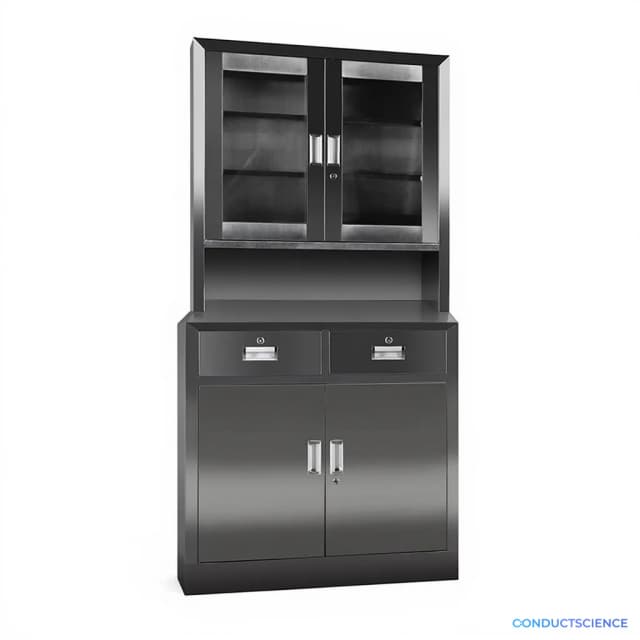
Weak Acid and Alkali Chemicals Storage Cabinet
Double-wall steel chemical storage cabinet for weak acids and alkalis, available in capacities from 15L to 340L with adjustable shelving and leak containment.

Louise Corscadden, PhD
Director of Science · ConductScience
Ask Louise about Weak Acid and Alkali Chemicals Storage Cabinet fit, setup, configuration, or quote prep.
Already working with us? Sign in to connect this with My Scientist.
Key Specifications
Full details →- Model fit
- Configured during quote
- SKU family
- BIO-0752
- Shipping box
- 42.0 x 43.6 x 38.0 cm
- Ordering
- Online checkout and quote request available
- Category
- Storage & Furniture
- Build notes
- Double-layer anti-fire cold-rolled steel,PP tray
The Weak Acid and Alkali Chemicals Storage Cabinet provides secure containment for corrosive chemical reagents commonly used in analytical and research laboratories. Constructed with double-layer anti-fire cold-rolled steel and featuring PP chemical-resistant trays, this cabinet system offers multiple capacity configurations from 4 gallons (15L) to 90 gallons (340L) to accommodate varying laboratory storage requirements.
The cabinet employs manual ventilation systems and adjustable shelving to organize chemical containers while maintaining separation protocols for incompatible substances. Each unit includes leak-containment trays to prevent cross-contamination and protect laboratory infrastructure from accidental spills during routine chemical handling operations.
How It Works
The storage cabinet employs physical containment principles to isolate corrosive chemicals from laboratory personnel and incompatible substances. The double-layer cold-rolled steel construction provides structural integrity and fire resistance, while the internal PP (polypropylene) trays offer chemical resistance to weak acids and alkalis that could corrode standard metal surfaces.
Manual ventilation systems allow controlled air circulation to prevent vapor accumulation while maintaining containment of chemical vapors. The adjustable shelving system enables segregation of chemicals by compatibility class and container size, reducing the risk of accidental mixing during storage and retrieval operations.
Leak containment is achieved through the molded PP tray system, which captures minor spills and prevents chemical migration to adjacent storage areas or building infrastructure. This passive containment approach requires no power source while providing continuous protection against common laboratory chemical storage hazards.
Features & Benefits
Automation Level
- manual
BKSC-12B
- BKSC-22B
BKSC-30B
- BKSC-45B
BKSC-60B
- BKSC-90B
Material
- Double-layer anti-fire cold-rolled steel,PP tray
12 gallon(45L)
- 22 gallon(83L)
30 gallon(114L)
- 45 gallon(170L)
60 gallon(227L)
- 90 gallon(340L)
Adjustable Shelf
- 1pc
3pcs
- 1pc
Door
- Single/Manual
External Size(W*D*H)mm
- 430*430*560
590*460*890
- 600*460*1650
1090*460*1120
- 1090*460*1650
Brand
- ConductScience
Research Domain
- Analytical Chemistry
- Environmental Monitoring
- Food Science
- Industrial Hygiene
- Materials Science
- Microbiology
- Pharmaceutical QC
Capacity
- 4 gallon(15L)
Shipping weight
- 28.0 lb
Shipping box
- L: 42.0 cm
- W: 43.6 cm
- H: 38.0 cm
| Feature | This Product | Typical Alternative | Advantage |
|---|---|---|---|
| Construction Material | Double-layer anti-fire cold-rolled steel with PP trays | Single-wall steel or plastic construction | Enhanced fire resistance and structural durability for long-term laboratory use. |
| Capacity Range | Seven capacity options from 15L to 340L | Limited capacity configurations | Accommodates diverse laboratory storage requirements from small research to large analytical facilities. |
| Chemical Resistance | PP containment trays for weak acid/alkali compatibility | Standard metal trays without chemical resistance | Prevents tray corrosion and extends cabinet service life in corrosive environments. |
| Shelf Configuration | Adjustable shelving with multiple positions | Fixed shelf configurations | Enables customization for varying container sizes and storage optimization. |
| Ventilation System | Manual ventilation without power requirements | Powered exhaust systems or no ventilation | Provides vapor management without electrical dependencies or operating costs. |
The cabinet system combines fire-resistant steel construction with chemical-resistant PP components across multiple capacity options. The manual operation and adjustable shelving provide reliable functionality without electrical requirements while accommodating diverse laboratory storage needs.
Practical Tips
Segregate chemicals by compatibility class using separate shelves or secondary containment within the cabinet.
Why: Prevents accidental mixing and reduces reaction hazards during storage and retrieval operations.
Inspect PP trays monthly for stress cracking or chemical damage, particularly in high-usage areas.
Why: Early detection of tray degradation prevents containment failure and chemical migration.
Maintain clear access paths and avoid overloading shelves beyond weight capacity specifications.
Why: Ensures safe retrieval operations and prevents shelf failure under excessive load.
Label shelf areas clearly with chemical class designations and compatibility warnings.
Why: Reduces placement errors and supports proper chemical segregation protocols.
Clean steel surfaces with appropriate solvents and inspect for corrosion or wear annually.
Why: Maintains structural integrity and identifies potential containment issues before failure.
If door alignment becomes poor, check mounting hardware and cabinet leveling before adjusting hinges.
Why: Proper alignment ensures effective containment and prevents vapor leakage through door seals.
Maintain accurate chemical inventory records with storage location and quantity information.
Why: Supports regulatory compliance and emergency response planning in laboratory environments.
Verify shelf load distribution periodically using known weights to ensure safe storage practices.
Why: Prevents overloading and maintains structural integrity under typical laboratory use conditions.
Setup Guide
What’s in the Box
- Chemical storage cabinet with steel construction
- PP chemical-resistant containment trays
- Adjustable shelf system (quantity varies by model)
- Installation hardware and mounting brackets (typical)
- User manual and safety guidelines (typical)
- Chemical compatibility reference chart (typical)
Warranty
ConductScience provides standard one-year manufacturer warranty covering material defects and construction quality. Technical support includes guidance on proper chemical storage practices and maintenance procedures.
Compliance
What chemical compatibility limitations apply to the PP tray system?
PP trays resist weak acids and alkalis but may degrade with strong oxidizing agents or aromatic solvents. Consult chemical compatibility charts for specific reagent storage requirements.
How does the manual ventilation system function without power?
Passive ventilation relies on natural air circulation through designed openings. Position cabinet to allow airflow and avoid blocking ventilation paths for effective vapor management.
What is the maximum container size that fits on the adjustable shelves?
Shelf spacing is adjustable to accommodate varying container heights. Consult product datasheet for specific internal dimensions and weight capacity per shelf.
Can different cabinet sizes be connected for larger storage systems?
Cabinets are designed as standalone units. Multiple cabinets can be positioned adjacent to each other but require separate ventilation and access considerations.
What maintenance is required for the steel construction and PP components?
Regular inspection of door seals, tray integrity, and steel surface condition. Clean PP trays with compatible solvents and inspect for chemical damage or stress cracking.
How should incompatible chemicals be segregated within the cabinet?
Use separate shelves or secondary containment for different chemical classes. Maintain separation distances according to institutional chemical hygiene plans and compatibility matrices.
Have a question about this product?
Have a question? Just ask.
Send it over and we'll email you a personalized answer — no call, no scheduling.
Prefer to talk it through?