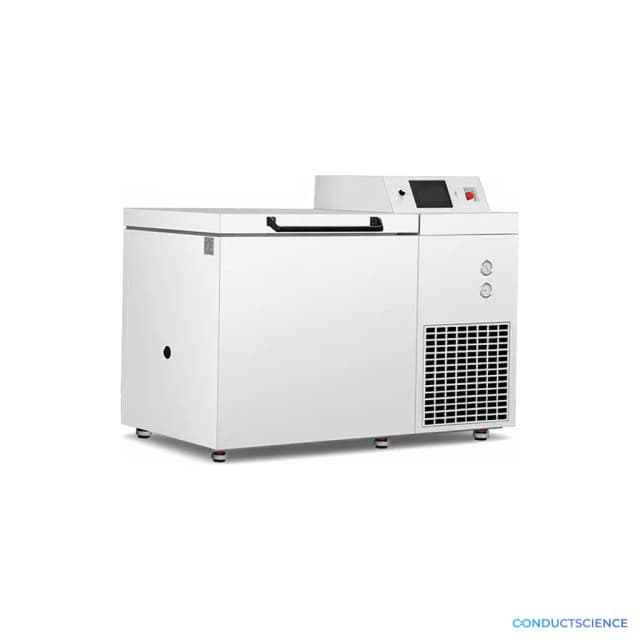
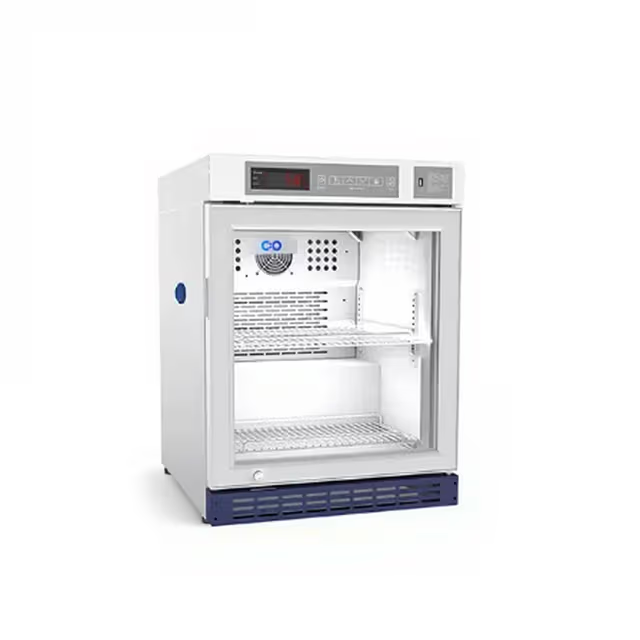
30℃ Freezer 368L 528L
Large-capacity laboratory freezer maintaining 30°C below ambient temperature, available in 368L and 528L configurations for bulk storage of biological samples and temperature-sensitive materials.

Louise Corscadden, PhD
Director of Science · ConductScience
Ask Louise about 30℃ Freezer 368L 528L fit, setup, configuration, or quote prep.
Already working with us? Sign in to connect this with My Scientist.
Key Specifications
Full details →- Model fit
- 2 selectable configurations
- SKU family
- BIO-0085
- Shipping box
- 188.4 x 75.0 x 73.6 cm
- Ordering
- Online checkout and quote request available
- Category
- Cold Storage
- Build notes
- Confirm accessories, station layout, and support needs before purchase
The 30°C Freezer is a large-capacity laboratory freezer designed for intermediate-temperature storage of biological samples, reagents, and temperature-sensitive materials. Available in 368L and 528L configurations, this unit maintains stable temperatures at 30°C below ambient, making it suitable for applications requiring controlled cold storage without the extreme temperatures of ultra-low freezers.
The freezer accommodates bulk storage requirements in research laboratories, biobanks, and pharmaceutical facilities where consistent temperature control is critical for sample integrity. The substantial internal volume supports high-throughput workflows and long-term storage protocols across multiple research domains.
How It Works
The freezer operates using vapor-compression refrigeration technology, where a refrigerant cycles through evaporation and condensation phases to remove heat from the internal chamber. The compressor pressurizes refrigerant vapor, which then condenses in the external coils, releasing heat to the ambient environment. The liquid refrigerant expands through an expansion valve, creating a cooling effect in the evaporator coils within the storage chamber.
Temperature control is maintained through a thermostat system that monitors internal conditions and cycles the compressor to maintain the setpoint. Insulation in the cabinet walls minimizes heat transfer from the external environment, while door seals prevent warm air infiltration during access cycles.
The large internal volume allows for efficient air circulation patterns that distribute cooling uniformly throughout the storage space, preventing temperature gradients that could compromise sample integrity in different locations within the freezer.
Features & Benefits
Automation Level
- manual
Research Domain
- Analytical Chemistry
- Cell Biology
- Clinical Diagnostics
- Food Science
- Microbiology
- Pharmaceutical QC
Shipping weight
- 153.0 lb
Shipping box
- L: 188.4 cm
- W: 75.0 cm
- H: 73.6 cm
| Feature | This Product | Typical Alternative | Advantage |
|---|---|---|---|
| Storage Capacity | 368L and 528L configurations available | Smaller units often offer 200-400L capacity | Higher capacity accommodates bulk storage requirements and reduces the need for multiple units in high-throughput laboratories |
| Temperature Range | 30°C below ambient operation | Standard laboratory freezers typically operate at -20°C to -30°C | Intermediate temperature range provides energy-efficient storage for samples not requiring ultra-low temperatures |
| Physical Construction | 153 kg unit weight with robust construction | Lighter units may compromise durability | Heavy-duty construction ensures stability and long-term reliability in demanding laboratory environments |
| Internal Volume Efficiency | Large external dimensions optimized for maximum internal capacity | Compact units may sacrifice internal volume for smaller footprint | Maximizes storage capacity while maintaining reasonable laboratory footprint requirements |
This freezer offers substantial storage capacity in both 368L and 528L configurations with robust construction designed for continuous laboratory operation. The intermediate temperature range provides an energy-efficient alternative to ultra-low freezers for applications not requiring extreme cold storage.
| Model | SKU | Listed price | Status | Shipping box |
|---|---|---|---|---|
| BDF-30V528D | BIO-BDF-30V528D | $4,329.00 | Available | 188.4 x 75.0 x 73.6 cm |
| BDF-30V368D | BIO-BDF-30V368D | $3,999.00 | Available | 188.4 x 75.0 x 73.6 cm |
Practical Tips
Schedule regular cleaning of condenser coils to maintain cooling efficiency and prevent dust accumulation.
Why: Clean coils ensure optimal heat transfer and reduce energy consumption while preventing system overheating.
Organize samples in clearly labeled containers with inventory tracking to minimize door opening time.
Why: Reduced access time maintains temperature stability and preserves sample integrity during storage.
Implement independent temperature monitoring with calibrated sensors placed throughout the storage volume.
Why: External monitoring provides verification of temperature uniformity and documentation for quality assurance protocols.
Ensure adequate ventilation around the unit and avoid blocking air circulation pathways.
Why: Proper airflow prevents heat buildup and reduces risk of compressor failure or reduced cooling efficiency.
Monitor door seal integrity and replace if gaps or damage are observed.
Why: Compromised seals allow warm air infiltration, increasing energy consumption and temperature instability.
Allow full temperature stabilization after power interruptions before accessing critical samples.
Why: Complete temperature recovery ensures stored materials remain within acceptable temperature ranges for integrity preservation.
Setup Guide
What’s in the Box
- 30°C Freezer main unit
- Power cord
- Adjustable shelving system (typical)
- User manual and operation guide
- Temperature monitoring documentation (typical)
Warranty
ConductScience provides a standard one-year manufacturer warranty covering parts and labor, with technical support available for installation guidance and troubleshooting assistance.
Compliance
References
Background reading relevant to this product:
What is the temperature stability and uniformity throughout the storage volume?
Consult product datasheet for specific temperature stability specifications. Large capacity units typically maintain uniformity through internal air circulation systems, though temperature mapping may be advisable for critical applications.
How long does temperature recovery take after door opening?
Recovery time depends on door opening duration and ambient conditions. Minimize access time and consider pre-cooling replacement items to reduce thermal load impact on stored samples.
What type of temperature monitoring and alarm systems are included?
Consult product specifications for built-in monitoring capabilities. Many laboratories implement independent temperature logging systems for critical sample storage documentation.
Can the internal configuration be customized for different sample types?
Most units include adjustable shelving systems that can accommodate various container sizes. Verify shelf load capacity and spacing options for your specific storage requirements.
What are the electrical requirements and energy consumption characteristics?
Consult product datasheet for specific electrical specifications and energy consumption data. Large capacity freezers typically require dedicated electrical circuits.
How does this compare to ultra-low temperature freezers for sample storage?
This unit provides intermediate temperature storage suitable for materials not requiring ultra-low temperatures, offering lower energy consumption and reduced complexity compared to -80°C freezers.
What maintenance procedures are recommended for optimal performance?
Regular cleaning, door seal inspection, and condenser coil maintenance are typically required. Consult manufacturer guidelines for specific maintenance schedules and procedures.
Have a question about this product?
Have a question? Just ask.
Send it over and we'll email you a personalized answer — no call, no scheduling.
Prefer to talk it through?