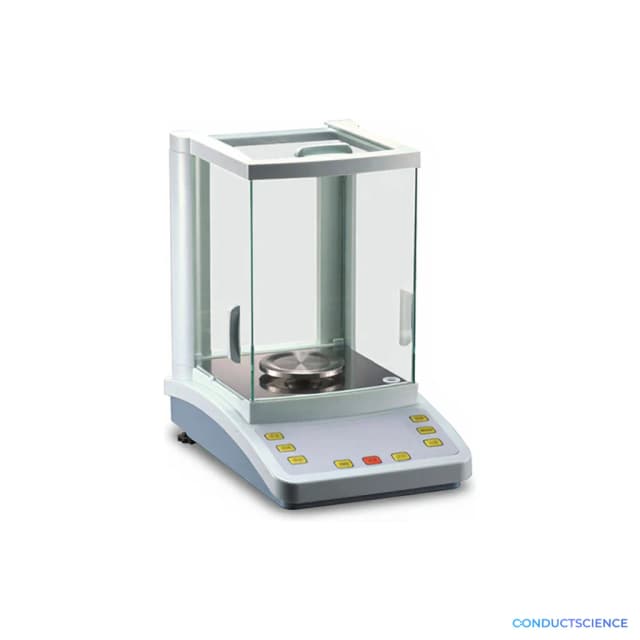
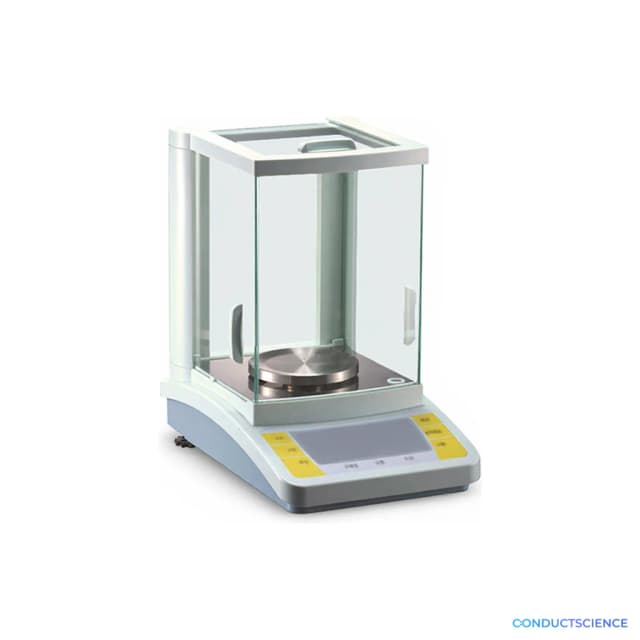
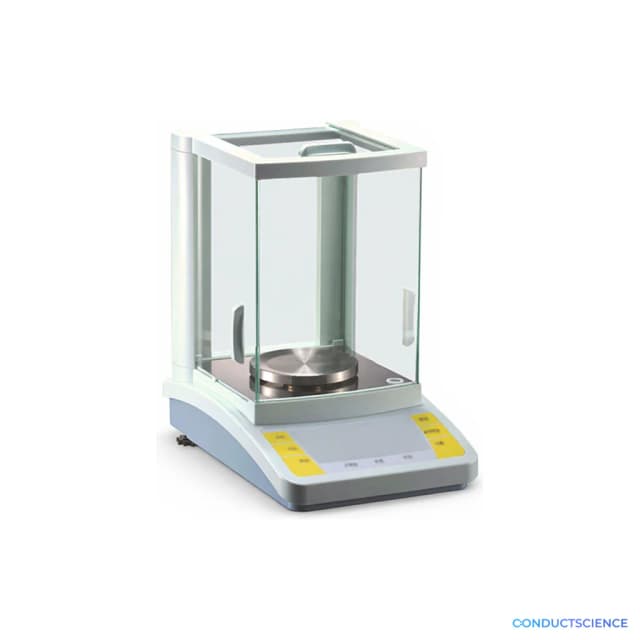
Automatic Electronic Analytical Balance BA-E(External Calibration)&BA-EN(Internal Calibration)
Precision analytical balance with 0.1mg resolution, available in 100g-220g capacities with external or internal calibration for quantitative analysis applications.

Louise Corscadden, PhD
Director of Science · ConductScience
Ask Louise about Automatic Electronic Analytical Balance BA-E(External Calibration)&BA-EN(Internal Calibration) fit, setup, configuration, or quote prep.
Already working with us? Sign in to connect this with My Scientist.
Key Specifications
Full details →- Model fit
- Configured during quote
- SKU family
- BIO-0353
- Shipping box
- 20.0 x 17.5 x 16.5 cm
- Ordering
- Online checkout and quote request available
- Category
- Balances
- Build notes
- Confirm accessories, station layout, and support needs before purchase
The Automatic Electronic Analytical Balance BA-E/BA-EN series provides precision weighing capabilities with 0.1mg resolution for quantitative analytical work. Available in external calibration (BA-E) and internal calibration (BA-EN) configurations, these balances feature multiple capacity options including 100g, 120g, and 220g models to accommodate diverse sample sizes. The integrated draft shield and LCD display with white backlight ensure reliable measurements in typical laboratory environments.
Designed for applications requiring sub-milligram precision, the balance achieves stable readings within 3 seconds and maintains repeatability of ±0.2mg. The RS232C interface enables data logging and integration with laboratory information systems. Operating temperature range of 18-23°C and minimum weighing capacity of 10mg make this balance suitable for analytical chemistry, pharmaceutical analysis, and quality control workflows requiring accurate mass determination.
How It Works
The analytical balance operates on electromagnetic force restoration principles, where the weighing pan is supported by an electromagnetic coil within a permanent magnetic field. When a sample is placed on the pan, the resulting downward force is detected by a position sensor, which triggers a proportional current through the coil to restore the pan to its null position. This current is directly proportional to the mass and is converted to a digital readout.
The draft shield minimizes air currents that could affect measurements, while the internal or external calibration systems ensure measurement accuracy through comparison with certified reference masses. The LCD display provides real-time weight readings, and the stable time specification indicates when measurements have reached equilibrium for reliable data collection.
Features & Benefits
Automation Level
- semi-automated
BA2204E
- BA1204EN
220g
- 120g
Min Weighing
- 10mg
Stable Time
- ≤3s
Scale Size
- φ80mm(Standard), φ90mm(Optional)
Operation Temp
- 18~23℃
Repeat Ability
- ±0.2mg
Liner
- ±0.3mg
Draft Shield Inner Size
- 175*165*200mm
Cal. Weight
- External calibration
Interface
- RS232C
Brand
- ConductScience
Research Domain
- Analytical Chemistry
- Clinical Diagnostics
- Environmental Monitoring
- Food Science
- Materials Science
- Pharmaceutical QC
Capacity
- 100g
Accuracy
- 0.1mg
Display Type
- LCD(white back light with black font), 96*24mm
Shipping weight
- 5.0 lb
Shipping box
- L: 20.0 cm
- W: 17.5 cm
- H: 16.5 cm
| Feature | This Product | Typical Alternative | Advantage |
|---|---|---|---|
| Resolution | 0.1mg across all capacity ranges | Entry-level models often provide 1mg resolution | Sub-milligram precision enables accurate analytical chemistry and pharmaceutical analysis workflows. |
| Calibration Options | Both external and internal calibration available | Many models offer only external calibration | Internal calibration option provides operational convenience while external calibration ensures maximum accuracy verification. |
| Stable Time | ≤3 seconds to stable reading | Basic models typically require 5-10 seconds | Faster equilibration improves efficiency during high-throughput analytical procedures. |
| Data Interface | RS232C connectivity standard | Basic models often lack data interfaces | Direct data transfer eliminates transcription errors and supports automated laboratory workflows. |
| Display Technology | LCD with white backlight, 96×24mm | Smaller displays without backlighting common in entry models | Clear readability in various laboratory lighting conditions improves measurement accuracy and user experience. |
| Capacity Range | 100g, 120g, and 220g models available | Single capacity options typical | Multiple capacity choices allow selection based on specific sample size requirements and laboratory workflows. |
The BA-E/BA-EN series provides 0.1mg resolution with rapid 3-second stabilization and flexible calibration options. RS232C connectivity and backlit display enhance laboratory integration and usability compared to basic analytical balance models.
Practical Tips
Perform calibration with weights at room temperature to avoid thermal effects on measurement accuracy.
Why: Temperature differences between calibration weights and balance chamber can introduce measurement drift.
Clean the weighing pan and draft shield weekly with appropriate solvents to prevent contamination buildup.
Why: Residue accumulation can affect measurement accuracy and cause drift over time.
Allow samples to equilibrate to balance chamber temperature before weighing, especially for volatile or hygroscopic materials.
Why: Temperature and moisture effects can cause apparent weight changes during measurement.
If readings drift or appear unstable, check for air currents and ensure the draft shield is properly closed.
Why: Even minor air movement can affect sub-milligram measurements significantly.
Record multiple measurements for critical samples and calculate statistical parameters to assess measurement reliability.
Why: Repeatability assessment helps identify measurement issues and provides confidence in analytical results.
Ensure the balance is properly grounded and placed on a stable, level surface away from vibration sources.
Why: Electrical safety and mechanical stability are essential for accurate measurements and user protection.
Use anti-static weighing techniques and containers when working with powdered materials that may exhibit static charge.
Why: Static electricity can cause erratic readings and apparent weight changes during measurement.
Keep spare draft shield components available as the sliding doors are subject to wear from frequent use.
Why: Damaged draft shield components can compromise measurement stability and accuracy.
Setup Guide
What’s in the Box
- BA-E or BA-EN analytical balance main unit
- Draft shield assembly
- Weighing pan and pan support
- Power adapter and cord
- RS232C interface cable (typical)
- User manual and operation guide
- Calibration certificate (typical)
- External calibration weights (BA-E models, typical)
Warranty
ConductScience provides a standard one-year manufacturer warranty covering defects in materials and workmanship, with technical support for installation, calibration, and operational assistance.
Compliance
What is the difference between external and internal calibration models?
External calibration (BA-E) requires certified external weights for calibration verification, providing maximum accuracy assurance. Internal calibration (BA-EN) uses built-in calibration mechanism for convenience, suitable for routine analytical work where external weight verification is not required.
How does environmental temperature affect measurement accuracy?
The balance operates within 18-23°C range for specified accuracy. Temperature variations outside this range can affect electronic stability and measurement repeatability. Allow 30-minute equilibration when moving between environments.
What sample containers are compatible with the weighing chamber?
The 175×165×200mm draft shield accommodates standard analytical glassware including beakers up to 150mm diameter, weighing boats, and sample vials. Ensure containers fit within chamber height while allowing draft shield closure.
Can the balance interface with laboratory information management systems?
Yes, the RS232C interface enables direct data transfer to LIMS and laboratory computers. Communication parameters are configurable through the balance menu system for compatibility with various data collection software.
How frequently should calibration be performed?
Calibration frequency depends on usage and accuracy requirements. Daily calibration checks are recommended for critical analytical work, with full calibration documentation weekly or per laboratory SOP requirements.
What is the minimum sample size for reliable measurements?
The 10mg minimum weighing specification ensures reliable measurements above this threshold. For samples below 10mg, measurement uncertainty increases and multiple replicates may be required for acceptable precision.
How does this balance compare to microanalytical balances?
This analytical balance provides 0.1mg resolution suitable for most quantitative analysis. Microanalytical balances offer 0.01mg or 0.001mg resolution for applications requiring higher precision but at significantly higher cost and with more stringent environmental requirements.
Have a question about this product?
Have a question? Just ask.
Send it over and we'll email you a personalized answer — no call, no scheduling.
Prefer to talk it through?