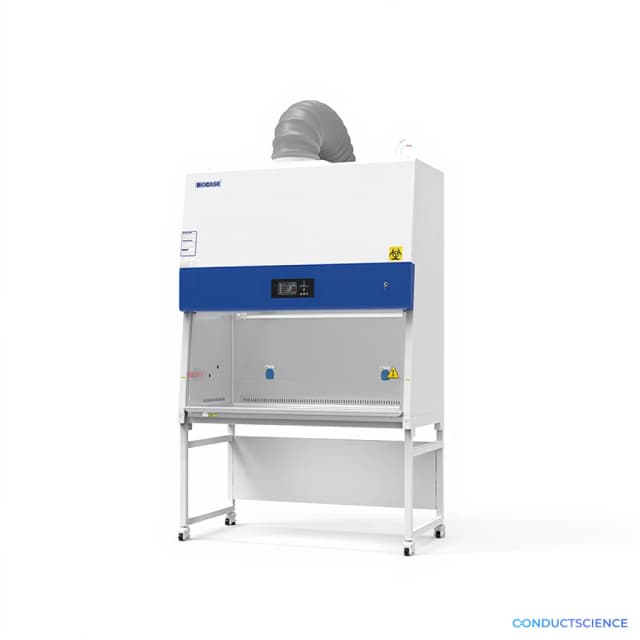
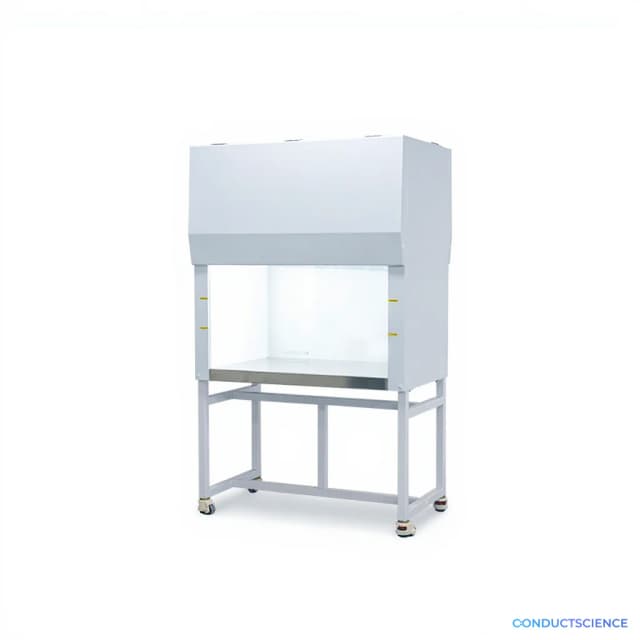
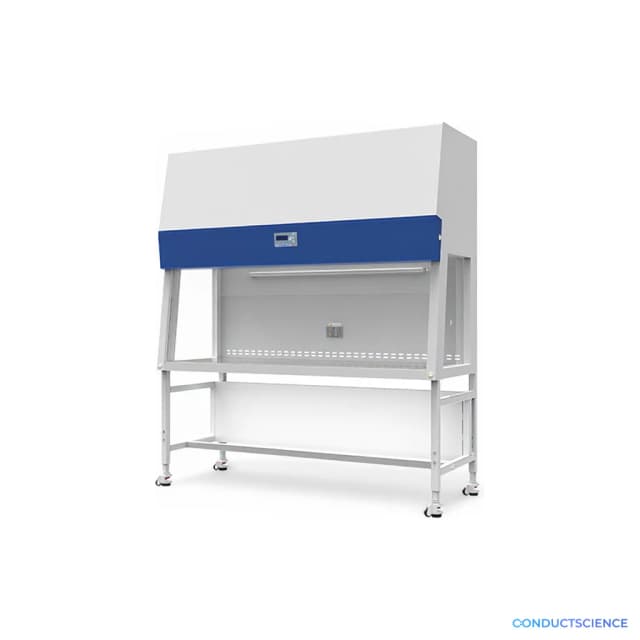
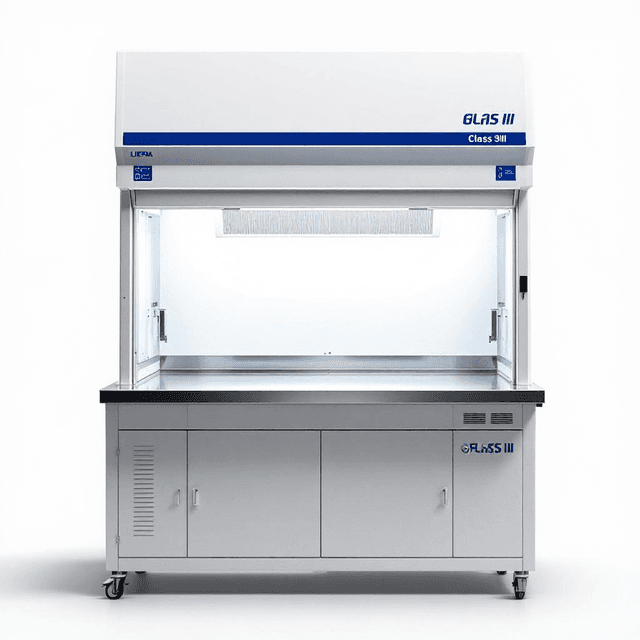
Basic Series Class ll A2 Biological Safety Cabinet
Class II A2 biological safety cabinet with dual HEPA filtration, 600×500mm work chamber, and precise airflow control for microbiological containment applications.

Louise Corscadden, PhD
Director of Science · ConductScience
Ask Louise about Basic Series Class ll A2 Biological Safety Cabinet fit, setup, configuration, or quote prep.
Already working with us? Sign in to connect this with My Scientist.
Key Specifications
Full details →- Model fit
- Configured during quote
- SKU family
- BIO-0890
- Shipping box
- 23.62 x 20.87 x 19.69 cm
- Ordering
- Online checkout and quote request available
- Category
- Clean Benches & Fume Hoods
- Build notes
- Confirm accessories, station layout, and support needs before purchase
The Basic Series Class II A2 Biological Safety Cabinet provides containment and sterile work environment for microbiological applications requiring personnel, product, and environmental protection. This unit operates through dual HEPA filtration with precise airflow control, maintaining 0.53±0.025 m/s inflow velocity and 0.33±0.025 m/s downflow velocity to establish protective air barriers. The 600×500×530mm work chamber accommodates standard laboratory equipment and procedures while providing 200mm safety height at the tested opening position.
Constructed with double-sided laminated glass front window and stainless steel work surface, the cabinet features dual 99.995% efficiency HEPA filters at 0.3μm with integrated filter life indicators. The LED illumination system delivers ≥1000 Lux uniform lighting across the work surface, while the LCD display provides real-time operational monitoring. Two 500W electrical outlets enable operation of small laboratory equipment within the contained environment.
How It Works
The Class II A2 biological safety cabinet operates on laminar airflow principles with dual HEPA filtration to create three levels of protection: personnel, product, and environmental. Room air enters through the front grille at 0.53±0.025 m/s, creating an inward airflow barrier that prevents aerosols from escaping the work chamber. This inflow air mixes with downflow air that has been HEPA-filtered and recirculated from the plenum above the work surface.
The downflow air moves at 0.33±0.025 m/s, providing a sterile curtain over the work surface that protects samples from contamination. Approximately 70% of the air is recirculated through the supply HEPA filter after passing through the rear grille, while 30% is exhausted through the exhaust HEPA filter. Both HEPA filters achieve 99.995% efficiency at 0.3μm particle size, ensuring removal of bacteria, fungi, and other contaminants. The balanced airflow design maintains negative pressure within the work chamber while providing positive protection of the work surface.
Features & Benefits
Automation Level
- manual
External Size(W*D*H)
- 700*640*1230mm(without base stand)
Internal Size(W*D*H)
- 600*500*530mm
Tested Opening
- Safety height 200mm(8)
Max Opening
- 370mm(15)
Inflow Velocity
- 0.53±0.025m/s
Down Flow Velocity
- 0.33±0.025m/s
HEPA Filter
- Two, 99.995% efficiency at 0.3μm. Filter life indicator
Front Window
- Double-sided laminated glass
Noise
- ≤67dB
LED Lamp
- 8W*2
Illumination
- ≥1000Lux
Consumption
- 500W
Socket
- Two, total load of two sockets: 500W
Brand
- ConductScience
Research Domain
- Cell Biology
- Clinical Diagnostics
- Environmental Monitoring
- Immunology
- Microbiology
- Pharmaceutical QC
Display Type
- LCD display
Shipping weight
- 495.31 lb
Shipping box
- L: 23.62 cm
- W: 20.87 cm
- H: 19.69 cm
| Feature | This Product | Typical Alternative | Advantage |
|---|---|---|---|
| Work Chamber Size | 600×500×530mm internal dimensions | Entry-level models often provide smaller work areas around 400×400mm | Larger work surface accommodates multiple samples and standard laboratory equipment simultaneously |
| Airflow Precision | ±0.025 m/s tolerance on both inflow and downflow velocities | Basic models may have looser airflow tolerances | Precise airflow control ensures consistent containment performance and regulatory compliance |
| Filter Efficiency | 99.995% efficiency at 0.3μm with life indicators | Standard models typically offer 99.97% efficiency without monitoring | Higher filtration efficiency with proactive maintenance alerts prevents unexpected filter failures |
| Lighting System | Dual 8W LED lights providing ≥1000 Lux | Fluorescent lighting or single LED systems are common | LED technology provides consistent illumination with longer service life and lower heat generation |
| Electrical Capacity | Two outlets with 500W total capacity | Single outlet or lower power capacity in basic models | Multiple outlets support simultaneous operation of heating blocks, mixers, and other small equipment |
| Display System | LCD display for operational monitoring | Analog gauges or basic indicator lights | Digital display provides precise parameter readings for documentation and quality assurance |
This cabinet combines precise airflow control with practical laboratory features including spacious work chamber, dual LED lighting, and LCD monitoring. The 99.995% HEPA efficiency with filter life indicators ensures reliable containment performance for routine microbiological applications.
Practical Tips
Verify airflow velocities at multiple points across the work opening using a calibrated digital anemometer, taking measurements at least 6 inches inside the cabinet opening.
Why: Multiple measurement points ensure uniform airflow distribution and identify potential dead spots or turbulent areas.
Clean work surfaces daily with 70% isopropanol, wiping from back to front to follow airflow direction, and allow complete evaporation before use.
Why: Following airflow direction prevents cross-contamination while proper drying eliminates alcohol vapor interference with sensitive procedures.
Allow cabinet to operate for 15-30 minutes before beginning work and avoid rapid arm movements that can disrupt airflow patterns.
Why: Stabilization time ensures proper temperature and airflow equilibrium while smooth movements maintain the protective air barrier.
Position arms only 6 inches into the cabinet opening and keep materials at least 4 inches from front and rear grilles.
Why: Proper positioning maintains inflow velocity at the work opening while preventing obstruction of critical airflow pathways.
If airflow seems inadequate, check for blocked grilles, overloaded work surface, or damaged HEPA filters before assuming motor problems.
Why: Most airflow issues result from obstruction rather than mechanical failure, making visual inspection the first diagnostic step.
Document daily airflow smoke tests and monthly velocity measurements to establish baseline performance trends.
Why: Regular documentation enables early detection of performance degradation before it affects containment effectiveness.
Organize materials from cleanest to most contaminated, left to right, to minimize cross-contamination during procedures.
Why: Systematic material arrangement follows natural arm movement patterns while reducing contamination risk through logical workflow design.
Setup Guide
What’s in the Box
- Basic Series Class II A2 Biological Safety Cabinet (main unit)
- Dual HEPA filters (pre-installed)
- LCD display panel
- LED lighting system (16W total)
- Power cord
- User manual and operation guide (typical)
- Installation and certification checklist (typical)
Warranty
ConductScience provides standard one-year manufacturer warranty covering defects in materials and workmanship, with technical support available for installation guidance and operational questions.
Compliance
What is the difference between Class II A2 and other biological safety cabinet types?
Class II A2 cabinets recirculate 70% of air through HEPA filtration while exhausting 30%, providing protection for personnel, product, and environment. This differs from Class II B cabinets which exhaust 100% of air externally, making A2 suitable for work with non-volatile chemicals and biological agents.
How often should airflow velocities be verified?
Airflow velocities should be verified monthly using calibrated instrumentation, with annual professional certification required. Daily visual smoke tests can confirm proper airflow patterns between formal measurements.
What size equipment can operate within the work chamber?
The 600×500mm work surface accommodates microscopes, centrifuges, and other equipment provided they do not block airflow grilles. Equipment should not exceed 530mm height or obstruct the rear air intake.
Can this cabinet be used for cell culture applications?
Yes, the sterile downflow air and HEPA filtration make it suitable for cell culture work including media preparation, subculturing, and transfection procedures requiring aseptic technique.
What maintenance is required for optimal performance?
Daily cleaning of work surfaces, weekly UV lamp operation if equipped, monthly airflow checks, and annual HEPA filter replacement or when filter life indicators show degradation. Professional certification is recommended annually.
How does the filter life indicator system work?
The system monitors differential pressure across HEPA filters to indicate loading and efficiency degradation. When indicators show filter replacement is needed, both supply and exhaust filters should be replaced simultaneously to maintain balanced airflow.
What types of applications are not suitable for Class II A2 cabinets?
Applications involving volatile toxic chemicals, radionuclides requiring containment, or procedures generating excessive heat or particles that could overload HEPA filters are not appropriate for A2 cabinets.
Have a question about this product?
Have a question? Just ask.
Send it over and we'll email you a personalized answer — no call, no scheduling.
Prefer to talk it through?