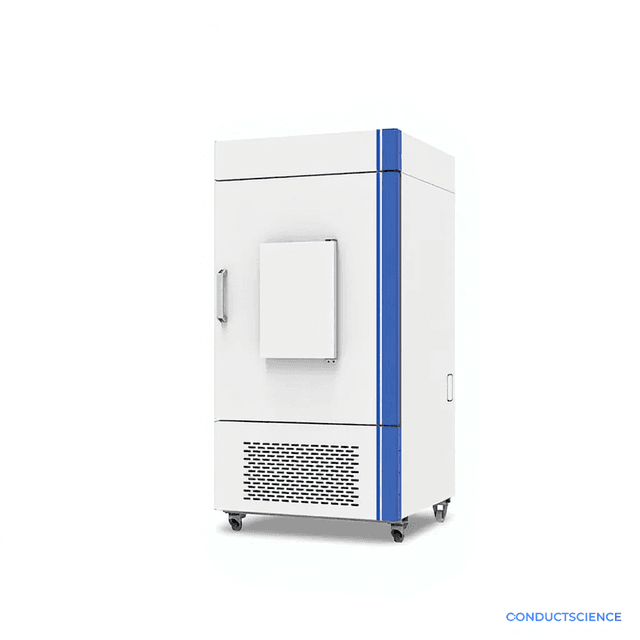
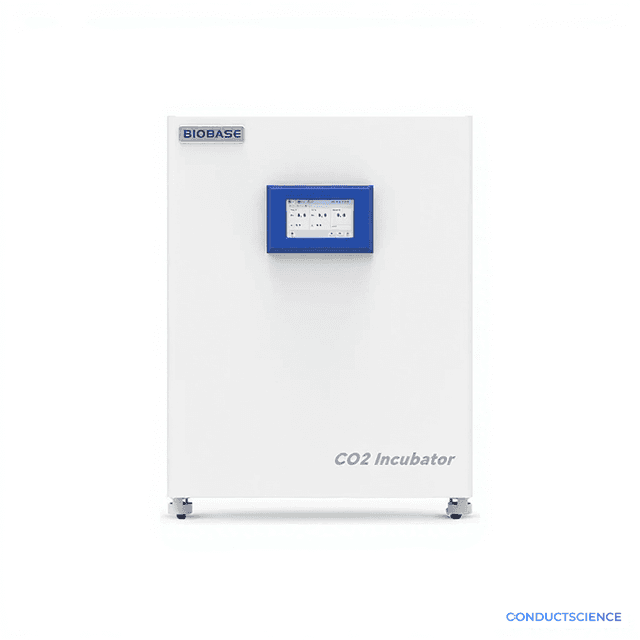
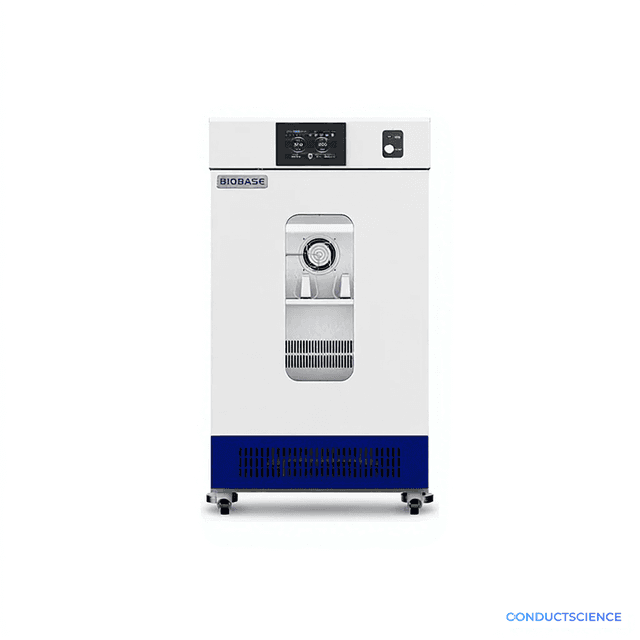
Climate Incubator
Large-capacity 1000L climate incubator with precise temperature (0-50°C), humidity (50-95% RH), and light control for biological cultivation and materials testing applications.

Louise Corscadden, PhD
Director of Science · ConductScience
Ask Louise about Climate Incubator fit, setup, configuration, or quote prep.
Already working with us? Sign in to connect this with My Scientist.
Key Specifications
Full details →- Model fit
- 5 selectable configurations
- SKU family
- Assigned during quote
- Shipping box
- 120.0 x 120.0 x 62.0 cm
- Ordering
- Online checkout and quote request available
- Category
- Laboratory Incubators
- Build notes
- Confirm accessories, station layout, and support needs before purchase
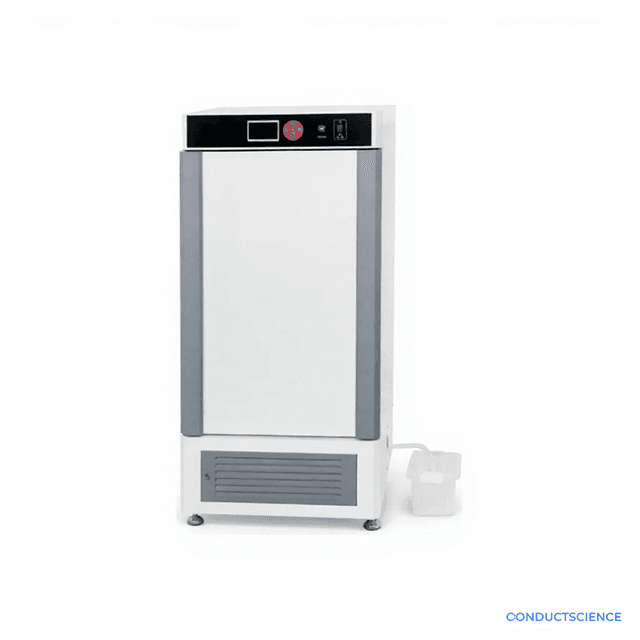
The Climate Incubator (ACI) is a large-capacity environmental chamber designed for controlled cultivation and storage applications requiring precise temperature, humidity, and light conditions. With a 1000L working volume, this incubator provides stable environmental parameters for biological samples, materials testing, and storage protocols across research and industrial applications.
The system incorporates PT100 temperature sensing with 0.1°C resolution and maintains temperature uniformity within 7°C across the chamber volume. Humidity control operates from 50-95% RH with ±1% RH accuracy, while integrated lighting provides up to 20,000 lux illumination. The timing function supports both programmed cycles up to 99 hours 59 minutes and continuous operation modes.
How It Works
The Climate Incubator operates through integrated environmental control systems that regulate temperature, humidity, and illumination within the chamber. The PT100 temperature sensor provides accurate thermal monitoring with 0.1°C resolution, while the control system maintains temperature stability through feedback regulation of heating and cooling elements.
Humidity control is achieved through vapor generation and removal systems that maintain relative humidity between 50-95% RH with ±1% RH accuracy. The integrated lighting system delivers up to 20,000 lux illumination, allowing researchers to control photoperiod and light intensity for photosensitive applications. The timing system enables both programmed cycling and continuous operation modes.
Air circulation systems ensure uniform distribution of temperature and humidity throughout the 1000L chamber volume, though temperature uniformity is specified at 7°C across the working space under standard operating conditions.
Features & Benefits
Shipping weight
- 243.0 lb
Shipping box
- L: 120.0 cm
- W: 120.0 cm
- H: 62.0 cm
| Feature | This Product | Typical Alternative | Advantage |
|---|---|---|---|
| Chamber Capacity | 1000L working volume | Entry-level models often offer 200-500L capacity | Accommodates larger experiments or multiple concurrent studies without requiring multiple units. |
| Temperature Range | 0-50°C (0-50°C no light, 10-50°C with light) | Basic models may offer 10-60°C or lack low-temperature capability | Provides near-freezing temperatures for cold storage and stability studies requiring refrigeration conditions. |
| Temperature Resolution | 0.1°C resolution with PT100 sensor | Standard models often use thermistors with 0.5-1°C resolution | Enables precise temperature control for applications requiring narrow thermal tolerances and accurate monitoring. |
| Humidity Control Range | 50-95% RH with ±1% RH accuracy | Basic units may lack humidity control or offer wider tolerance ranges | Supports experiments requiring specific moisture conditions with pharmaceutical-grade humidity accuracy. |
| Illumination System | 20,000 lux integrated lighting | Many models lack lighting or provide lower intensity illumination | Enables photosynthesis studies and circadian research requiring high-intensity light exposure. |
| Power Consumption | 2056W consumption | Varies by capacity and features | Power requirements should be evaluated against facility electrical capacity and operating costs. |
This climate incubator offers comprehensive environmental control with large capacity, precise temperature and humidity regulation, and integrated high-intensity lighting. The combination of 1000L volume, PT100 sensing, and broad parameter ranges supports diverse research applications requiring stable environmental conditions.
| Model | SKU | Listed price | Status | Shipping box |
|---|---|---|---|---|
| bjpx-aci1000 | BJPX-ACI1000 | $6,590.00 | Available | 120.0 x 120.0 x 62.0 cm |
| Thermo Scientific Heratherm (821L) | THM-HERATHERM | $28,990.00 | Available | 120.0 x 120.0 x 62.0 cm |
| Binder KBF-S 1020 (1020L) | BIN-KBF-S-1020 | $25,990.00 | Available | 120.0 x 120.0 x 62.0 cm |
| Memmert HPP1060eco (1060L) | MEM-HPP1060ECO | $32,990.00 | Available | 120.0 x 120.0 x 62.0 cm |
| BIOBASE BJPX-ACI (1000-1500L) | BIO-BJPX-ACI | $23,000.00 | Available | 120.0 x 120.0 x 62.0 cm |
Practical Tips
Verify temperature uniformity across chamber locations using calibrated thermometers before starting experiments.
Why: The 7°C uniformity specification means significant temperature variation exists across the working volume.
Clean humidity sensors and air circulation components regularly to prevent contamination affecting control accuracy.
Why: Humidity control systems are sensitive to dust and biological contamination that can impact sensor readings.
Allow 2-4 hours stabilization time when changing temperature or humidity setpoints before loading samples.
Why: Large chamber volume requires extended time to reach thermal and moisture equilibrium throughout the space.
Monitor both temperature and humidity fluctuations when door is opened frequently during experiments.
Why: Large chamber volume leads to greater environmental disturbance and longer recovery times after door openings.
Position temperature and humidity monitoring sensors at sample locations rather than relying solely on chamber displays.
Why: The 7°C uniformity specification indicates significant spatial variation in actual sample conditions.
Ensure adequate ventilation around the unit to handle 2056W heat dissipation and maintain specified working environment temperature.
Why: High power consumption generates substantial heat that must be removed to prevent performance degradation.
Consider the lighting impact on minimum temperature when planning low-temperature experiments requiring illumination.
Why: Light operation raises the minimum achievable temperature from 0°C to 10°C due to heat generation.
Schedule annual calibration of the PT100 temperature sensor to maintain measurement accuracy over time.
Why: Industrial temperature sensors drift with use and require periodic verification for critical applications.
Setup Guide
What’s in the Box
- Climate Incubator main unit (typical)
- Power cable (typical)
- User manual and documentation (typical)
- Sample shelving system (typical)
- Calibration certificate (typical)
Warranty
ConductScience provides a standard one-year manufacturer warranty covering defects in materials and workmanship, with technical support available for troubleshooting and maintenance guidance.
Compliance
What is the actual usable volume for samples given the 1000L chamber capacity?
Consult product datasheet for internal dimensions and shelf configurations to determine effective sample volume, as this depends on shelving arrangement and air circulation requirements.
How does temperature uniformity of 7°C affect experimental reproducibility?
The 7°C uniformity means temperature can vary by this amount across the chamber volume, which may require sample positioning considerations for temperature-sensitive applications requiring tighter thermal control.
Can the humidity control system handle condensation at low temperatures?
The humidity range is specified at 50-95% RH, but condensation risk at the lower temperature range (0-10°C) should be evaluated based on specific dew point calculations for your experimental conditions.
What calibration schedule is recommended for the PT100 sensor?
Industrial PT100 sensors typically require annual calibration verification, though frequency should be determined based on your application's accuracy requirements and regulatory guidelines.
How does the lighting system affect chamber temperature?
The specification notes different temperature ranges with and without light (0-50°C no light, 10-50°C with light), indicating lighting generates heat that raises the minimum achievable temperature to 10°C.
What data logging capabilities are available?
Consult product datasheet for data recording features, as environmental monitoring applications typically require continuous logging of temperature, humidity, and light conditions.
Can shelving be adjusted for different sample container sizes?
Typical climate incubators include adjustable shelving systems, but specific shelf dimensions and adjustment ranges should be verified from the product specifications.
Have a question about this product?
Have a question? Just ask.
Send it over and we'll email you a personalized answer — no call, no scheduling.
Prefer to talk it through?
Accessories
Enhance your setup with compatible accessories