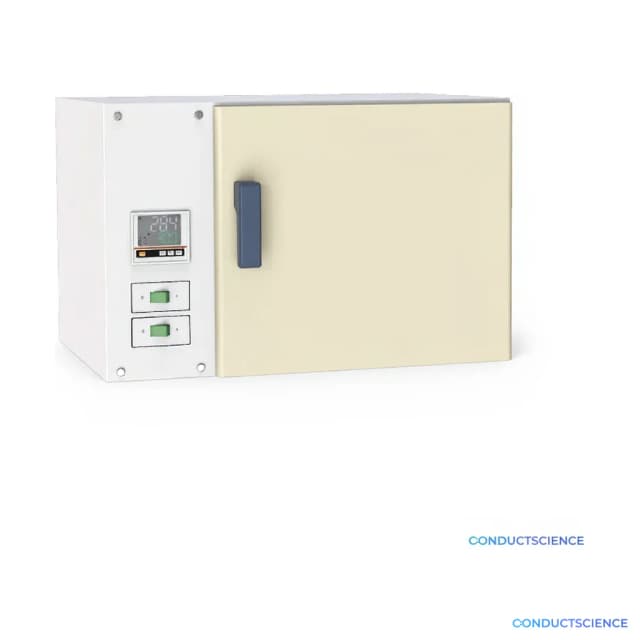
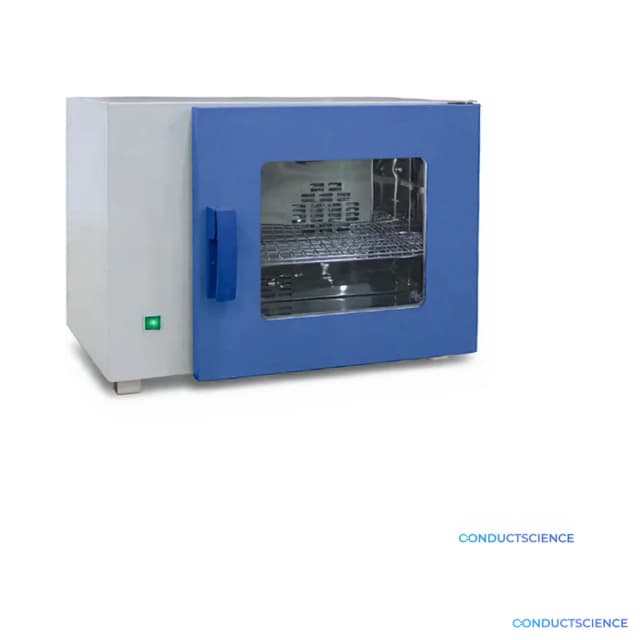
Drying Oven/Incubator (Dual Purpose)
Dual-purpose drying oven and incubator with 304 mirror stainless steel interior, available in 20–210 L capacities.
LCD intelligent controller with three-speed fan; incubator mode RT+5–80°C (±0.5°C), drying mode 80–300°C (±1°C). Automatic heating shutdown on door open; optional programmable control and data interface.

Louise Corscadden, PhD
Director of Science · ConductScience
Ask Louise about Drying Oven/Incubator (Dual Purpose) fit, setup, configuration, or quote prep.
Already working with us? Sign in to connect this with My Scientist.
Key Specifications
Full details →- Model fit
- 5 selectable configurations
- SKU family
- BIO-0950
- Shipping box
- 42.0 x 43.6 x 38.0 cm
- Ordering
- Online checkout and quote request available
- Category
- Drying Ovens
- Build notes
- Confirm accessories, station layout, and support needs before purchase
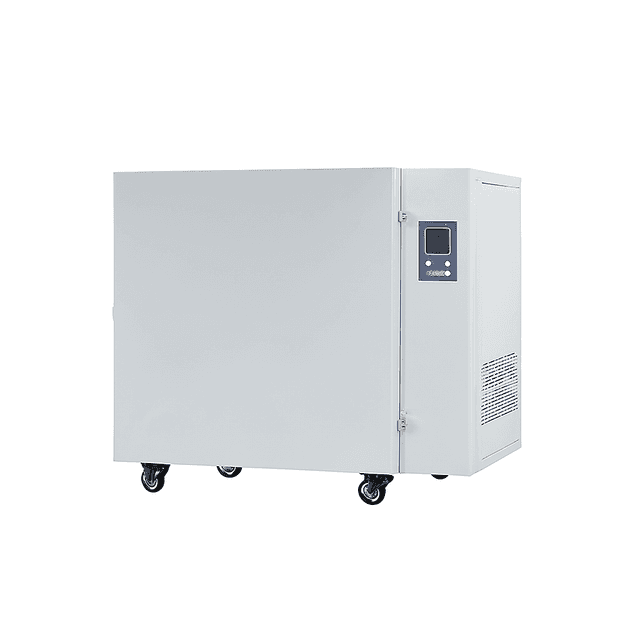
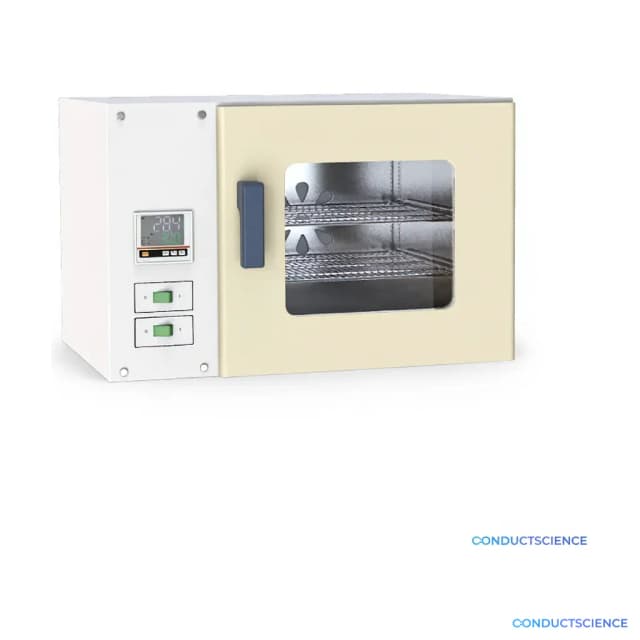
The ConductScience dual-purpose oven and incubator (BOV-D-P series) combines precision incubation and high-temperature drying in a single unit with a 304 mirror stainless steel interior. The LCD intelligent controller supports three-speed fan adjustment with optional automatic regulation; a door-open heating shutdown prevents thermal runaway. The 80–300°C drying range extends coverage to higher-temperature sterilization applications.
Technical Specifications
| Parameter | BOV-D20P | BOV-D45P | BOV-D72P | BOV-D125P | BOV-D210P |
|---|---|---|---|---|---|
| Capacity | 20 L | 45 L | 72 L | 125 L | 210 L |
| Temperature Range (Incubator) | RT+5–80°C | ||||
| Temperature Range (Drying) | 80–300°C | ||||
| Temperature Resolution | 0.1°C | ||||
| Temperature Fluctuation | ±0.5°C (incubator); ±1°C (drying) | ||||
| Timing Range | 0–9999 min | ||||
| Power Consumption | 600 W | 1000 W | 1500 W | 2000 W | 3000 W |
| Power Supply | 220V, 50/60 Hz (standard); 110V optional | ||||
| Internal Size (D×W×H mm) | 260×280×280 | 350×360×350 | 400×400×450 | 450×500×550 | 500×600×700 |
| External Size (D×W×H mm) | 450×420×590 | 550×495×700 | 590×535×800 | 650×635×1040 | 705×735×1190 |
| Net / Gross Weight (kg) | 24 / 27 | 38 / 46 | 47 / 55 | 71 / 81 | 85 / 97 |
Key Features
- 304 mirror stainless steel inner chamber
- Thickened double-layer toughened glass observation window
- Intelligent LCD temperature controller with timing and over-temperature alarm
- Three-speed fan control with automatic regulation option
- Automatic heating shutdown when door opens
- Optional programmable control, timer, and data interface
How It Works
The dual-purpose design operates through convective heat transfer with forced air circulation to maintain uniform temperature distribution throughout the chamber. In incubation mode, the system maintains temperatures from ambient +5°C to 60°C using precision heating elements with feedback control to support biological processes requiring stable, moderate temperatures. The temperature control system maintains fluctuations within ±0.5°C to preserve cell viability and experimental reproducibility.
In oven mode, the heating system extends the operating range from 80°C to 250°C for drying and sterilization applications. The higher temperature capability with ±1°C stability enables moisture removal, thermal processing, and dry heat sterilization protocols. The internal air circulation system ensures consistent temperature across all shelf positions, eliminating hot spots that could compromise sample integrity.
Programmable timing control allows automated operation cycles from 1 to 9999 minutes, enabling unattended processing while maintaining precise thermal conditions. The 0.1°C temperature resolution provides fine control over thermal parameters critical for temperature-sensitive protocols.
Features & Benefits
Shipping weight
- 29.98 lb
Shipping box
- L: 42.0 cm
- W: 43.6 cm
- H: 38.0 cm
| Feature | This Product | Typical Alternative | Advantage |
|---|---|---|---|
| Temperature Range Coverage | Dual ranges: RT+5-60°C (incubation) and 80-250°C (oven) | Single-purpose units typically cover either low-temperature incubation or high-temperature drying, requiring separate equipment | Eliminates the need for multiple units, reducing laboratory space requirements and equipment investment. |
| Temperature Resolution | 0.1°C resolution across full operating range | Entry-level models often provide 1°C resolution or limited precision | Enables precise control for temperature-sensitive protocols requiring fine thermal parameter adjustment. |
| Capacity Options | Five sizes from 35L to 240L | Limited size options requiring compromise between space and throughput | Allows selection of optimal capacity for specific laboratory workflows and space constraints. |
| Temperature Stability | ±0.5°C (incubation) and ±1°C (oven mode) | Basic units may have wider temperature fluctuations | Maintains consistent conditions critical for reproducible experimental results and sample integrity. |
| Timer Range | Programmable from 1 to 9999 minutes | Limited timing options or manual operation only | Supports both short-duration and extended processing protocols with automated cycle control. |
This dual-purpose system provides the functionality of separate incubation and drying equipment in a single unit, with precise temperature control and extensive timing capabilities. The wide range of available capacities accommodates diverse laboratory requirements from benchtop to high-volume applications.
| Model | SKU | Listed price | Status | Shipping box |
|---|---|---|---|---|
| BOV-D210P | BIO-0950 | $2,790.00 | Available | 42.0 x 43.6 x 38.0 cm |
| BOV-D125P | BIO-0950 | $1,990.00 | Available | 42.0 x 43.6 x 38.0 cm |
| BOV-D72P | BIO-0950 | $1,590.00 | Available | 42.0 x 43.6 x 38.0 cm |
| BOV-D45P | BIO-0950 | $1,290.00 | Available | 42.0 x 43.6 x 38.0 cm |
| BOV-D20P | BIO-0950 | $1,090.00 | Available | 42.0 x 43.6 x 38.0 cm |
Practical Tips
Calibrate temperature at multiple points within the chamber using certified reference thermometers positioned at different shelf levels.
Why: Ensures temperature accuracy across the entire working volume and identifies any temperature gradients.
Clean the interior chamber and shelves regularly with appropriate solvents, avoiding abrasive materials that could damage surfaces.
Why: Prevents contamination buildup and maintains optimal heat transfer for consistent temperature performance.
Allow adequate spacing between samples and avoid overloading shelves to maintain proper air circulation.
Why: Ensures uniform temperature distribution and prevents hot spots that could compromise sample integrity.
Pre-heat the chamber to operating temperature before loading temperature-sensitive samples.
Why: Minimizes thermal shock and reduces time for samples to reach target temperature.
If temperature overshoot occurs, check that the ambient temperature is within the specified +5 to 35°C range.
Why: High ambient temperatures can affect the controller's ability to maintain precise temperature regulation.
Use appropriate personal protective equipment when accessing the chamber at high temperatures, particularly in oven mode.
Why: Prevents thermal burns from hot surfaces and protects against exposure to heated air when opening the chamber door.
Document temperature and timing parameters for each protocol to ensure experimental reproducibility.
Why: Enables method validation and troubleshooting if experimental results vary between runs.
Setup Guide
What’s in the Box
- Main unit with digital temperature controller
- Two adjustable shelves (typical)
- Power cord (typical)
- Operating manual (typical)
- Temperature calibration certificate (typical)
Warranty
ConductScience provides a standard one-year manufacturer warranty covering parts and labor, with technical support available for installation guidance and troubleshooting assistance.
Compliance
What is the temperature uniformity across the chamber?
Temperature fluctuation is maintained within ±0.5°C in incubation mode and ±1°C in oven mode. Consult product datasheet for specific uniformity mapping data across shelf positions.
Can I switch between incubation and oven modes during operation?
Mode switching requires cooling to safe temperatures before transitioning between incubation (RT+5-60°C) and oven (80-250°C) ranges to prevent thermal shock to samples and equipment.
What type of temperature calibration is recommended?
Use certified reference thermometers traceable to national standards, positioned at multiple points within the chamber to verify temperature accuracy across the operating range.
How does the timing function work with temperature ramping?
The 1-9999 minute timer begins counting once the set temperature is reached, ensuring accurate process timing independent of heat-up duration.
What ventilation requirements are needed for installation?
Ensure adequate clearance around the unit for heat dissipation, particularly important for higher capacity models with power consumption up to 2000W.
Can I use this for sterilization applications?
The oven mode reaches 250°C, suitable for dry heat sterilization protocols, though specific time-temperature validation should be performed for critical applications.
Have a question about this product?
Have a question? Just ask.
Send it over and we'll email you a personalized answer — no call, no scheduling.
Prefer to talk it through?
Accessories
Enhance your setup with compatible accessories