Electronic&Digital Magnetic Stirring Heating Mantles
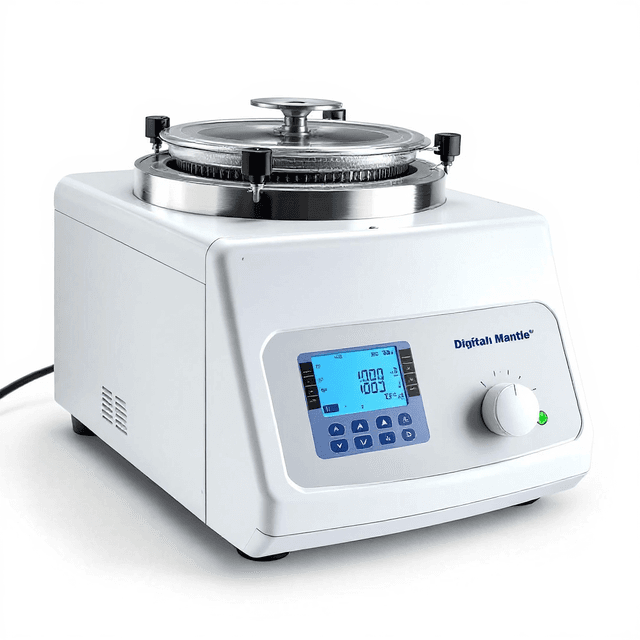
Digital heating mantles with magnetic stirring capability for precise temperature control and mixing of solutions in round-bottom flasks from 100ml to 2000ml capacity.

Louise Corscadden, PhD
Director of Science · ConductScience
Ask Louise about Electronic&Digital Magnetic Stirring Heating Mantles fit, setup, configuration, or quote prep.
Already working with us? Sign in to connect this with My Scientist.
Key Specifications
Full details →- Model fit
- Configured during quote
- SKU family
- BIO-0685
- Shipping box
- 16.5 x 22.0 x 19.5 cm
- Ordering
- Online checkout and quote request available
- Category
- Benchtop Instruments
- Build notes
- Confirm accessories, station layout, and support needs before purchase
The Electronic & Digital Magnetic Stirring Heating Mantles provide precise temperature control and magnetic stirring for laboratory applications requiring heated mixing of solutions and reactions. These units combine resistive heating elements with magnetic stirring mechanisms to maintain homogeneous temperature distribution and consistent mixing in round-bottom flasks from 100ml to 2000ml capacity.
The digital control interface allows researchers to set precise temperature parameters up to 380°C with variable stirring speeds from 0-1200 rpm for continuous operation. Multiple capacity models accommodate different experimental scales while maintaining consistent heating profiles and stirring performance across the vessel volume.
How It Works
The heating mantle utilizes resistive heating elements embedded in a thermally conductive fabric housing that conforms to the spherical shape of round-bottom flasks. Digital temperature controllers monitor internal temperature through integrated sensors and modulate power delivery to maintain precise setpoints up to 380°C.
Magnetic stirring operates through a rotating magnetic field generated beneath the heating chamber, coupling with magnetic stir bars placed inside the flask. Variable speed control from 0-1200 rpm allows optimization of mixing intensity based on solution viscosity and reaction requirements.
The combination of controlled heating and stirring ensures uniform temperature distribution throughout the sample volume while preventing thermal gradients that could affect reaction kinetics or sample integrity.
Features & Benefits
Automation Level
- semi-automated
Capacity(ml)
- 100
250
- 500
1000
- 2000
Working Time
- Continuous
Max Use Temp.
- 380°C
Consumption
- 100W
180W
- 250W
300W
- 500W
Internal Size(mm)
- φ70*50
φ90*60
- φ105*65
φ135*80
- φ175*95
External Size(W*D*H)
- 220*195*165mm
Brand
- ConductScience
Research Domain
- Analytical Chemistry
- Environmental Monitoring
- Food Science
- Materials Science
- Microbiology
- Pharmaceutical QC
Speed/RPM
- 0~1200rpm
Power/Voltage
- AC220/110V±10%, 50/60Hz
Shipping weight
- 3.0 lb
Shipping box
- L: 16.5 cm
- W: 22.0 cm
- H: 19.5 cm
| Feature | This Product | Typical Alternative | Advantage |
|---|---|---|---|
| Temperature Range | Up to 380°C maximum operating temperature | Entry-level heating mantles often limited to 200-300°C maximum | Enables high-temperature synthesis reactions and sample preparation procedures requiring elevated thermal conditions |
| Stirring Integration | Built-in magnetic stirring with 0-1200 rpm variable speed control | Many heating mantles require separate magnetic stirrer units | Reduces bench space requirements and simplifies experimental setup with unified controls |
| Capacity Range | Five capacity options from 100ml to 2000ml | Limited model selection often requires purchasing multiple units | Supports diverse experimental scales from analytical to preparative procedures with consistent performance |
| Power Options | Variable power ratings from 100W to 500W matched to capacity | Fixed power units may provide inadequate heating for larger volumes | Optimizes heating efficiency and reduces energy consumption based on actual sample requirements |
| Operating Mode | Continuous operation capability without duty cycle limitations | Some units require cooling periods during extended use | Supports long-duration experiments and reaction monitoring without operational interruptions |
These heating mantles combine high-temperature capability with integrated magnetic stirring across multiple capacity options. The continuous operation design and variable power ratings provide flexibility for diverse laboratory heating and mixing applications.
Practical Tips
Verify temperature accuracy using a calibrated thermometer in water or oil bath before critical applications.
Why: Ensures temperature readings correspond to actual sample conditions for reproducible results.
Clean heating well surfaces regularly and inspect for chemical residue or damage to heating elements.
Why: Prevents contamination and maintains efficient heat transfer to samples.
Allow adequate preheating time and use appropriately sized stir bars for optimal mixing performance.
Why: Ensures uniform temperature distribution and effective mixing throughout the sample volume.
Never operate empty heating wells and ensure adequate ventilation around the unit during high-temperature procedures.
Why: Prevents damage to heating elements and reduces risk of thermal hazards in the laboratory environment.
If stirring becomes erratic, check magnetic coupling and verify stir bar is properly sized for the flask geometry.
Why: Poor magnetic coupling reduces mixing effectiveness and can cause inconsistent temperature distribution.
Monitor solution levels during extended heating to prevent dry conditions that could affect sample integrity.
Why: Maintains consistent thermal conditions and prevents sample degradation or equipment damage.
Setup Guide
What’s in the Box
- Electronic magnetic stirring heating mantle (typical)
- Power cord (typical)
- User manual and safety instructions (typical)
- Temperature probe or sensor (typical)
Warranty
ConductScience provides a standard one-year manufacturer warranty covering defects in materials and workmanship with technical support for operational guidance.
Compliance
What is the temperature accuracy and stability of the heating control system?
The digital control system maintains temperature setpoints up to 380°C. Consult the product datasheet for specific accuracy and stability specifications for your application requirements.
Can the stirring speed be precisely controlled for low-viscosity solutions?
Yes, the variable speed control operates from 0-1200 rpm allowing fine adjustment for different solution viscosities and mixing requirements.
What flask neck sizes and shapes are compatible with these heating mantles?
The units are designed for standard round-bottom flasks. Consult the internal dimensions specifications to verify compatibility with your specific flask geometry and neck configurations.
How do I prevent overheating during extended continuous operation?
The units support continuous operation, but ensure adequate ventilation and monitor solution levels to prevent dry heating conditions that could damage samples or equipment.
Can multiple units be operated simultaneously on the same power circuit?
Consider the total power draw (100W to 500W per unit) when planning electrical requirements. Verify your circuit capacity can handle multiple units safely.
What maintenance is required for the heating elements and stirring mechanism?
Regular cleaning of the heating well and inspection of the stirring mechanism for proper magnetic coupling. Avoid chemical spills that could damage heating elements.
How does heating performance compare with traditional heating methods?
Heating mantles provide more uniform heat distribution than hot plates and better temperature control than open flames, with integrated stirring eliminating the need for separate equipment.
Have a question about this product?
Have a question? Just ask.
Send it over and we'll email you a personalized answer — no call, no scheduling.
Prefer to talk it through?