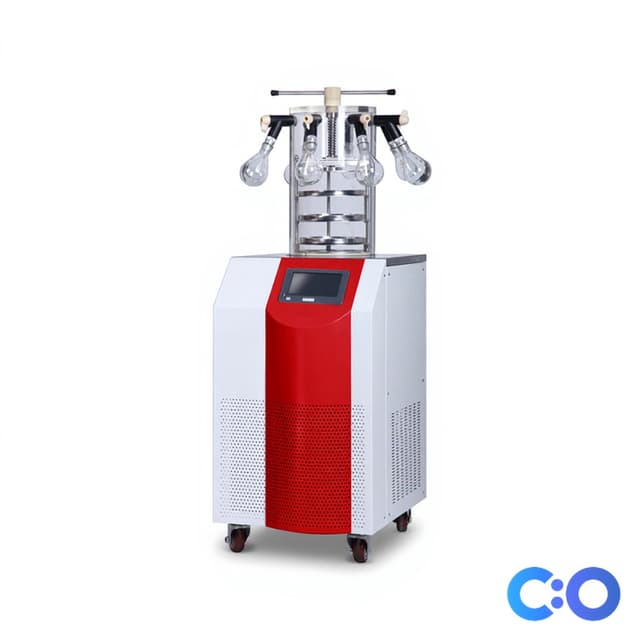
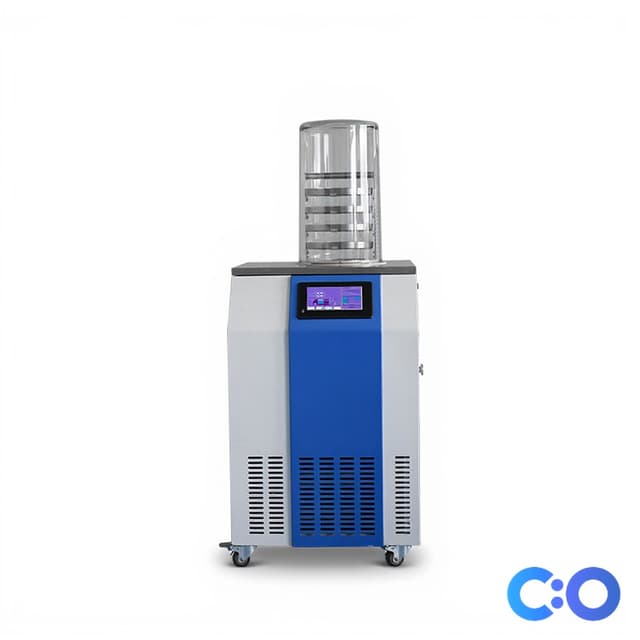
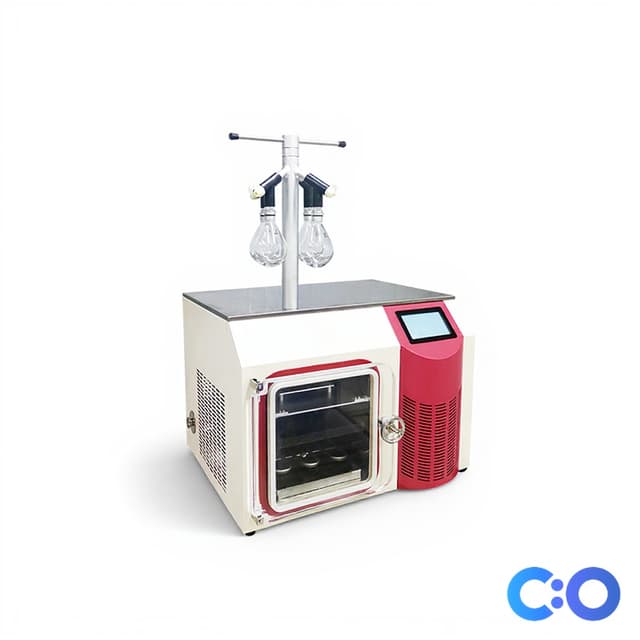
Laboratory Vertical Freeze Dryer (10L–18L)
Vertical benchtop freeze dryer available in 10 L, 12 L, and 18 L configurations.
All models include a ≤−60 °C cold trap and a 2 L/s rotary-vane vacuum pump. Standard chamber with flask manifold is the listed configuration; stopping chambers, 8-port manifolds, and lower-temperature cold traps (≤−80 °C on 10 L/12 L; ≤−110 °C on 18 L) are available on request.

Louise Corscadden, PhD
Director of Science · ConductScience
Ask Louise about Laboratory Vertical Freeze Dryer (10L–18L) fit, setup, configuration, or quote prep.
Already working with us? Sign in to connect this with My Scientist.
Key Specifications
Full details →- Model fit
- 3 selectable configurations
- SKU family
- Assigned during quote
- Shipping box
- 46.5 x 44.0 x 35.5 cm
- Ordering
- Online checkout and quote request available
- Category
- Freeze Dryers
- Build notes
- Confirm accessories, station layout, and support needs before purchase
The BK-FD Series covers the most common benchtop lyophilization needs in a research lab — from small exploratory runs to routine medium-throughput processing. All three models share the same vertical manifold design and ≤−60 °C cold trap. The right model depends on your sample volume, throughput, and how low you need to go on the cold trap.
Choosing Your Capacity
| BK-FD10 (10 L) | BK-FD12 (12 L) | BK-FD18 (18 L) | |
|---|---|---|---|
| Drying area (Standard chamber) | 0.12 m² | 0.12 m² | 0.18 m² |
| Shelf load — per shelf / total (Standard chamber) | 1.2 L / 2.4 L | 1.2 L / 2.4 L | 1.8 L / 3.6 L |
| Vial capacity (Φ22 / Φ16 / Φ12 mm) | 147 / 297 / 492 | 147 / 297 / 492 | 183 / 345 / 615 |
| Lower-temperature cold-trap option | ≤−80 °C | ≤−80 °C | ≤−110 °C |
| Power draw | 1300 W | 1300 W | 1600 W |
| Best for | Method development, pilot runs, small-scale protein/enzyme lyophilization | Routine R&D batches, pharmaceutical formulation screening, bacterial/cell culture preservation | High-throughput labs, multi-project shared equipment, production-scale research batches |
Shared Specifications
- Cold trap temperature: ≤−60 °C standard across all capacities. Lower-temperature option varies by capacity (see table) — recommended for sugar-rich, organic-solvent, or low-eutectic samples.
- Vacuum pump: 2 L/s rotary-vane pump included with every unit (no separate purchase required).
- Electrical: 110 V, 60 Hz single-phase available for US delivery (220 V 50/60 Hz is the factory default).
- Vacuum degree: ≤ 5 Pa.
- Refrigerant: R600a + R23 (−60 °C builds); R404a + R23 (−80 °C builds).
- Cooling: Air cooling.
- Tray spacing: 50 mm between shelves.
- Operating mode: Manifold-style, designed for pre-frozen samples (pre-freeze in −80 °C ULT freezer or LN₂ before connecting flasks).
Configuration Options
The published price is for the Standard chamber (flat shelf, flask manifold) with the ≤−60 °C cold trap. Four chamber builds are available on every capacity:
- Standard — flat shelf, flask manifold (the listed configuration).
- Standard + 8-port manifold — adds an external manifold with conical-mouth flasks (100 mL, 200 mL, 250 mL, 500 mL, 2 pcs each) for parallel small-volume drying.
- Stopping chamber — enables in-chamber vial stoppering under vacuum (for pharmaceutical vial finishing).
- Stopping + 8-port manifold — combined stoppering chamber and external manifold.
The lower-temperature cold-trap option listed in the table above is available on every chamber build. For stopping-chamber, manifold, or lower-temperature configurations, use the Request a Quote button and specify your workflow — we’ll return a custom quote with final pricing and lead time.
Common Applications
- Proteins & enzymes — preserve activity and shelf life without denaturing.
- Bacterial & viral stocks — long-term viability without cryogenic storage.
- Pharmaceutical formulations — excipient screening and stability studies.
- Natural product extracts — remove water while retaining bioactive compounds.
- Tissue & biopsy samples — structural preservation for downstream histology or proteomics.
Not sure which capacity or configuration fits your workflow? Use the Request a Quote button — our team can help size the unit to your weekly sample load and confirm the right chamber type.
How It Works
Freeze drying operates through sublimation, where frozen water transitions directly from solid ice to water vapor without passing through the liquid phase. The process begins with sample freezing, followed by primary drying under vacuum conditions where ice sublimates, and secondary drying to remove residual moisture bound to the sample matrix.
The BK-FD10 system maintains samples on temperature-controlled shelves while the cold trap condenser captures sublimated water vapor at ≤-60°C. The vacuum pump reduces chamber pressure to ≤5Pa, creating the low-pressure environment necessary for sublimation to occur at temperatures well below the material's normal melting point. This controlled environment preserves the original structure of heat-sensitive materials by avoiding the damaging effects of liquid water formation during conventional drying.
Features & Benefits
Shipping weight
- 29.98 lb
Shipping box
- L: 46.5 cm
- W: 44.0 cm
- H: 35.5 cm
| Feature | This Product | Typical Alternative | Advantage |
|---|---|---|---|
| Freeze-Drying Area | 0.12m² with 4 trays | Entry-level models often provide smaller areas with fewer trays | Enables simultaneous processing of multiple sample types or replicates for improved experimental efficiency. |
| Cold Trap Temperature | ≤-60°C standard, -80°C optional | Basic systems typically offer single fixed temperature settings | Dual temperature capability accommodates diverse sample requirements from standard biologics to volatile compounds. |
| Water Capture Capacity | 3-4L/24h with 6L trap volume | Smaller systems often have limited daily processing capacity | Higher throughput reduces batch processing time and increases laboratory productivity for medium-volume applications. |
| Vacuum Performance | ≤5Pa operating pressure | Basic models may achieve higher pressure levels | Lower operating pressure ensures complete sublimation and prevents sample degradation during extended drying cycles. |
| Configuration Options | Standard chamber or 8-port manifold | Most systems offer single configuration only | Dual configuration capability accommodates both bulk tray processing and individual flask applications in a single instrument. |
| Loading Capacity | 1.2L per shelf across 4 levels | Smaller systems typically handle lower volumes per shelf | Higher per-shelf capacity allows processing of larger individual samples or multiple replicates without compromising drying uniformity. |
The BK-FD10 Series provides laboratory-scale freeze-drying capability with 0.12m² processing area, dual cold trap temperature options, and flexible configuration design. The system's 3-4L/24h water capture capacity and ≤5Pa vacuum performance deliver reliable lyophilization for diverse research applications requiring sample preservation and structural integrity.
| Model | SKU | Listed price | Status | Shipping box |
|---|---|---|---|---|
| 18L (BK-FD18) | BIO-0114 | $7,650.00 | Available | 46.5 x 44.0 x 35.5 cm |
| 12L (BK-FD12) | BIO-0115 | $5,525.00 | Available | 46.5 x 44.0 x 35.5 cm |
| 10L (BK-FD10) | BIO-0116 | $4,250.00 | Available | 46.5 x 44.0 x 35.5 cm |
Practical Tips
Verify cold trap temperature accuracy using calibrated thermocouples before processing temperature-sensitive samples.
Why: Accurate temperature control ensures optimal sublimation rates and prevents sample degradation during extended drying cycles.
Clean the cold trap thoroughly after each 3-4L water capture cycle and inspect for ice buildup or contamination.
Why: Regular cleaning prevents cross-contamination between batches and maintains optimal water vapor capture efficiency.
Pre-freeze samples completely before starting vacuum to prevent foaming and ensure uniform ice crystal formation.
Why: Complete freezing prevents sample loss during initial vacuum application and creates consistent pore structure for uniform drying.
Distribute samples evenly across all 4 trays to maximize the 1.2L per shelf capacity and maintain balanced loading.
Why: Even distribution prevents chamber pressure variations and ensures consistent sublimation rates across all sample positions.
Monitor vacuum gauge readings throughout the cycle; pressure increases may indicate cold trap saturation or leak issues.
Why: Stable vacuum levels are critical for maintaining sublimation conditions and preventing incomplete drying or sample collapse.
Record initial sample volume, final dry weight, and cycle time for each batch to establish drying efficiency baselines.
Why: Consistent documentation enables process optimization and validates complete moisture removal for quality control purposes.
Allow adequate ventilation around the unit and wear appropriate PPE when handling samples at extreme low temperatures.
Why: Proper safety measures prevent exposure to cryogenic temperatures and ensure safe operation in laboratory environments.
Check vacuum pump oil levels regularly and replace according to manufacturer specifications to maintain ≤5Pa performance.
Why: Proper pump maintenance ensures consistent vacuum levels necessary for efficient sublimation and prevents costly system downtime.
Setup Guide
What’s in the Box
- Freeze dryer main unit (selected capacity)
- Sample trays (3-4 pcs depending on chamber configuration; Φ180×20mm or Φ200×20mm)
- Cold trap assembly
- 2 L/s rotary-vane vacuum pump
- Drying rack, cover, and acrylic bucket
- Power cable and electrical connections
- User manual and operation guide
- 1-year manufacturer warranty documentation
Warranty
ConductScience provides a standard 1-year manufacturer warranty covering parts and labor with comprehensive technical support for installation, operation, and maintenance guidance.
Compliance
What is the maximum sample volume that can be processed per batch?
The system can process up to 4.8L total liquid volume (1.2L per tray × 4 trays) distributed across the 0.12m² freeze-drying area.
How long does a typical freeze-drying cycle require?
Standard freeze-drying cycles require 24-36 hours depending on sample type, volume, and desired final moisture content.
What maintenance is required for the cold trap system?
Regular defrosting of the 6L cold trap after processing 3-4L of captured water, typically after each major batch cycle, along with cleaning and inspection of the φ219×140mm trap chamber.
Can the system accommodate different container types?
The system offers both standard chamber operation with 4 trays and optional 8-port manifold configuration for direct flask attachment, providing flexibility for various sample containers.
What vacuum level is maintained during operation?
The system maintains vacuum levels of ≤5Pa, which is optimal for efficient sublimation while preventing sample collapse or structural damage.
Is the -80°C cold trap option necessary for most applications?
The standard -60°C trap temperature is adequate for most biological and pharmaceutical samples; the -80°C option is beneficial for volatile solvents or extremely low-temperature applications.
How is temperature uniformity maintained across all tray levels?
The 50mm inter-tray spacing ensures adequate air circulation and uniform temperature distribution, while the controlled chamber environment maintains consistent conditions across all four tray positions.
Does this freeze dryer come with a vacuum pump, or is it sold separately?
Yes — every BK-FD vertical freeze dryer ships with a 2 L/s rotary-vane vacuum pump included. No separate purchase or sourcing is required. The pump is sized to maintain ≤ 5 Pa vacuum throughout the lyophilization cycle for the 10 L, 12 L, and 18 L models.
What are the electrical requirements for installation?
The unit runs on 110 V, 60 Hz single-phase power (standard US laboratory outlet). Plan for a dedicated 15 A circuit for stable operation. Other voltage configurations may be available on request.
Is a -80 °C cold trap version available, and which temperature should I choose?
Yes — in addition to the standard ≤ −60 °C cold trap, a ≤ −80 °C variant is available on request. Choose the −60 °C model for routine lyophilization of dilute aqueous samples, proteins, and bacterial/viral stocks. Choose the −80 °C model when your samples have low eutectic points: sugar-rich solutions (>2 % sucrose, glucose, or other carbohydrates), organic-solvent mixtures, or formulations with high solute content. Colder trap surface ensures vapor capture stays ahead of the sublimation front and prevents collapse or incomplete drying.
I have water-based samples with 2-10 % sugar content (e.g., culture media, formulations with carbohydrate excipients). Which configuration is best?
For aqueous solutions with 2-10 % sugar or molasses-style content, the ≤ −80 °C cold trap is recommended. At those solute concentrations the eutectic temperature drops well below −40 °C, and a colder trap keeps the vapor pressure differential favorable for sublimation. A −60 °C trap can work but typically requires longer cycles and risks partial cake collapse with high-solute formulations.
Do I need to pre-freeze samples, or does the unit freeze them in-chamber?
The vertical BK-FD series is a manifold-style dryer designed for pre-frozen samples. Pre-freeze your flasks or vials in a −80 °C ULT freezer or with liquid nitrogen before connecting them to the manifold ports. If your workflow needs in-chamber freezing with programmable shelf temperature ramps (no separate freezer step), see our pilot freeze dryer with shelf-temperature control — it freezes and dries in the same chamber and is better suited to pharmaceutical formulation work.
What is the typical drying time per batch?
Cycle time depends on sample volume, fill depth, solute content, and the cold trap variant chosen. For typical aqueous samples at the rated water-capture rate (3-4 L/24 h on the 10 L model, 5-6 L/24 h on the 12 L, 7-9 L/24 h on the 18 L), a full cycle runs roughly 24-48 hours. Sugar- or organic-rich samples with the −80 °C trap may extend toward 48-72 hours.
Have a question about this product?
Have a question? Just ask.
Send it over and we'll email you a personalized answer — no call, no scheduling.
Prefer to talk it through?