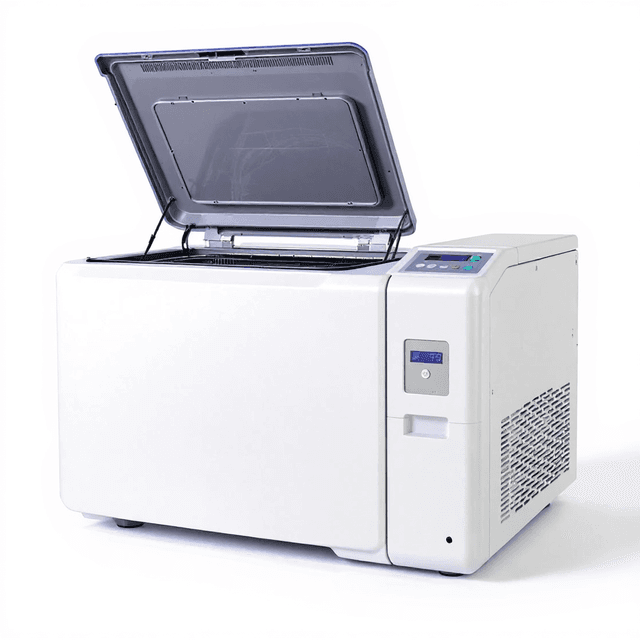
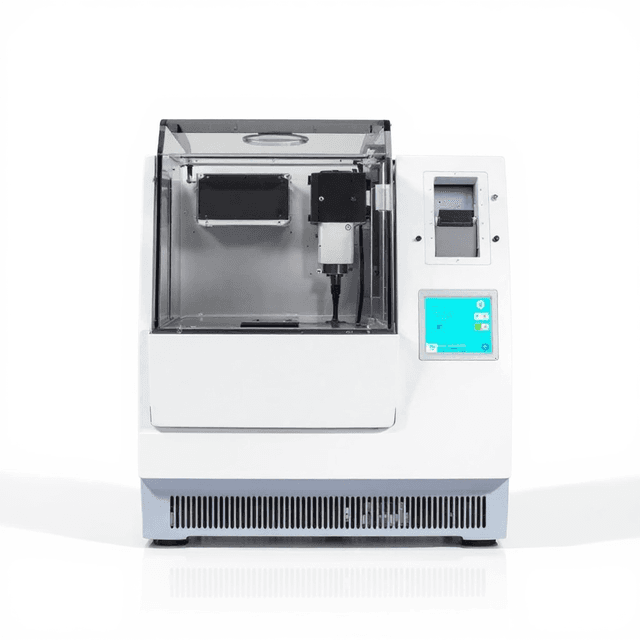
Hand-held Laser Dust Particle Counter-CLJ-H630
Portable laser-based particle counter for real-time air quality monitoring and cleanroom classification with ISO 5-8 certification.
| Automation Level | semi-automated |
| ISO Certification | ISO 5-8 @ 0.5 and 5.0μm |
| Brand | ConductScience |

The Hand-held Laser Dust Particle Counter CLJ-H630 provides portable, real-time particle counting and sizing for environmental monitoring and cleanroom applications. This handheld instrument uses laser scattering technology to detect and enumerate particles across multiple size channels, offering researchers a field-deployable solution for air quality assessment and contamination monitoring.
With ISO 5-8 certification at 0.5 and 5.0 μm detection thresholds, the CLJ-H630 supports particle monitoring workflows in controlled environments where air cleanliness classification is critical. The portable design enables point-of-use measurements in laboratory settings, manufacturing facilities, and research environments where particle contamination control is essential.
How It Works
The CLJ-H630 employs laser light scattering technology to detect and size individual particles in an air sample. When particles pass through a focused laser beam, they scatter light at angles and intensities proportional to their size. A photodetector array captures the scattered light signals, which are processed by onboard electronics to determine particle size and generate count data across multiple size channels.
The instrument draws air samples through an internal sampling system at a controlled flow rate. As particles traverse the optical sensing volume, each scattering event is analyzed to classify the particle into predetermined size bins. The real-time counting algorithm accumulates particle data and calculates concentrations, typically reported as particles per cubic foot or cubic meter of air sampled.
Built-in calibration routines ensure measurement accuracy by referencing known particle standards. The ISO certification indicates the instrument's performance has been validated against internationally recognized particle counting standards at the specified detection thresholds.
Features & Benefits
Automation Level
- semi-automated
ISO Certification
- ISO 5-8 @ 0.5 and 5.0μm
Brand
- ConductScience
Research Domain
- Analytical Chemistry
- Environmental Monitoring
- Industrial Hygiene
- Materials Science
- Microbiology
- Pharmaceutical QC
Weight
- 29.98 kg
Dimensions
- L: 42.0 mm
- W: 43.6 mm
- H: 38.0 mm
Comparison Guide
| Feature | This Product | Typical Alternative | Advantage |
|---|---|---|---|
| Handheld Design | Portable laser particle counter with handheld form factor | Fixed-mount systems require permanent installation | Enables measurement flexibility across multiple locations within a facility |
| ISO Certification Level | ISO 5-8 certification at 0.5 and 5.0 μm detection thresholds | Entry-level models may lack formal certification | Provides validated performance for regulatory compliance documentation |
| Detection Technology | Laser scattering-based particle detection system | LED-based systems offer lower cost but reduced sensitivity | Delivers higher accuracy for small particle detection in critical applications |
| Power Source | Battery-powered portable operation | AC-powered units require electrical connections | Supports measurements in locations without convenient power access |
The CLJ-H630 combines ISO-certified accuracy with handheld portability, making it suitable for cleanroom verification and environmental monitoring applications. The laser-based detection system provides reliable particle counting across the size range required for air cleanliness classification.
Practical Tips
Perform zero count verification before each measurement session using filtered air or the instrument's internal filter.
Why: Ensures accurate baseline measurements and identifies potential contamination in the optical system.
Clean the sampling inlet regularly and inspect for particle buildup that could affect flow characteristics.
Why: Maintains proper sampling flow rate and prevents measurement artifacts from inlet contamination.
Allow the instrument to equilibrate to room temperature for 15-30 minutes before critical measurements.
Why: Temperature variations can affect laser stability and optical performance.
Record environmental conditions (temperature, humidity, air pressure) during measurements for data interpretation.
Why: Environmental factors influence particle behavior and may be required for regulatory documentation.
If counts appear unusually high, check for obstructions in the sampling path and verify proper flow rate.
Why: Sampling system issues can cause erroneous readings or particle reentrainment artifacts.
Avoid pointing the laser directly at eyes and follow standard laser safety protocols during operation.
Why: Protects operators from potential eye damage from the internal laser source.
Position the sampling inlet to avoid direct airflow disruption and maintain consistent orientation during measurements.
Why: Minimizes sampling artifacts and ensures representative measurements of the target environment.
Store the instrument in a clean, dry environment and protect sampling ports when not in use.
Why: Prevents contamination buildup in the optical system that could affect measurement accuracy.
Setup Guide
What’s in the Box
- Hand-held laser particle counter main unit
- Power adapter/charging cable (typical)
- Sampling probe or inlet extension (typical)
- USB data cable (typical)
- User manual and calibration certificate (typical)
- Carrying case (typical)
Warranty
ConductScience provides a one-year manufacturer warranty covering defects in materials and workmanship, with technical support for instrument operation and data interpretation.
Compliance
References
Background reading relevant to this product:
What particle size range can this instrument detect and how many size channels are available?
The CLJ-H630 is certified for ISO 5-8 classification at 0.5 and 5.0 μm detection thresholds. Consult the product datasheet for complete size channel configuration and measurement range specifications.
How does the ISO certification relate to cleanroom classification requirements?
The ISO 5-8 certification validates the instrument's ability to accurately count particles at the size thresholds required for cleanroom classification per ISO 14644-1 standards, covering Class 5 through Class 8 environments.
What is the sampling flow rate and how long can the instrument operate on battery power?
Consult the product datasheet for specific flow rate specifications and battery life under typical operating conditions, as these parameters affect measurement duration and sample volume.
Can the instrument log data for later analysis or does it only provide real-time display?
The instrument includes digital display capabilities. Consult the product documentation for data logging functionality, storage capacity, and data export options.
How should the instrument be calibrated and how often is recalibration required?
The unit ships with calibration certification. Follow manufacturer guidelines for recalibration intervals, typically annually or as required by your quality system protocols.
What environmental conditions affect measurement accuracy?
Temperature, humidity, and air pressure variations can influence particle scattering properties. Consult the operating manual for environmental specifications and correction procedures.
How does this compare to fixed-mount cleanroom particle counters?
This handheld unit provides portability for spot measurements and system verification, while fixed units offer continuous monitoring. The ISO certification ensures comparable accuracy for classification measurements.
Have a question about this product?
Accessories
Enhance your setup with compatible accessories
Frequently Bought Together