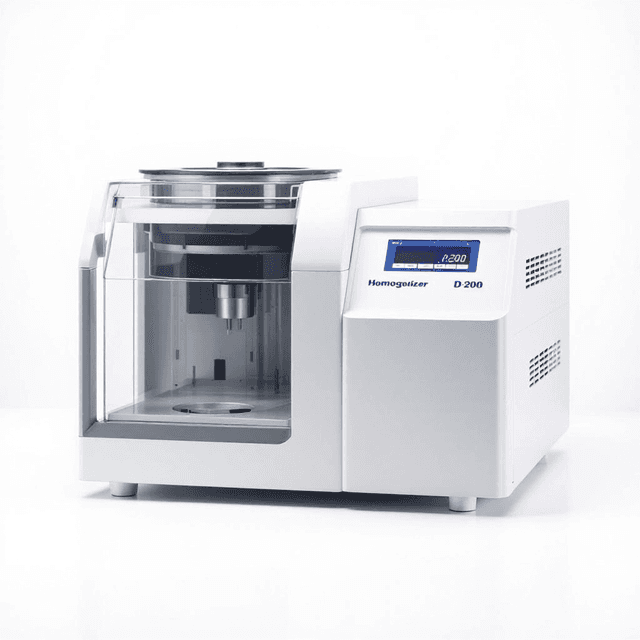
Homogenizer D-160
Compact benchtop mechanical homogenizer for consistent tissue disruption and sample preparation in research applications, featuring portable design with reliable mechanical performance.

Louise Corscadden, PhD
Director of Science · ConductScience
Ask Louise about Homogenizer D-160 fit, setup, configuration, or quote prep.
Already working with us? Sign in to connect this with My Scientist.
Key Specifications
Full details →- Model fit
- 2 selectable configurations
- SKU family
- BIO-0587
- Shipping box
- 19.0 x 4.5 x 5.5 cm
- Ordering
- Online checkout and quote request available
- Category
- Benchtop Instruments
- Build notes
- Confirm accessories, station layout, and support needs before purchase
Homogenizer D-160
Overview
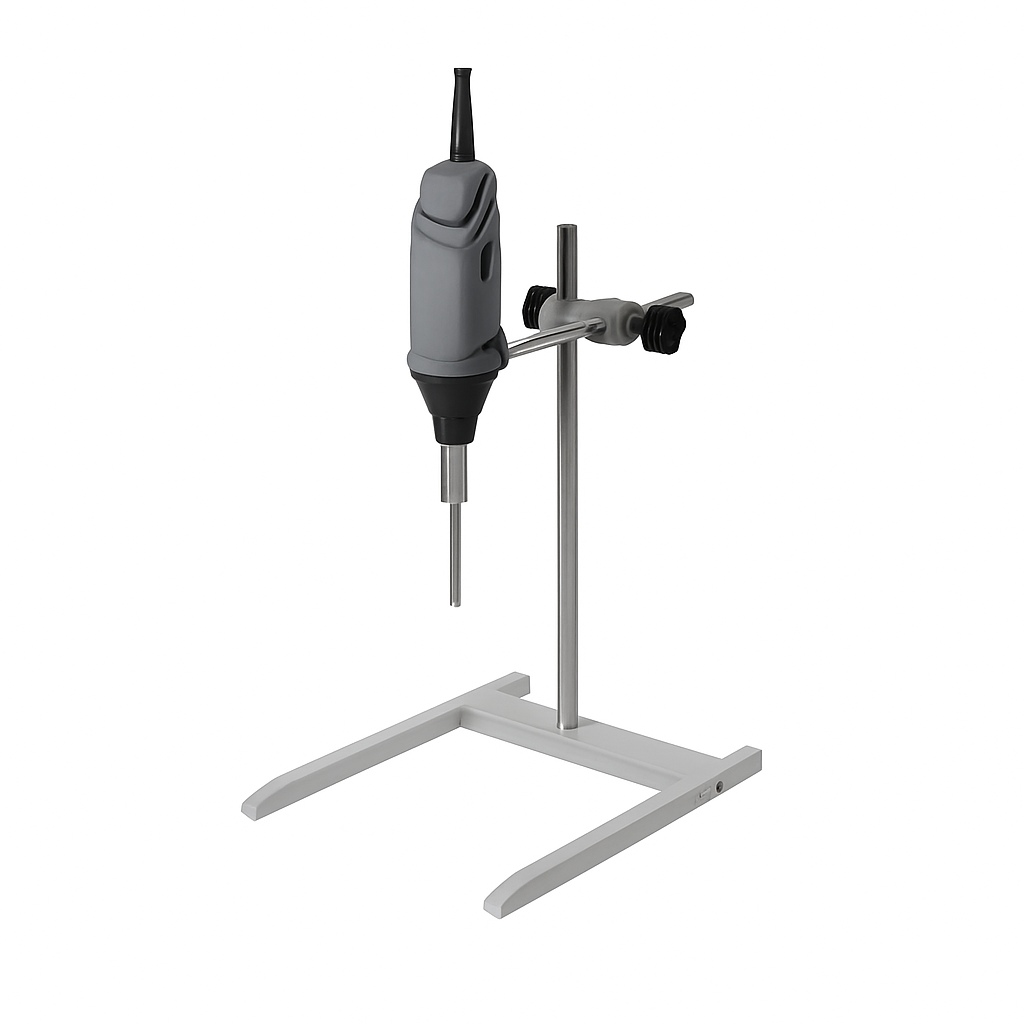
The D-160 is a handheld high-speed homogenizer designed for laboratory applications requiring tissue disruption, sample preparation, and material dispersion. Available in two capacity variants to suit different sample volumes.
Applications
The D-160 can be used in genetic research, tissue destruction, fragmentation, cytoplasmization, pathological analysis, nano-material dispersion, polymerization, ink coatings, fine chemicals, prospecting, environmental protection, energy and other fields.
Key Features
- Lightweight design, handheld and can be operated with one hand
- The application of different dispersing heads is suitable for liquid samples of 0.1~250ml
- High-quality 316L stainless steel dispersing head, corrosion-resistant, high-temperature sterilization
- The dispersing head is easy to disassemble and clean; high-speed and high-efficiency motor
- The speed is adjustable in 10 gears, and the speed range: 8000~32000rpm
Specifications
| Parameter | Specification |
|---|---|
| Speed Range | 8000~32000rpm |
| Max. Circumferential Speed | 6.3~14m/s |
| Speed Control | 10 stage |
| Max. Viscosity | 5000mPa·s |
| Material of Dispersing Shaft | SS316 & PTFE seal ring |
| Noise | ≤72dB |
| Ambient Temperature Range | 0~40°C |
| Relative Humidity | 85%RH |
| Protection Type | IP20 |
| Power Consumption | 160W |
| Motor Type | AC carbon brush motor |
| Power Supply | AC110/220V±10%, 50/60Hz |
| External Dimensions (W×D×H) | 45×55×190mm |
| Package Dimensions (W×D×H) | 470×240×250mm |
| Gross Weight | 4kg |
Model Comparison
| Parameter | D-160/5 | D-160/10 |
|---|---|---|
| Item No. | 8014111000 | 8014121000 |
| Recommended Configuration | D160 drive, H370 stand, DS-160/5 shaft, volumes from 0.1~50ml | D160 drive, H370 stand, DS-160/10 shaft, volumes from 1~250ml |
| Working Volume (H₂O) | 0.1~50ml | 1~250ml |
| Standard Accessory | Base stand + DS-160/5 dispersing shaft | Base stand + DS-160/10 dispersing shaft |
| Stator Diameter | 5mm | 10mm |
| Rotor Diameter | 3mm | 6mm |
| Min./Max. Immersion Depth | 7/50mm | 10/120mm |
How It Works
The Homogenizer D-160 operates through mechanical force application to disrupt cellular structures and tissue matrices. The instrument utilizes a motor-driven mechanism that applies controlled shearing forces to samples, breaking down cell walls and membranes through physical disruption. This mechanical approach provides consistent results across different sample types without the need for chemical additives or extreme temperature conditions.
During operation, samples are placed in appropriate containers and subjected to the homogenizer's mechanical action. The disruption process creates uniform particle size distribution and ensures complete tissue breakdown for downstream processing. The mechanical nature of the homogenization process preserves the integrity of target molecules while effectively releasing cellular contents.
The compact design incorporates precision engineering to deliver consistent mechanical performance while maintaining operator safety. The unit's construction allows for easy cleaning and maintenance between samples, preventing cross-contamination in multi-sample processing workflows.
Features & Benefits
Shipping weight
- 4.0 lb
Shipping box
- L: 19.0 cm
- W: 4.5 cm
- H: 5.5 cm
| Feature | This Product | Typical Alternative | Advantage |
|---|---|---|---|
| Instrument Weight | 4.0 kg | Entry-level models often range 2-6 kg depending on motor capacity | Provides optimal balance between portability and mechanical stability for consistent performance. |
| Footprint Dimensions | 19.0 x 4.5 x 5.5 inches | Larger units may require 24+ inch bench depth | Maximizes laboratory space efficiency while accommodating standard sample processing needs. |
| Operation Type | Mechanical disruption | Some models use ultrasonic or bead-beating mechanisms | Provides consistent results without heat generation or specialized media requirements. |
| Construction Design | Benchtop portable unit | Fixed installation or wheeled cart systems vary by model | Enables flexible positioning and multi-station use within laboratory environments. |
The Homogenizer D-160 combines compact design with mechanical reliability for research applications requiring consistent tissue disruption. The 4.0 kg weight and efficient footprint make it suitable for laboratories where space optimization and portability are important considerations.
| Model | SKU | Listed price | Status | Shipping box |
|---|---|---|---|---|
| D-160/10 | BIO-D160-10 | $1,490.00 | Available | 19.0 x 4.5 x 5.5 cm |
| D-160/5 | BIO-D160-5 | $1,290.00 | Available | 19.0 x 4.5 x 5.5 cm |
Practical Tips
Establish baseline processing times using standard reference samples before processing experimental materials.
Why: Ensures consistent results across different sample batches and operators.
Clean all sample-contact surfaces immediately after use and inspect mechanical components regularly for wear.
Why: Prevents sample carryover and maintains optimal mechanical performance over time.
Process samples in small batches and avoid overloading the instrument beyond specified capacity.
Why: Maintains consistent homogenization quality and prevents mechanical stress on the motor.
Always secure sample containers properly and wear appropriate PPE during operation.
Why: Prevents sample spillage and protects operators from potential aerosol generation.
Document processing parameters and times for each sample type to establish reproducible protocols.
Why: Enables method validation and ensures consistent results across research studies.
If unusual vibrations occur, stop operation immediately and check for proper sample container placement and balance.
Why: Prevents potential damage to the instrument and maintains operator safety.
Setup Guide
What’s in the Box
- Homogenizer D-160 main unit
- Power cord (typical)
- User manual and operation guide (typical)
- Basic tool kit for maintenance (typical)
- Safety instructions documentation (typical)
Warranty
ConductScience provides a standard one-year manufacturer warranty covering defects in materials and workmanship. Technical support is available to assist with operational questions and troubleshooting throughout the warranty period.
Compliance
References
Background reading relevant to this product:
What sample volumes can the D-160 effectively process?
Consult product datasheet for specific sample volume ranges and recommended container sizes for optimal homogenization results.
How do I prevent cross-contamination between different sample types?
Implement thorough cleaning protocols between samples, including disassembly and cleaning of all sample-contact surfaces with appropriate solvents.
What maintenance schedule is recommended for consistent performance?
Regular inspection of mechanical components and periodic lubrication as specified in the user manual will maintain optimal performance and extend instrument life.
Can the D-160 process frozen tissue samples directly?
Consult the user manual for temperature limitations and recommended protocols, as some applications may require partial thawing before processing.
What safety precautions should be observed during operation?
Always use appropriate personal protective equipment, ensure proper sample container securing, and avoid overloading the unit beyond specified capacity limits.
How does processing time affect sample quality?
Optimal processing time varies by sample type and desired particle size; start with shorter intervals and assess results to prevent over-processing.
Is the D-160 suitable for processing samples containing solvents?
Check material compatibility specifications for solvent resistance and follow appropriate safety protocols when processing samples with organic solvents.
Have a question about this product?
Have a question? Just ask.
Send it over and we'll email you a personalized answer — no call, no scheduling.
Prefer to talk it through?