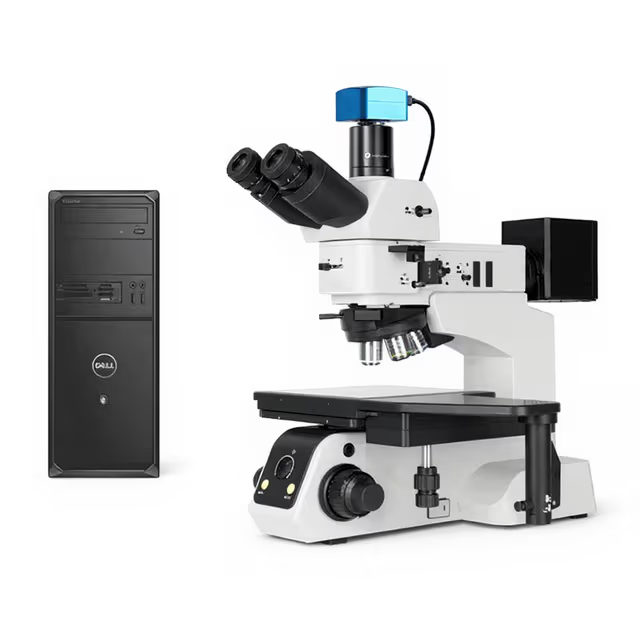
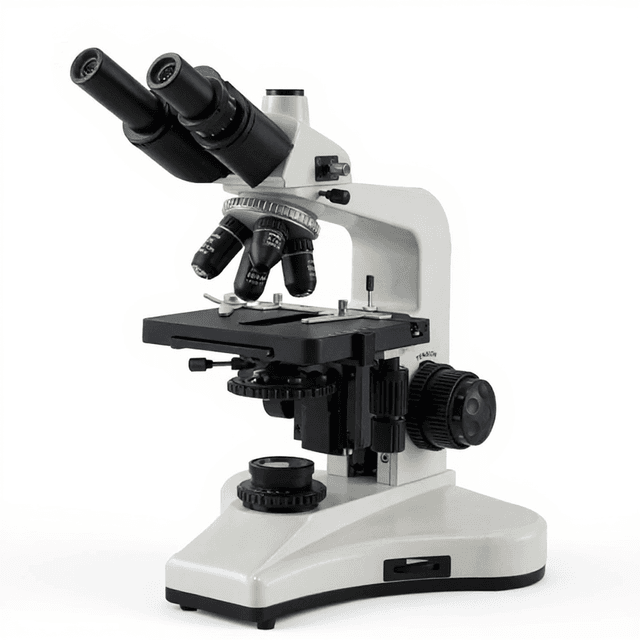
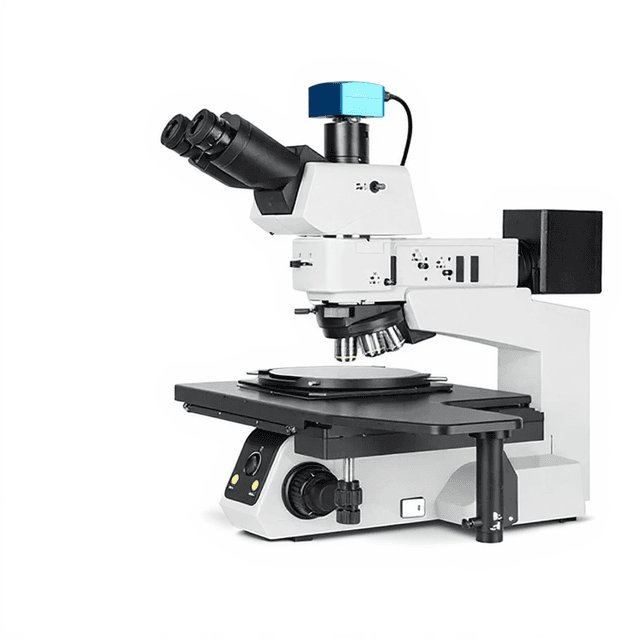
Laboratory Biological Microscope — Infinity Optics
Brightfield biological microscope with NIS infinity optics, LED illumination, and quadruple nosepiece for routine cellular and tissue examination in research laboratories.

Louise Corscadden, PhD
Director of Science · ConductScience
Ask Louise about Laboratory Biological Microscope — Infinity Optics fit, setup, configuration, or quote prep.
Already working with us? Sign in to connect this with My Scientist.
Key Specifications
Full details →- Model fit
- Configured during quote
- SKU family
- MCX-0078
- Shipping box
- 4.9 x 6.6 x 6.6 cm
- Ordering
- Online checkout and quote request available
- Category
- Microscopy
- Build notes
- Confirm accessories, station layout, and support needs before purchase
The Laboratory Biological Microscope (BIO-0539) is a brightfield optical microscope designed for routine biological observation and analysis in research laboratories. Built around an NIS infinity optical system, this instrument provides high-resolution imaging capabilities for examining cellular structures, tissue sections, and microorganisms across a range of magnifications.
The system features a high luminescent white 3W LED illumination source paired with an inserted condenser (NA 1.25) for optimal contrast and resolution. The reversed-type quadruple nosepiece with coding ensures precise objective alignment and identification. An integrated LCD display provides real-time magnification indication, brightness control, time sleeping mode, and lock functions for enhanced user experience and documentation.
How It Works
The microscope operates on brightfield illumination principles, where white light from the 3W LED source passes through the condenser system and specimen, with contrast generated by the differential absorption and scattering of light by cellular structures. The NIS infinity optical system eliminates spherical aberration by producing parallel light rays between the objective and tube lens, ensuring consistent image quality across all magnifications.
The inserted condenser with numerical aperture of 1.25 provides high-resolution illumination matching the capability of high-power objectives. The reversed-type quadruple nosepiece allows rapid switching between objectives while maintaining precise optical alignment through coded positioning. The LCD display system provides digital feedback on magnification settings, illumination intensity, and operational parameters for consistent imaging conditions.
Features & Benefits
Shipping weight
- 29.98 lb
Shipping box
- L: 4.9 cm
- W: 6.6 cm
- H: 6.6 cm
| Feature | This Product | Typical Alternative | Advantage |
|---|---|---|---|
| Optical System Design | NIS infinity optical system with spherical aberration correction | Entry-level models often use finite optics with limited aberration correction | Provides consistent image quality across all magnifications for reliable morphological measurements |
| Illumination Source | High luminescent white 3W LED with daylight balancing | Basic models commonly use lower-power LEDs or halogen sources | Delivers stable color temperature and extended operational life without frequent lamp replacement |
| Condenser Numerical Aperture | Inserted condenser NA 1.25 for high-resolution imaging | Standard condensers typically offer NA 0.9 to 1.2 depending on model | Matches requirements of high-power objectives for maximum resolving capability in critical applications |
| Nosepiece Configuration | Reversed-type quadruple nosepiece with coding system | Basic models often provide triple nosepieces without coding features | Accommodates more objective combinations while ensuring precise alignment through coded positioning |
| Display Integration | LCD display with magnification, brightness, and operational status | Entry-level systems typically lack integrated display feedback | Enables consistent documentation of imaging parameters and prevents setting confusion during observations |
The microscope combines infinity-corrected optics with advanced LED illumination and integrated display feedback. The NA 1.25 condenser and coded quadruple nosepiece provide research-grade capabilities in a laboratory-focused platform.
Practical Tips
Verify magnification accuracy using a stage micrometer at regular intervals, especially after objective changes or mechanical adjustments.
Why: Ensures measurement accuracy for quantitative morphological analysis and documentation consistency.
Clean objective lenses with lens tissue and appropriate solvents, avoiding excessive pressure on front elements.
Why: Prevents optical degradation that can reduce resolution and introduce imaging artifacts.
Establish Köhler illumination for each magnification change by adjusting field and aperture diaphragms.
Why: Optimizes contrast and resolution while providing uniform field illumination for consistent imaging.
If images appear dim or uneven, check condenser centering and height adjustment before adjusting LED brightness.
Why: Mechanical alignment issues are often mistaken for illumination problems and proper condenser setup resolves most brightness concerns.
Document magnification and illumination settings displayed on the LCD for each imaging session.
Why: Enables reproducible imaging conditions and accurate scale bar calculations for published images.
Allow LED illumination to warm up for several minutes before critical observations to achieve stable color temperature.
Why: Prevents color balance drift during extended observation sessions that could affect staining interpretation.
Use the time sleeping mode during extended breaks to preserve LED life while maintaining ready-to-use status.
Why: Balances energy conservation with operational convenience for laboratories with intermittent microscopy needs.
Setup Guide
What’s in the Box
- Laboratory Biological Microscope main unit
- Reversed-type quadruple nosepiece
- Binocular viewing head (typical)
- Eyepieces (typical)
- Objective lenses (typical)
- Inserted condenser NA 1.25
- Mechanical stage (typical)
- Power adapter
- User manual
- Dust cover (typical)
Warranty
ConductScience provides a standard one-year manufacturer warranty covering defects in materials and workmanship, with technical support available for operational and maintenance guidance.
Compliance
References
Background reading relevant to this product:
What is the maximum numerical aperture supported by the condenser system?
The inserted condenser provides NA 1.25, which supports high-resolution objectives up to 100x oil immersion for maximum resolving power.
How does the LED illumination compare to traditional halogen sources?
The 3W LED provides daylight-balanced illumination with reduced heat generation, extended lamp life, and stable intensity compared to halogen sources that require frequent replacement.
What magnification information is displayed on the LCD?
The LCD display shows current magnification settings, illumination brightness levels, time sleeping status, and lock indicators for consistent documentation.
Can the microscope accommodate phase contrast or DIC techniques?
The base configuration supports brightfield observation; consult product datasheet for available contrast enhancement accessories and compatibility.
How is objective identification managed in the nosepiece?
The reversed-type quadruple nosepiece includes coding features that provide positive identification and precise alignment of each objective position.
What maintenance is required for the LED illumination system?
LED illumination requires minimal maintenance compared to halogen systems, with time sleeping mode extending lamp life and reducing heat-related component stress.
Is the microscope suitable for live cell imaging applications?
The LED illumination with reduced heat generation supports live specimen observation, though specific environmental control requirements depend on the experimental protocol.
Have a question about this product?
Have a question? Just ask.
Send it over and we'll email you a personalized answer — no call, no scheduling.
Prefer to talk it through?
Frequently Bought Together
Related Products