Laboratory Water Bottle Filler
Automatic and manual bottle filling for vivarium watering programs that need repeatable rack handling across several bottle formats.
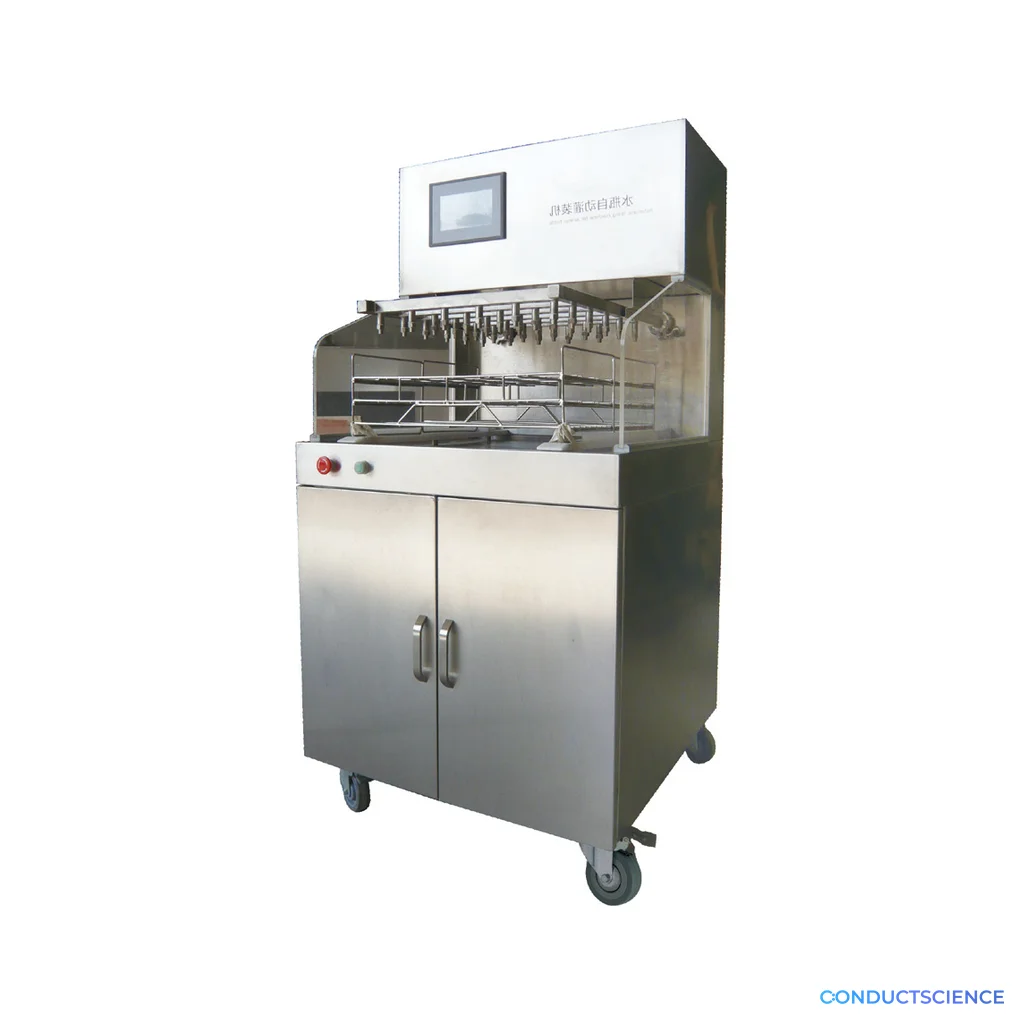
The 700 × 750 × 1550 mm station uses a 300 L tank, sanitary clamp-connected piping, saved capacity-specific parameters, automatic rack detection, programmable piping disinfection, and documented rates from 1800 to 4000 bottles per hour.

Louise Corscadden, PhD
Director of Science · ConductScience
Ask Louise about Laboratory Water Bottle Filler fit, setup, configuration, or quote prep.
Already working with us? Sign in to connect this with My Scientist.
Key Specifications
Full details →- External dimensions
- 700 × 750 × 1550 mm
- Electrical
- 220 V · 50 Hz · 300 W
- Tank and inlet
- 300 L · 3/4 in water inlet
- Fill consistency
- ≤5% stated fill error · verify with selected bottles and process
- 200-250 mL format
- Rack 430 × 210 × 130 mm · 36 bottles/fill · 4000 bottles/h
- 300-400 mL format
- Rack 395 × 210 × 150 mm · 30 bottles/fill · 3000 bottles/h
Turn bottle filling into a controlled watering-room process
A laboratory water bottle filler helps animal-care teams move from individual manual filling to a defined rack-based workflow. The scientific value is indirect but important: watering availability, fill consistency, bottle identification, additive control, and clean handling all affect the reliability of husbandry. The equipment should therefore be selected with the animal protocol, water-quality program, bottle fleet, sanitation method, and daily care schedule in view.
The station measures 700 × 750 × 1550 mm and uses a 300 L tank with sanitary clamp-connected piping. Manual and automatic modes are available. In automatic operation, rack placement triggers filling and the cycle stops at the saved target. The catalog states that bottle-fill variation is no more than 5%, but the facility should verify actual performance with its bottle geometry, rack, water conditions, target volume, and inspection method.
Throughput depends on the bottle and rack. Documented configurations range from 36 bottles per fill and 4000 bottles per hour for 200 to 250 mL bottles to 20 bottles per fill and 1800 bottles per hour for 500 to 700 mL square bottles. Intermediate configurations cover 300 to 400 mL and 500 mL round bottles. These are planning values; loading rhythm, upstream washing, cap or stopper handling, and downstream distribution can determine the real line capacity.
A programmable mode supports piping disinfection, while saved parameters and process records support repeatable operation. Approved acid or mineral additions can be incorporated when the facility has defined the recipe, compatibility, mixing, labeling, and quality checks. The filler does not determine water suitability or dosing. Teams should define changeover, flushing, microbial control, residual checks, bottle segregation, rejected fills, and the response to interrupted cycles.
Share bottle drawings, rack counts, target volumes, daily throughput, water specification, approved additives, inlet and drainage conditions, sanitation procedure, quality checks, room layout, and delivery route with ConductScience. The quote will confirm rack compatibility, filling configuration, piping, controls, accessories, placement, testing, training, and qualification support. That creates one documented bridge between the watering-room equipment and the care program it serves.
Features & Benefits
External dimensions
- 700 × 750 × 1550 mm
Electrical
- 220 V · 50 Hz · 300 W
Tank and inlet
- 300 L · 3/4 in water inlet
Fill consistency
- ≤5% stated fill error · verify with selected bottles and process
200-250 mL format
- Rack 430 × 210 × 130 mm · 36 bottles/fill · 4000 bottles/h
300-400 mL format
- Rack 395 × 210 × 150 mm · 30 bottles/fill · 3000 bottles/h
500 mL round format
- Rack 430 × 180 × 200 mm · 20 bottles/fill · 2000 bottles/h
500-700 mL square format
- Rack 395 × 175 × 200 mm · 20 bottles/fill · 1800 bottles/h
Operating modes
- Manual · automatic rack detection · saved parameters · programmable piping disinfection
Setup Guide
What’s in the Box
- Water bottle filler; selected racks, piping, controls, accessories, and qualification scope confirmed in the quote
Which throughput value should we use for planning?
Use the row that matches the actual bottle and rack, then allow for loading, inspection, stopper handling, and distribution.
Can the system add treatment compounds?
It can support approved acid or mineral additions, but recipe, compatibility, dosing, labeling, and quality checks remain the institution's responsibility.
How should fill consistency be qualified?
Qualify the saved setting with the selected bottles, water conditions, target volume, rack, and documented sampling method.
Have a question about this product?
Have a question? Just ask.
Send it over and we'll email you a personalized answer — no call, no scheduling.
Prefer to talk it through?