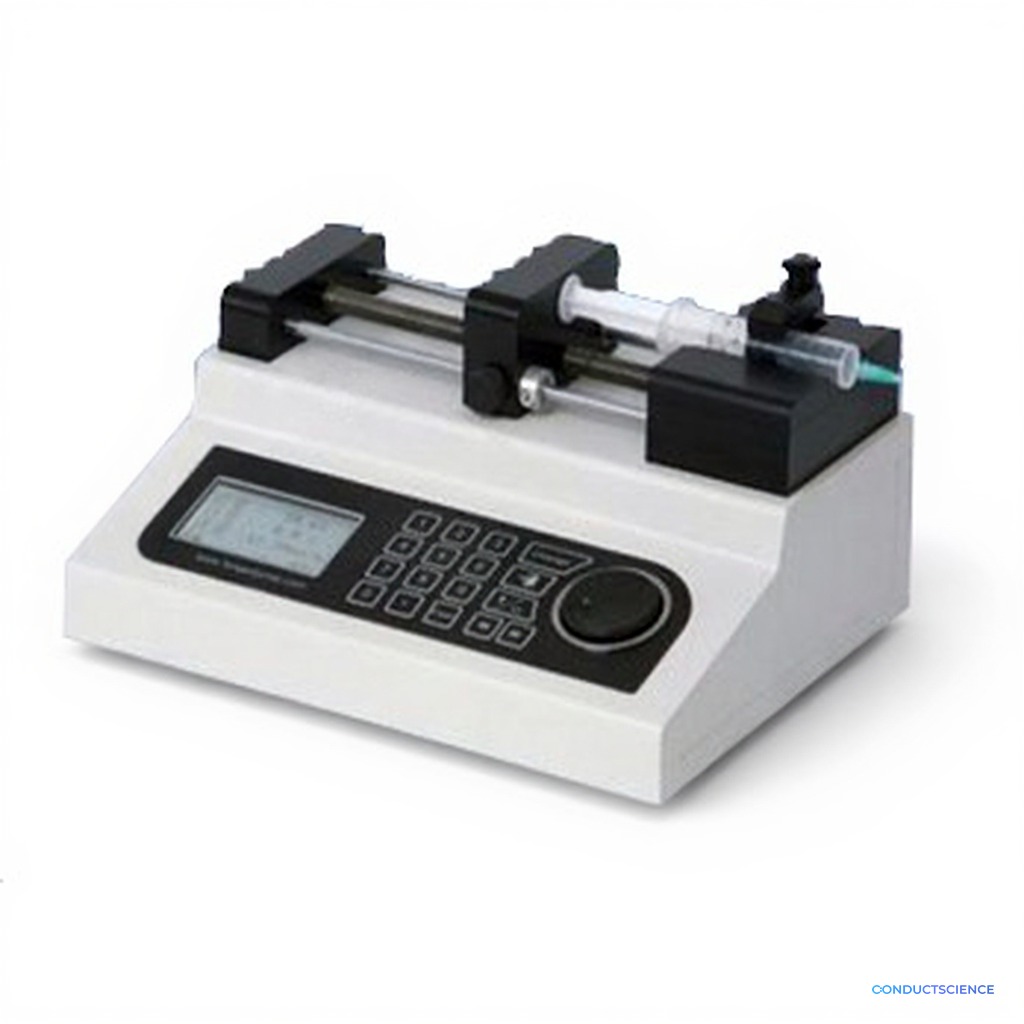
Low-Pulsation Precision Syringe Pump
Single-channel precision syringe pump with 5x reduced pulsation for microfluidic applications, supporting 10 µL to 60 mL syringes with flow rates from 0.166 nL/min to 10.831 mL/min.

Louise Corscadden, PhD
Director of Science · ConductScience
Ask Louise about Low-Pulsation Precision Syringe Pump fit, setup, configuration, or quote prep.
Already working with us? Sign in to connect this with My Scientist.
Key Specifications
Full details →- Model fit
- Configured during quote
- SKU family
- CS-MFL-00001
- Shipping box
- 280.0 x 210.0 x 140.0 cm
- Ordering
- Online checkout and quote request available
- Category
- Microfluidic Pumps & Flow Control
- Build notes
- Confirm accessories, station layout, and support needs before purchase
The Low-Pulsation Precision Syringe Pump delivers continuous, controlled fluid delivery for microfluidic applications requiring high flow stability. This single-channel pump accommodates syringes from 10 µL to 60 mL with flow rates spanning 0.166 nL/min to 10.831 mL/min, providing the broad dynamic range needed for diverse experimental protocols. The pump's 5x reduced pulsation technology minimizes flow variation, critical for applications sensitive to pressure fluctuations.
The digital knob and membrane interface provides precise flow control, while RS-485 connectivity enables integration into automated laboratory systems. The compact 280 × 210 × 140 mm footprint accommodates benchtop installations in space-constrained environments. This pump supports continuous perfusion studies, droplet generation, and other microfluidic workflows where consistent flow delivery is paramount.
How It Works
The syringe pump operates through precision stepper motor control of the syringe plunger, converting rotational motion into linear displacement for controlled fluid delivery. The motor advances the plunger at programmed rates, with flow rate determined by the combination of plunger velocity and syringe diameter. The pump's microprocessor calculates the required motor steps to achieve the target flow rate based on the installed syringe size.
The 5x pulsation reduction is achieved through advanced motor control algorithms that minimize velocity variations during stepper motor operation. This technology smooths the inherent step-wise motion characteristic of stepper motors, reducing pressure oscillations that can affect sensitive microfluidic processes. The digital interface allows precise flow rate programming with real-time monitoring and adjustment capabilities.
RS-485 communication enables remote control and integration with laboratory automation systems, allowing programmed flow sequences and data logging. The membrane interface provides tactile feedback while maintaining a sealed control surface suitable for laboratory environments.
Features & Benefits
Channels
- 1
Syringe Range
- 10 uL - 60 mL
Flow Rate
- 0.166 nL/min - 10.831 mL/min
Features
- 5x reduced pulsation
Interface
- Digital knob + membrane, RS-485
Automation Level
- semi-automated
Brand
- ConductScience
Research Domain
- Analytical Chemistry
- Cell Biology
- Materials Science
- Microfluidics
- Neuroscience
- Pharmaceutical QC
Shipping weight
- 3.6 lb
Shipping box
- L: 280.0 cm
- W: 210.0 cm
- H: 140.0 cm
| Feature | This Product | Typical Alternative | Advantage |
|---|---|---|---|
| Pulsation Reduction | 5x reduced pulsation technology | Standard stepper motor control with inherent pulsation | Critical for applications requiring stable pressure conditions and uniform droplet generation. |
| Flow Rate Range | 0.166 nL/min to 10.831 mL/min | Narrower ranges typically covering 2-3 orders of magnitude | Eliminates the need for multiple pumps when protocols require both ultra-low and moderate flow rates. |
| Syringe Compatibility | 10 µL to 60 mL syringe range | Limited to specific syringe size ranges | Provides flexibility for diverse experimental protocols without requiring multiple pump systems. |
| Communication Interface | Digital knob + membrane interface with RS-485 | Manual controls only or basic USB connectivity | Enables integration with automated systems and remote control for unattended operation. |
| Form Factor | 280 × 210 × 140 mm, 3.6 kg | Larger benchtop units or limited-feature compact models | Optimizes bench space while maintaining full precision pumping capabilities. |
This pump combines broad flow rate capability with enhanced stability through pulsation reduction technology. The single-channel design focuses on precision delivery while RS-485 communication enables system integration for automated workflows.
Practical Tips
Verify flow rate accuracy using gravimetric or volumetric methods when changing syringe sizes or after extended use.
Why: Syringe dimensional variations and wear can affect flow rate accuracy over time.
Clean the syringe mounting area and drive mechanism regularly to prevent buildup of dried samples or lubricants.
Why: Contamination can affect mechanical precision and introduce variability in flow delivery.
Prime the system thoroughly and eliminate air bubbles before starting precision applications, especially at low flow rates.
Why: Air bubbles compress and expand, creating flow irregularities that are magnified at low flow rates.
Check tubing connections and syringe seating if flow rates appear inconsistent or if the system loses prime during operation.
Why: Loose connections create pressure leaks that manifest as flow rate variations or complete flow stoppage.
Allow the pump to reach thermal equilibrium before critical measurements, especially in temperature-controlled environments.
Why: Temperature changes affect fluid viscosity and mechanical clearances, influencing flow precision.
Use appropriate secondary containment when pumping hazardous or valuable samples to contain potential spills or leaks.
Why: Mechanical systems can fail, and secondary containment prevents contamination of work areas and equipment.
Select syringe size based on the target flow rate to optimize precision, using smaller syringes for lower flow rates.
Why: Smaller syringes provide finer resolution for precise flow control at low rates.
Document syringe manufacturer and lot numbers when calibrating, as barrel dimensions can vary between batches.
Why: Dimensional variations affect the relationship between plunger displacement and volume delivery.
Setup Guide
What’s in the Box
- Low-Pulsation Precision Syringe Pump main unit
- Power adapter and cord
- RS-485 communication cable (typical)
- Syringe mounting hardware (typical)
- User manual and quick-start guide (typical)
- Calibration certificate (typical)
Warranty
ConductScience provides a standard one-year manufacturer warranty covering defects in materials and workmanship. Technical support includes installation guidance, troubleshooting assistance, and application consulting for optimal performance in research applications.
Compliance
What is the minimum stable flow rate achievable with small volume syringes?
The pump delivers flow rates as low as 0.166 nL/min when used with 10 µL syringes, suitable for ultra-low volume microfluidic applications. Consult the product datasheet for flow stability specifications at minimum rates.
How does the 5x pulsation reduction compare to standard syringe pumps?
The pulsation reduction technology minimizes pressure oscillations inherent in stepper motor-driven systems, providing smoother flow delivery compared to conventional syringe pumps. This is particularly important for droplet generation and pressure-sensitive processes.
Can the pump be controlled remotely for automated protocols?
Yes, the RS-485 interface allows integration with laboratory automation systems for remote control, programmed sequences, and data logging. Communication protocols and command sets are detailed in the user manual.
What syringe types and manufacturers are compatible?
The pump accommodates syringes from 10 µL to 60 mL capacity. Consult the product datasheet for specific syringe brand compatibility and mounting requirements, as barrel diameter affects flow rate calculations.
How precise is the flow rate control across the operating range?
Flow rate precision varies with syringe size and flow rate setting. Consult the product datasheet for accuracy specifications at different operating points, as smaller syringes typically provide higher precision at low flow rates.
What maintenance is required for consistent performance?
Regular maintenance includes cleaning the syringe mounting area, lubricating the drive mechanism as specified, and periodic calibration verification. The user manual provides detailed maintenance schedules and procedures.
Can multiple pumps be synchronized for multi-channel applications?
While this is a single-channel unit, multiple pumps can be controlled through the RS-485 interface using appropriate automation software. Each pump requires individual addressing for synchronized operation.
Have a question about this product?
Have a question? Just ask.
Send it over and we'll email you a personalized answer — no call, no scheduling.
Prefer to talk it through?