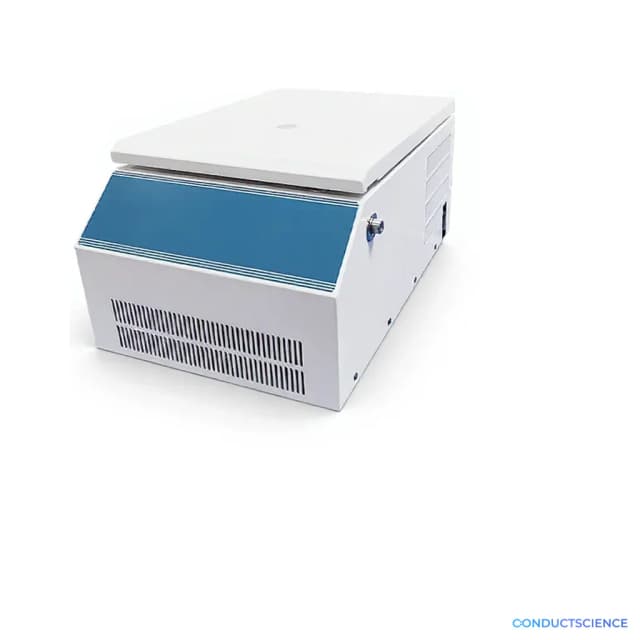
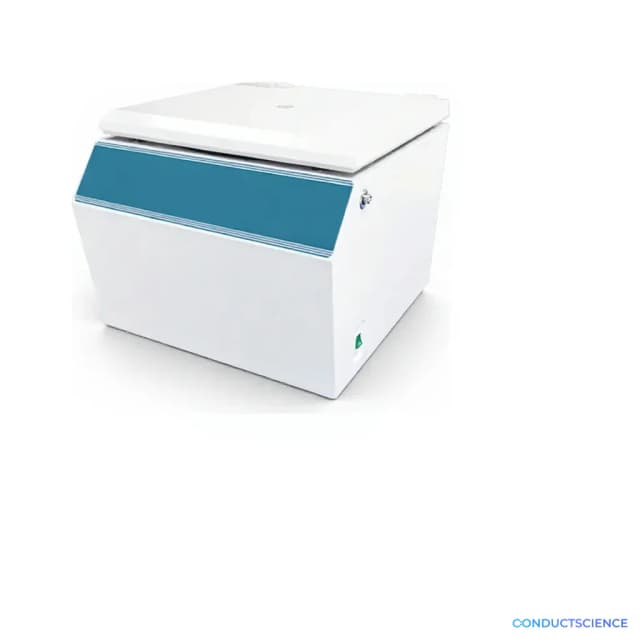
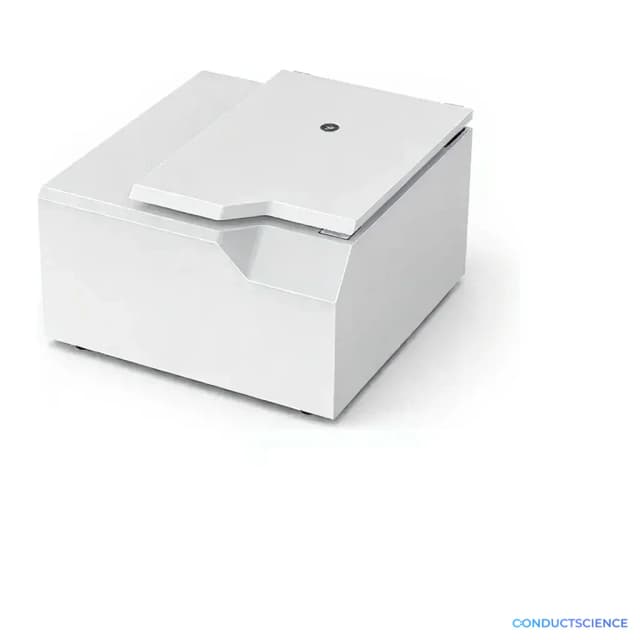
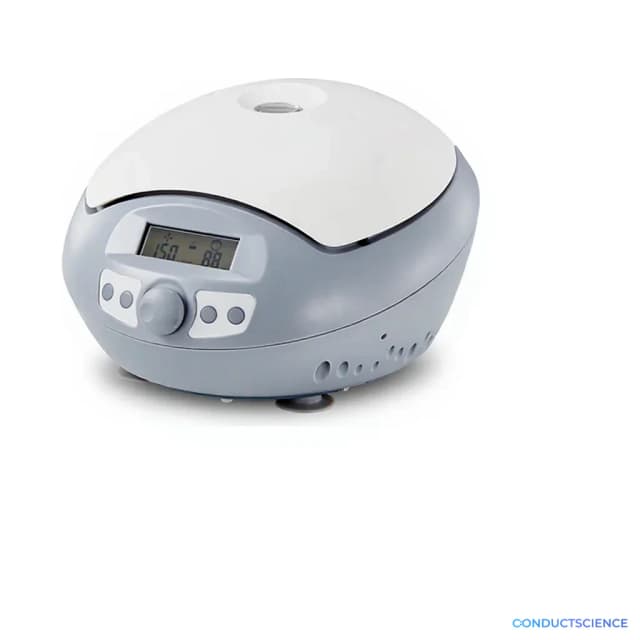
Low Speed Centrifuge (Custom Configuration)
High-capacity refrigerated centrifuge with 8,000 rpm maximum speed and 6×2400ml capacity, featuring precise temperature control from -20°C to +40°C for large-volume sample processing.

Louise Corscadden, PhD
Director of Science · ConductScience
Ask Louise about Low Speed Centrifuge (Custom Configuration) fit, setup, configuration, or quote prep.
Already working with us? Sign in to connect this with My Scientist.
Key Specifications
Full details →- Model fit
- Configured during quote
- SKU family
- BIO-0314
- Shipping box
- 97.0 x 96.0 x 84.5 cm
- Ordering
- Online checkout and quote request available
- Category
- Centrifuges
- Build notes
- Confirm accessories, station layout, and support needs before purchase
The Low Speed Centrifuge is a refrigerated benchtop centrifuge designed for high-capacity sample processing in laboratory environments. Operating at speeds up to 8,000 rpm with a maximum relative centrifugal force of 14,900×g, this unit accommodates up to 6×2400ml sample containers, making it suitable for large-volume separations and preparative work.
The integrated CFC-free refrigeration system maintains precise temperature control from -20°C to +40°C with ±1°C accuracy, enabling temperature-sensitive sample processing. Digital controls provide timing flexibility from 1 second to 99 hours 59 minutes, while speed accuracy of ±20 rpm ensures reproducible separation conditions. The robust 7000W power system and 515 kg construction provide stable operation for demanding applications requiring extended run times and high sample throughput.
How It Works
Centrifugal separation operates on the principle of applying centrifugal force to samples, causing particles of different densities to separate based on their sedimentation rates. When the rotor spins, samples experience forces many times greater than gravity, with the relative centrifugal force (RCF) calculated as 1.118 × 10⁻⁵ × radius × (rpm)². At maximum speed of 8,000 rpm, this centrifuge generates up to 14,900×g, sufficient for efficient separation of cellular components, precipitates, and suspended particles.
The integrated refrigeration system uses a CFC-free compressor to maintain precise temperature control during separation. Temperature regulation is critical for preserving sample integrity, preventing protein denaturation, and maintaining the stability of temperature-sensitive compounds. The system can cool samples to -20°C for applications requiring sub-ambient conditions or maintain elevated temperatures up to +40°C for specialized protocols.
Digital speed and timing controls ensure reproducible separation conditions. The microprocessor-controlled system maintains speed accuracy within ±20 rpm while providing flexible timing from brief 1-second pulses to extended 99-hour runs. This precision enables standardized protocols and consistent results across multiple sample batches.
Features & Benefits
Automation Level
- semi-automated
Max speed
- 8,000 rpm
Max. Volume
- 6*2400ml
Refrigerated System
- CFC-free compressor
Timing Range
- 1s~99h59min
Speed Accuracy
- ±20rpm
Temperature Accuracy
- ±1℃
Noise
- <58dB
Rated Power
- 7000W
Outer Dimension(L*W*H)
- 960*845*970mm
Brand
- ConductScience
Research Domain
- Analytical Chemistry
- Cell Biology
- Food Science
- Materials Science
- Microbiology
- Pharmaceutical QC
Temperature Range
- -20℃~+40℃
Power/Voltage
- AC220V, 50Hz(Standard); AC110V, 60Hz(Optional)
Weight
- Main instrument: 600kg(220V), 610kg(110V); Rotor: 67kg
Max force
- 14,900 ×g
Shipping weight
- 515.0 lb
Shipping box
- L: 97.0 cm
- W: 96.0 cm
- H: 84.5 cm
| Feature | This Product | Typical Alternative | Advantage |
|---|---|---|---|
| Sample Capacity | 6×2400ml (14.4L total) | Entry-level models often offer 4-8 positions with smaller tube capacities | Enables processing of larger sample volumes without multiple runs, improving workflow efficiency. |
| Temperature Range | -20°C to +40°C with ±1°C accuracy | Many models offer limited temperature range or ambient-only operation | Supports both sub-ambient and elevated temperature protocols for diverse sample types. |
| Maximum RCF | 14,900×g at 8,000 rpm | Lower-end units typically provide 5,000-10,000×g maximum | Sufficient force for efficient separation of dense particles and cellular components. |
| Construction Weight | 515 kg net weight | Benchtop models usually weigh 50-200 kg | Heavy construction provides vibration damping and stability during high-speed operation. |
| Timing Flexibility | 1 second to 99 hours 59 minutes | Standard models often limit maximum run times to 12-24 hours | Accommodates both brief pulse protocols and extended preparative separations. |
| Noise Level | <58 dB operation | Varies by model, with some exceeding laboratory comfort levels | Maintains quiet operation suitable for laboratory environments during extended runs. |
This centrifuge combines high sample capacity with precise refrigeration and robust construction for demanding preparative applications. The 6×2400ml capacity and extended timing range support high-throughput workflows, while the heavy construction and quiet operation ensure stable performance in laboratory settings.
Practical Tips
Verify speed accuracy monthly using a calibrated tachometer, checking at multiple speed points across the operating range.
Why: Speed accuracy directly affects RCF calculations and separation reproducibility.
Clean the chamber and rotor after each use with appropriate disinfectants, paying attention to sample spill areas.
Why: Prevents cross-contamination and maintains optimal performance of moving parts.
Pre-cool the rotor and chamber to target temperature before loading temperature-sensitive samples.
Why: Minimizes thermal shock to samples and reduces time to reach thermal equilibrium.
If vibration occurs during operation, immediately stop and check tube balance and rotor installation.
Why: Imbalanced loads can damage the drive system and compromise sample integrity.
Document run parameters including speed, temperature, time, and sample volumes for protocol reproducibility.
Why: Standardized documentation enables consistent results and troubleshooting of separation issues.
Always use appropriate personal protective equipment and ensure the lid is properly secured before operation.
Why: High-speed rotation and refrigerants require proper safety precautions to prevent injury.
Allow the unit to warm up for 10-15 minutes before first use each day to stabilize all systems.
Why: Thermal and mechanical stabilization ensures optimal performance and extends equipment life.
Check refrigeration system performance weekly by monitoring temperature stability and cooling rates.
Why: Early detection of refrigeration issues prevents sample loss and costly repairs.
Setup Guide
What’s in the Box
- Low Speed Centrifuge BKC-VL8RD-I-L main unit
- Standard rotor (typical)
- Power cord for specified voltage
- User manual and operation guide
- Installation hardware (typical)
- Calibration certificate (typical)
- Safety documentation (typical)
Warranty
ConductScience provides a standard 1-year manufacturer warranty covering parts and labor, with technical support for installation, operation, and troubleshooting. Extended warranty and service contracts are available for applications requiring enhanced coverage.
Compliance
What is the maximum sample volume per tube position?
Each of the six positions can accommodate up to 2400ml sample containers, providing 14.4L total capacity per run.
How precise is the temperature control during refrigerated runs?
The CFC-free refrigeration system maintains temperature accuracy within ±1°C across the full range from -20°C to +40°C.
What rotor compatibility should I verify before use?
Consult the rotor compatibility chart in the user manual to ensure your specific rotor is rated for 8,000 rpm maximum speed and is properly balanced for your sample types.
How long can I run continuous centrifugation protocols?
The timing system supports runs from 1 second up to 99 hours 59 minutes, with the robust 515 kg construction designed for extended operation.
What power requirements are needed for installation?
Standard configuration requires AC220V 50Hz power, with AC110V 60Hz available as an option. The 7000W rated power necessitates dedicated electrical circuits.
How do I ensure proper sample balance distribution?
Load samples in opposing positions to maintain balance, ensuring equal weight distribution. Use water-filled tubes as counterbalances when processing uneven numbers of samples.
What maintenance is required for the refrigeration system?
The CFC-free compressor requires regular inspection of cooling lines and periodic refrigerant level checks as outlined in the maintenance schedule. Consult product datasheet for specific intervals.
How does this compare to ultracentrifuges for my application?
This low-speed centrifuge is optimal for cell harvesting, precipitate separation, and large-volume preparative work. For subcellular fractionation requiring >20,000×g, consider ultracentrifuge alternatives.
Have a question about this product?
Have a question? Just ask.
Send it over and we'll email you a personalized answer — no call, no scheduling.
Prefer to talk it through?
Accessories
Enhance your setup with compatible accessories
Replacement Parts & Consumables
Upgrade Options