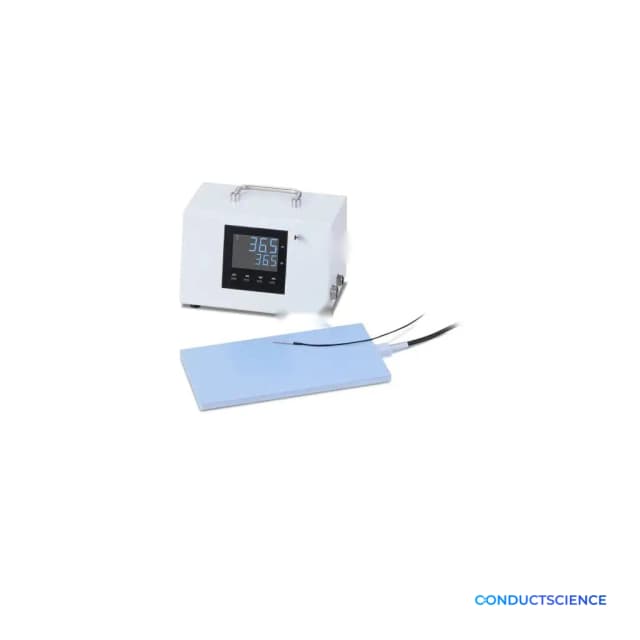
Magnetic Stirrer Optional Accessories
Complete magnetic stir bar accessory set with multiple sizes from 10×6 mm to 80×13 mm plus 300 mm magnetic retrieval tool for laboratory mixing applications.

Louise Corscadden, PhD
Director of Science · ConductScience
Ask Louise about Magnetic Stirrer Optional Accessories fit, setup, configuration, or quote prep.
Already working with us? Sign in to connect this with My Scientist.
Key Specifications
Full details →- Model fit
- Configured during quote
- SKU family
- BIO-0796
- Shipping box
- 42.0 x 43.6 x 38.0 cm
- Ordering
- Online checkout and quote request available
- Category
- Benchtop Instruments
- Build notes
- Confirm accessories, station layout, and support needs before purchase
Magnetic stirrer accessories provide essential components for customizing magnetic stirring setups across laboratory applications. This accessory set includes magnetic stir bars in multiple sizes and configurations, plus specialized retrieval tools for safe handling. The stir bars range from compact 10×6 mm options for small volumes to large 80×13 mm bars for high-capacity mixing applications.
Each stir bar is designed to provide consistent magnetic coupling with stirrer plates while maintaining chemical inertness across pH ranges and solvent conditions. The 300 mm magnetic bar remover enables safe retrieval of stir bars from reaction vessels without contamination risk or direct contact with potentially hazardous solutions.
How It Works
Magnetic stir bars operate through magnetic coupling with rotating magnetic fields generated by stirrer plates. The stir bar's internal magnet follows the rotating field beneath the vessel, creating consistent circular motion that generates fluid mixing through convective flow patterns.
Different bar geometries optimize mixing efficiency for specific applications: smaller bars provide gentle stirring for delicate samples, while larger bars generate more vigorous mixing for viscous solutions or larger volumes. The magnetic coupling strength depends on bar size, vessel thickness, and stirrer field strength.
The magnetic retrieval tool uses a strong permanent magnet to safely extract stir bars from solutions without direct contact, preventing contamination and enabling recovery from hot or hazardous liquids.
Features & Benefits
Automation Level
- manual
18900006
- 10*6
√
- √
18900007
- 15*8
18900008
- 20*8
18900009
- 25*8
12500005
- 30*6
18900011
- 40*8
12500004
- 50*8
18900013
- 65*8
18900014
- 80*13
18900015
- Magnetic bar remover, length of 300mm
/
- /
Cat. No.
- 18900001
18901898
- 18900136
Brand
- ConductScience
Research Domain
- Analytical Chemistry
- Cell Biology
- Environmental Monitoring
- Food Science
- Materials Science
- Microbiology
- Pharmaceutical QC
Shipping weight
- 29.98 lb
Shipping box
- L: 42.0 cm
- W: 43.6 cm
- H: 38.0 cm
| Feature | This Product | Typical Alternative | Advantage |
|---|---|---|---|
| Size Range Coverage | Nine different sizes from 10×6 mm to 80×13 mm | Basic sets often include only 3-4 standard sizes | Accommodates full range of vessel sizes from microtubes to large beakers without requiring separate purchases. |
| Retrieval Tool Inclusion | 300 mm magnetic bar remover included | Many sets require separate purchase of retrieval tools | Provides immediate safe handling capability for all vessel depths and hazardous solutions. |
| Bar Geometry Variety | Multiple length-to-diameter ratios optimized for different applications | Standard sets often use single aspect ratio design | Enables optimization of mixing efficiency for specific vessel shapes and solution viscosities. |
| Size Selection Options | Includes both standard and specialized sizes (30×6, 80×13 mm) | Focus on most common middle sizes only | Covers edge cases like very small volumes and high-volume applications that standard sets miss. |
This accessory set provides comprehensive size coverage with specialized geometries for applications ranging from microscale to preparative volumes. The included retrieval tool and variety of aspect ratios address common limitations of basic stir bar sets.
Practical Tips
Match stir bar length to vessel diameter ratio of approximately 1:1.5 for optimal vortex formation.
Why: Proper sizing ensures efficient mixing without wall contact that can cause noise or decoupling.
Inspect stir bar coatings regularly for chips or scratches that could cause contamination.
Why: Damaged coatings expose the magnetic core and can introduce metal ions into sensitive samples.
Always use the magnetic retriever rather than pouring solutions to recover stir bars.
Why: Prevents accidental loss of expensive bars and eliminates contamination risk from direct handling.
Test magnetic coupling strength periodically by gradually increasing stirring speed until decoupling occurs.
Why: Identifies weakened magnets or coating issues before they affect critical experiments.
If stir bar stops following at moderate speeds, check for debris buildup or magnetic interference from nearby equipment.
Why: External magnetic fields or accumulated ferrous particles can disrupt proper magnetic coupling.
Allow 30 seconds of stirring after reaching target speed before sampling to ensure complete homogenization.
Why: Mixing time affects sample consistency and analytical precision in quantitative measurements.
Setup Guide
What’s in the Box
- Magnetic stir bar 10×6 mm
- Magnetic stir bar 15×8 mm
- Magnetic stir bar 20×8 mm
- Magnetic stir bar 25×8 mm
- Magnetic stir bar 30×6 mm
- Magnetic stir bar 40×8 mm
- Magnetic stir bar 50×8 mm
- Magnetic stir bar 65×8 mm
- Magnetic stir bar 80×13 mm
- Magnetic bar remover (300 mm length)
- Storage case (typical)
Warranty
ConductScience provides a one-year manufacturer warranty covering material defects and coating integrity under normal laboratory use conditions.
Compliance
References
Background reading relevant to this product:
How do I select the correct stir bar size for my application?
Choose bar length approximately 2/3 of vessel diameter. For volumes under 50 mL use 10-15 mm bars, 50-250 mL use 20-25 mm bars, 250-1000 mL use 40-50 mm bars, and above 1000 mL use 65-80 mm bars.
What stirring speeds work best with different bar sizes?
Smaller bars (10-25 mm) can handle 100-800 rpm, while larger bars (40-80 mm) typically operate at 50-400 rpm. Monitor for decoupling at higher speeds.
Are these stir bars compatible with heated applications?
Consult product datasheet for maximum temperature ratings. Most PTFE-coated bars handle temperatures up to 250°C, but verify compatibility with your specific heating requirements.
How should I clean stir bars between different sample types?
Rinse with appropriate solvents, sonicate if needed for stubborn residues, and verify complete removal of previous sample. Use dedicated bars for incompatible sample types.
Can I autoclave these magnetic stir bars?
Consult product datasheet for sterilization compatibility. Many PTFE-coated bars withstand autoclaving, but repeated thermal cycling may affect magnetic coupling strength.
What causes stir bar decoupling and how can I prevent it?
Decoupling occurs from excessive speed, high solution viscosity, or weak magnetic field. Use larger bars for viscous solutions and gradually increase stirring speed.
Have a question about this product?
Have a question? Just ask.
Send it over and we'll email you a personalized answer — no call, no scheduling.
Prefer to talk it through?