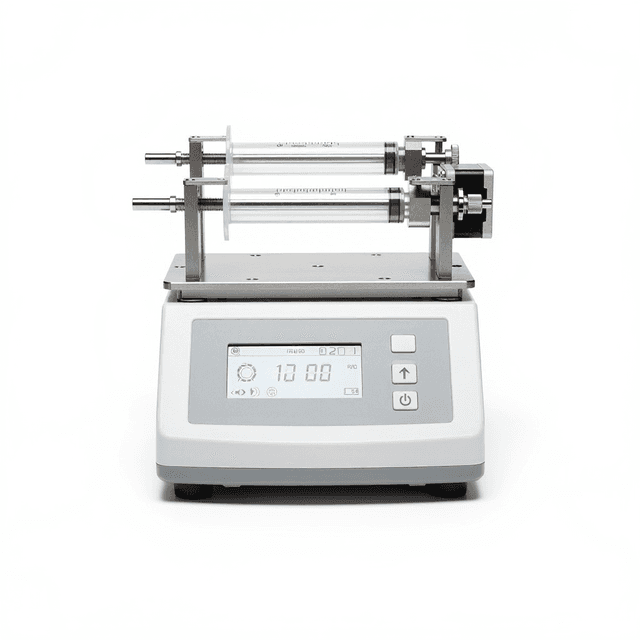
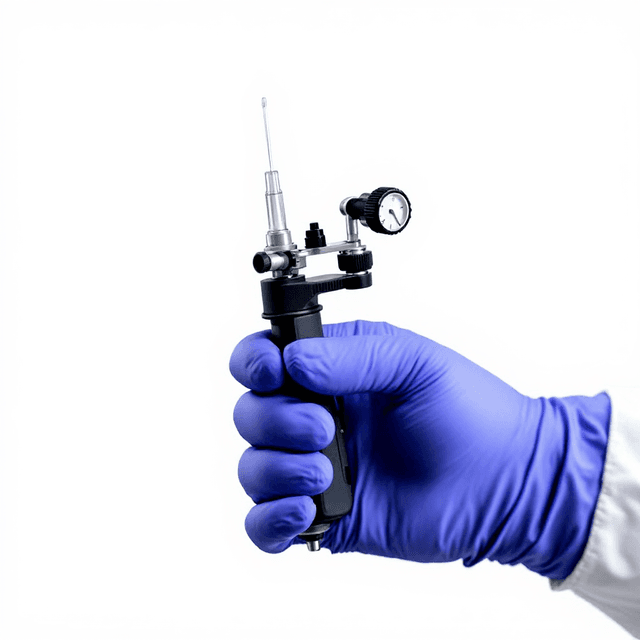
Single-Channel Precision Syringe Pump
Single-channel precision syringe pump designed for basic microfluidics applications and teaching laboratories requiring controlled fluid delivery.
| Number of Channels | 1 |
| Automation Level | semi-automated |
| Brand | ConductScience |

The Single-Channel Precision Syringe Pump provides controlled fluid delivery for basic microfluidics applications and educational laboratory settings. This compact benchtop unit delivers precise volumetric flow control through a single syringe-based delivery channel, enabling researchers to establish reproducible fluid handling protocols in controlled experimental environments.
The pump operates through precision stepper motor control of syringe displacement, allowing for accurate flow rate programming and consistent delivery volumes. Its straightforward interface makes it suitable for teaching laboratory techniques while maintaining the precision required for basic research applications where single-channel fluid delivery is sufficient.
How It Works
The syringe pump operates on the principle of positive displacement fluid delivery through precision mechanical control. A stepper motor drives a lead screw mechanism that controls the position of a syringe plunger with high accuracy. As the plunger advances or retracts, it displaces a known volume of fluid from the syringe barrel, creating predictable flow rates based on the programmed motor speed.
Flow rate precision depends on the mechanical resolution of the stepper motor system and the internal diameter of the syringe being used. The pump controller calculates the required motor steps per unit time to achieve the desired volumetric flow rate, accounting for the syringe geometry. This displacement-based approach provides excellent flow stability and reproducibility compared to pressure-driven systems, particularly at low flow rates typical in microfluidics applications.
Features & Benefits
Number of Channels
- 1
Automation Level
- semi-automated
Brand
- ConductScience
Research Domain
- Analytical Chemistry
- Cell Biology
- Materials Science
- Microbiology
- Pharmaceutical QC
Weight
- 2.5 kg
Dimensions
- L: 200.0 mm
- W: 150.0 mm
- H: 100.0 mm
Comparison Guide
| Feature | This Product | Typical Alternative | Advantage |
|---|---|---|---|
| Number of Channels | 1 channel | Entry-level models often offer 1-2 channels, while advanced systems may provide 4-8 channels | Single-channel design simplifies setup and reduces complexity for applications requiring only one fluid stream. |
| Application Focus | Basic microfluidics and teaching applications | Specialized models may target high-precision research or industrial production | Educational focus makes the system accessible for learning fundamental microfluidics principles. |
| Physical Dimensions | Compact 200 x 150 x 100 mm footprint | Benchtop models vary widely in size depending on channel count and features | Small footprint maximizes available bench space in teaching laboratories and basic research setups. |
| Weight | Lightweight at 2.5 kg | Pump weight typically increases with channel count and precision features | Portable design allows easy relocation between experimental setups or storage. |
This single-channel syringe pump offers a compact, lightweight solution for basic microfluidics applications and educational use. The straightforward design prioritizes ease of use and portability over advanced features, making it suitable for fundamental fluid handling applications.
Practical Tips
Perform flow rate verification using the actual syringe and fluid that will be used in experiments.
Why: Syringe-to-syringe variations and fluid properties affect actual delivered volumes.
Clean the syringe and fluid path thoroughly between different fluid types to prevent cross-contamination.
Why: Residual fluids can affect subsequent experiments and may cause chemical interactions.
Prime the system carefully to eliminate air bubbles before starting critical experiments.
Why: Air bubbles cause flow irregularities and affect delivery precision.
Check for binding or mechanical resistance if flow rates appear inconsistent.
Why: Mechanical issues in the drive system directly affect volumetric accuracy.
Record syringe size and fluid properties with each experiment for reproducible results.
Why: These parameters directly affect flow calculations and experimental repeatability.
Use appropriate chemical-resistant tubing and fittings for the fluids being pumped.
Why: Chemical compatibility prevents equipment damage and ensures operator safety.
Setup Guide
What’s in the Box
- Single-channel syringe pump main unit
- Power adapter (typical)
- Syringe mounting hardware (typical)
- Delivery tubing set (typical)
- User manual and quick start guide (typical)
- Calibration certificate (typical)
Warranty
ConductScience provides a standard one-year manufacturer warranty covering defects in materials and workmanship, with technical support available for setup and operational guidance.
Compliance
What syringe sizes are compatible with this pump?
Consult the product datasheet for specific syringe volume and diameter compatibility specifications, as this varies by pump model and mounting hardware.
What is the minimum achievable flow rate?
Minimum flow rate depends on syringe size and stepper motor resolution. Refer to technical specifications for flow rate ranges with different syringe configurations.
Can the pump handle viscous fluids?
Syringe pumps can handle moderately viscous fluids, but flow rate accuracy may be affected. Consult specifications for viscosity limits and consider fluid properties when selecting flow rates.
How is flow rate calibrated?
Calibration typically involves weighing delivered volumes over timed intervals with the specific syringe to be used, then adjusting controller parameters accordingly.
What tubing connections are standard?
Standard tubing fittings and connection types should be specified in the technical documentation, as these vary by manufacturer and application requirements.
Is remote control or data logging available?
Interface capabilities for external control or data recording should be verified in the product specifications, as basic models may have limited connectivity options.
How often should the pump be serviced?
Regular maintenance includes cleaning, lubrication of drive mechanisms, and periodic calibration verification. Specific intervals depend on usage frequency and fluid types.
Have a question about this product?
Accessories
Enhance your setup with compatible accessories
Frequently Bought Together
Upgrade Options