Small Capacity Rotary Evaporator
Benchtop rotary evaporator with 1L capacity, 0-200 rpm rotation, and temperature control to 99°C for gentle solvent removal and sample concentration in analytical and preparative chemistry applications.

Louise Corscadden, PhD
Director of Science · ConductScience
Ask Louise about Small Capacity Rotary Evaporator fit, setup, configuration, or quote prep.
Already working with us? Sign in to connect this with My Scientist.
Key Specifications
Full details →- Model fit
- Configured during quote
- SKU family
- BIO-0608
- Shipping box
- 69.0 x 63.0 x 40.0 cm
- Ordering
- Online checkout and quote request available
- Category
- Benchtop Instruments
- Build notes
- Aluminum alloy
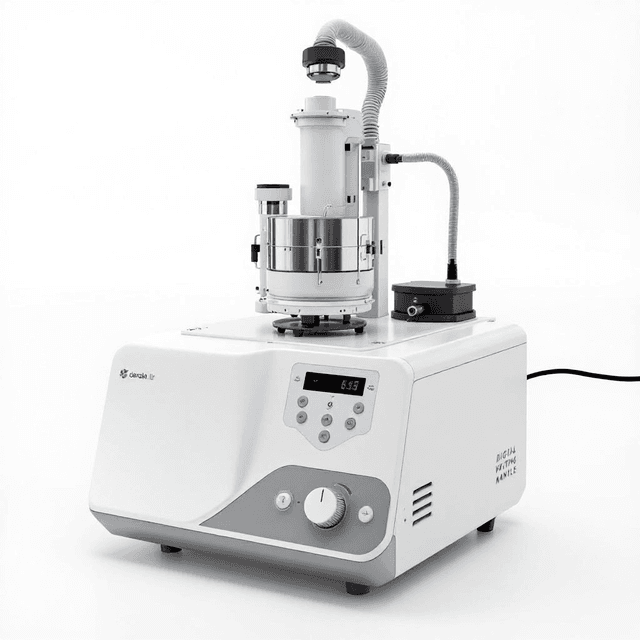
The Small Capacity Rotary Evaporator is a benchtop solvent removal system designed for laboratory-scale concentration and purification applications. This unit combines controlled rotation, heating, and vacuum to facilitate gentle evaporation of solvents from sample solutions while minimizing thermal decomposition. The system features a 1L standard rotary flask with vertical condenser configuration, enabling efficient solvent recovery and sample concentration for analytical chemistry, pharmaceutical development, and materials synthesis workflows.
Operating with rotation speeds from 0-200 rpm and temperature control from room temperature to 99°C (±1°C accuracy), this rotary evaporator provides precise process control for heat-sensitive compounds. The integrated vacuum capability (-0.098 MPa) and 120mm stroke height allow for effective solvent removal while maintaining sample integrity through gentle processing conditions.
How It Works
Rotary evaporation operates on the principle of reducing solvent boiling point through vacuum application while enhancing heat transfer through flask rotation. The sample solution in the rotary flask is continuously rotated, creating a thin film on the flask wall that increases surface area for evaporation. Simultaneously, the heating bath provides controlled thermal energy while the vertical condenser cools and recovers evaporated solvent vapors.
The vacuum system reduces atmospheric pressure, lowering the boiling point of the solvent and enabling evaporation at lower temperatures than would be required at atmospheric pressure. This prevents thermal degradation of heat-sensitive compounds. The rotation motion prevents bumping and superheating by maintaining constant agitation and creating a larger evaporation surface. The stroke height mechanism allows vertical adjustment of the flask position for optimal immersion in the heating bath.
Evaporated solvent travels through the vapor duct to the vertical condenser where it condenses back to liquid form and collects in the receiving flask. This closed-loop system enables solvent recovery while concentrating the non-volatile components in the rotary flask through controlled, gentle processing conditions.
Features & Benefits
Automation Level
- manual
RE-2000B
- RE-2000E
RE-52A
- RE-52C
Rotary Bottle
- 1L 24#(Standard size)
Collecting Bottle
- 1L 35#(Ball mill mouth)
Condenser
- Vertical φ85*430mm
Charging Valve
- 19#(Standard size)
Rotating Speed
- 0~200rpm
Vacuum
- -0.098Mpa
Temp. Range
- RT~99℃
Temp. Accuracy
- ±1℃
Stroke Height
- 120mm
Rotating Power
- 40W
Heating Power
- 1.5KW
Shelf Material
- Aluminum alloy
Brand
- ConductScience
Research Domain
- Analytical Chemistry
- Clinical Diagnostics
- Environmental Monitoring
- Food Science
- Materials Science
- Pharmaceutical QC
Shipping weight
- 25.0 lb
Shipping box
- L: 69.0 cm
- W: 63.0 cm
- H: 40.0 cm
| Feature | This Product | Typical Alternative | Advantage |
|---|---|---|---|
| Flask Capacity | 1L standard capacity with 24# joint | Entry-level models often limited to 500mL capacity | Larger capacity accommodates bigger sample volumes and reduces need for multiple evaporation cycles |
| Temperature Range | Room temperature to 99°C with ±1°C accuracy | Basic units may lack precise temperature control | Accurate temperature control prevents overheating of thermally sensitive compounds |
| Rotation Speed Control | Variable 0-200 rpm with 40W motor | Fixed or limited speed ranges in basic models | Wide speed range allows optimization for different solvent systems and sample viscosities |
| Vacuum Capability | -0.098 MPa operating vacuum | Lower vacuum levels in entry-level systems | Higher vacuum enables more efficient evaporation at lower temperatures for better sample preservation |
| Stroke Height Adjustment | 120mm vertical adjustment range | Limited or no height adjustment in basic units | Flexible positioning optimizes heat transfer and accommodation of different sample volumes |
| Condenser Configuration | Vertical condenser 85×430mm | Smaller condensers in compact models | Larger condenser surface area improves condensation efficiency and solvent recovery rates |
This rotary evaporator provides laboratory-standard capacity and performance with precise temperature control, variable rotation speed, and effective vacuum capability. The 1L flask capacity and comprehensive adjustment features make it suitable for routine analytical chemistry and sample preparation workflows requiring reliable solvent removal.
Practical Tips
Verify temperature accuracy using a calibrated thermometer in the heating bath and adjust controller as needed for your working temperature range.
Why: Accurate temperature control prevents thermal decomposition and ensures reproducible evaporation conditions.
Clean all glassware with appropriate solvents after each use and inspect joint seals for wear or damage.
Why: Residual contamination and poor seals can affect vacuum integrity and cross-contaminate samples.
Start evaporation with moderate rotation speed and temperature, then adjust based on solvent behavior and bumping tendency.
Why: Gradual parameter adjustment prevents violent boiling and sample loss while optimizing evaporation efficiency.
Always use appropriate PPE and work in a fume hood when evaporating toxic or flammable solvents.
Why: Vapor exposure and fire hazards require proper ventilation and protective equipment for safe operation.
Record rotation speed, temperature, and vacuum settings for reproducible sample preparation protocols.
Why: Documented parameters enable consistent results and troubleshooting of processing variations.
If evaporation is slow, check vacuum integrity and increase temperature gradually rather than dramatically increasing rotation speed.
Why: Poor vacuum is often the limiting factor, and excessive rotation can cause splashing without improving evaporation rate.
Use a receiving flask larger than the expected solvent volume to prevent overflow during efficient evaporation cycles.
Why: Adequate collection capacity prevents solvent loss and potential vacuum system contamination.
Setup Guide
What’s in the Box
- Main rotary evaporator unit
- 1L rotary flask (24# standard joint)
- 1L collecting bottle (35# ball mouth)
- Vertical condenser (85×430mm)
- Charging valve (19# standard)
- Power cord
- User manual (typical)
- Glassware clamps and connections (typical)
Warranty
ConductScience provides a one-year manufacturer warranty covering defects in materials and workmanship, with technical support for operational guidance and troubleshooting assistance.
Compliance
References
Background reading relevant to this product:
What vacuum source is required for optimal operation?
The system requires a vacuum source capable of achieving -0.098 MPa. A standard laboratory vacuum pump or vacuum controller with appropriate capacity for the evaporation rate is recommended.
How do I select appropriate rotation speed for different solvents?
Start with 50-80 rpm for most organic solvents and adjust based on sample behavior. Higher speeds (up to 200 rpm) increase heat transfer for viscous solutions, while lower speeds prevent splashing of volatile solvents.
What is the maximum sample volume for efficient evaporation?
The 1L flask capacity allows for samples up to approximately 500-700 mL for optimal rotation and heat transfer, depending on solvent volatility and evaporation requirements.
Can this unit handle water-based solutions?
Yes, the temperature range up to 99°C accommodates aqueous solutions, though efficient water evaporation requires adequate vacuum and may benefit from higher rotation speeds for enhanced heat transfer.
What maintenance is required for consistent performance?
Regular cleaning of glassware with appropriate solvents, inspection of joint seals, and periodic calibration of temperature control ensure reliable operation. Replace worn seals and gaskets as needed.
How accurate is the temperature control for heat-sensitive compounds?
Temperature accuracy of ±1°C provides sufficient precision for most heat-sensitive applications when combined with reduced pressure operation to lower effective evaporation temperatures.
What are the electrical requirements for installation?
Consult product datasheet for specific electrical specifications. The 1.5KW heating element requires appropriate electrical service and circuit protection for safe operation.
Can I use non-standard glassware with this system?
The unit uses standard laboratory joints (24# rotary flask, 35# collecting bottle, 19# charging valve) compatible with most laboratory glassware suppliers for easy replacement and customization.
Have a question about this product?
Have a question? Just ask.
Send it over and we'll email you a personalized answer — no call, no scheduling.
Prefer to talk it through?