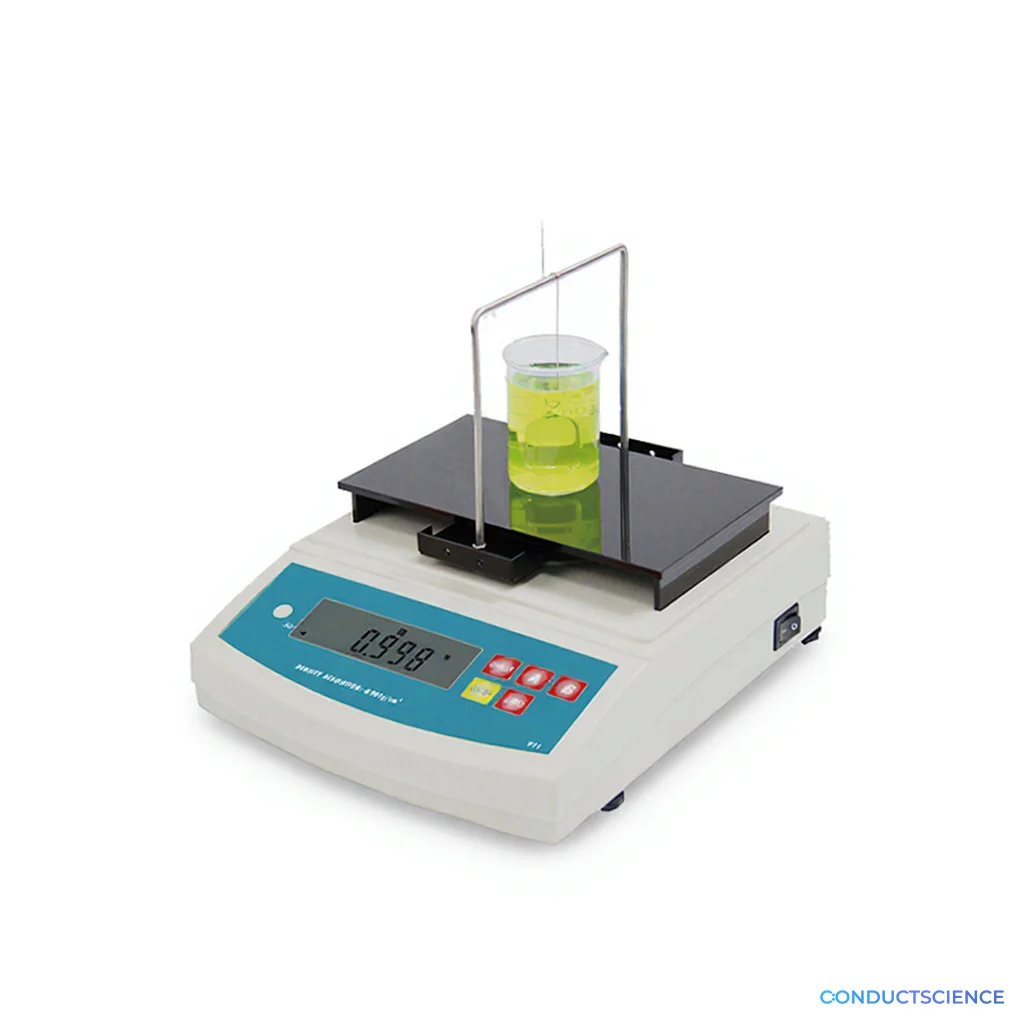
Solid and Liquid Densimeter
Solid and liquid densimeter for density measurement of solids and liquids.
Uses Archimedes principle; ~5 second measurement; water temperature compensation; solution compensation; RS-232C. Optional DE-20B assembly for corrosive or volatile liquids.

Louise Corscadden, PhD
Director of Science · ConductScience
Ask Louise about Solid and Liquid Densimeter fit, setup, configuration, or quote prep.
Already working with us? Sign in to connect this with My Scientist.
Key Specifications
Full details →- Model fit
- 2 selectable configurations
- SKU family
- Assigned during quote
- Shipping box
- 11.6 x 13.5 x 5.0 cm
- Ordering
- Online checkout and quote request available
- Category
- Analytical Instruments
- Build notes
- Confirm accessories, station layout, and support needs before purchase
The BK-DME solid and liquid densimeter measures the density of both solid materials and liquids, supporting quality management, cost control, formula research, and material studies. Measurement is based on Archimedes principle. Water temperature compensation and solution compensation functions ensure accuracy across varying conditions. For volatile, corrosive, or strong acid/base liquids, the optional DE-20B anti-corrosive assembly is required.
Technical Specifications
| Parameter | BK-DME300D | BK-DME600D |
|---|---|---|
| Capacity | 0.005–300 g | 0.005–600 g |
| Density Range | 0.001–99.999 g/cm³ | |
| Density Resolution | 0.001 g/cm³ | |
| Measuring Time | ~5 seconds | |
| Principle | Archimedes | |
| Temperature Compensation | Water temperature compensation | |
| Interface | RS-232C | |
| Power Supply | AC 100–240 V, 50/60 Hz | |
| External Dimensions (W×D×H) | 195 × 230 × 197 mm | |
| Net Weight | 1.78 kg | 1.79 kg |
Standard Accessories
Tweezers, thermometer, 100 g weight, windshield, power transformer, tank, testing board, particle measuring assembly, floating body measuring assembly, measuring plate, DE-20A standard liquid measuring assembly.
Optional Accessories
DE-40 printer; DE-20B anti-corrosive liquid measuring assembly.
How It Works
The densimeter operates on Archimedes principle, which states that the buoyant force on a submerged object equals the weight of the displaced fluid. For solid samples, the instrument measures the sample's weight in air and then its apparent weight when submerged in a reference liquid (typically distilled water). The density is calculated from the difference between these two measurements, accounting for the known density of the reference liquid and environmental conditions.
For liquid measurements, the displacement method involves measuring the volume displaced by a known mass of sample or using a calibrated sinker of known volume. The instrument's measurement system automatically corrects for temperature variations and provides rapid density determinations within approximately 5 seconds. Distilled water testing validates measurement accuracy, while the auto-detection function ensures proper measurement conditions are maintained throughout the analysis.
Features & Benefits
General Specifications
| Measurement principle | Archimedes displacement |
| Density range | 0.001–99.999 g/cm³ |
| Density resolution | 0.001 g/cm³ |
| Measurement time | ~5 seconds |
| Display output | Density (g/cm³) + Baumé degrees |
| Power supply | AC 100–240 V, 50/60 Hz |
| Data interface | RS-232C |
Correction & Safety
| Zero tracking | Automatic |
| Temperature compensation | Water temperature compensation |
| Solution compensation | Included |
| Overload warning | Buzzer alert |
| Liquid reference | Distilled water validation |
Physical Dimensions
| Instrument (W×D×H) | 195 × 230 × 197 mm |
| Measuring tank (W×D×H) | 153 × 107 × 93 mm |
| Package (W×D×H) | 440 × 180 × 345 mm |
| Net weight (DME300D) | 1.78 kg |
| Net weight (DME600D) | 1.79 kg |
| Gross weight | 4.5 kg |
Model Comparison
| Specification | BB-BK-DME300D | BB-BK-DME600D |
|---|---|---|
| Capacity | 0.005–300 g | 0.005–600 g |
| Density range | 0.001–99.999 g/cm³ | 0.001–99.999 g/cm³ |
| Density resolution | 0.001 g/cm³ | 0.001 g/cm³ |
| Measurement time | ~5 seconds | ~5 seconds |
| Net weight | 1.78 kg | 1.79 kg |
| Price | $2,799.99 | $2,899.99 |
Standard Accessories
- Tweezers
- Thermometer
- 100 g calibration weight
- Windshield
- Transformer / power adapter
- Measuring tank (153×107×93 mm, transparent)
- Testing board
- Particle measuring assembly
- Floating body assembly
- Measuring plate
- DE-20A standard liquid measuring assembly
Optional Accessories
- DE-40 thermal printer
- DE-20B anti-corrosive liquid measuring assembly
| Feature | This Product | Typical Alternative | Advantage |
|---|---|---|---|
| Measurement Time | Approximately 5 seconds | Entry-level models often require 30-60 seconds per measurement | Enables higher sample throughput and reduces analysis bottlenecks in busy laboratories |
| Capacity Range | 0.001-120g | Basic instruments typically handle 10-100g ranges | Accommodates both micro-samples and larger specimens in a single instrument platform |
| Calibration System | Auto correction with distilled water testing validation | Manual calibration procedures with external standards | Reduces operator error and ensures consistent measurement accuracy without extensive training |
| Display Options | Density values, Baumé degrees, and percentage of main material | Single density value output in basic models | Provides comprehensive results in multiple formats to meet diverse analytical requirements |
| Material Compatibility | Standard configuration with optional anti-corrosive assembly | Limited chemical compatibility in standard instruments | Extends analytical capabilities to aggressive chemicals with appropriate accessories |
| Power Requirements | Universal AC 100-240V, 50/60Hz | Fixed voltage requirements in many models | Ensures global compatibility without voltage converters or modifications |
This densimeter combines rapid 5-second measurements with broad 0.001-120g capacity range and automatic correction capabilities. The instrument offers comprehensive display options including density, Baumé values, and material percentages, while optional accessories extend compatibility to corrosive materials.
| Model | SKU | Listed price | Status | Shipping box |
|---|---|---|---|---|
| BK-DME600D | BB-BK-DME600D | $1,890.00 | Available | 11.6 x 13.5 x 5.0 cm |
| BK-DME300D | BB-BK-DME300D | $1,790.00 | Available | 11.6 x 13.5 x 5.0 cm |
Practical Tips
Perform distilled water testing at the beginning of each analytical session to verify measurement accuracy.
Why: Environmental conditions can drift throughout the day, affecting measurement precision.
Clean measurement surfaces with appropriate solvents and dry thoroughly between different sample types.
Why: Residual contamination can bias density measurements and affect subsequent analyses.
Allow samples to equilibrate to room temperature before measurement to minimize thermal effects.
Why: Temperature variations affect both sample density and the reference liquid properties.
Remove all air bubbles from liquid samples using gentle agitation or vacuum degassing.
Why: Trapped air reduces apparent density and creates measurement errors in displacement calculations.
Perform multiple measurements on critical samples and calculate average values for improved precision.
Why: Replicate measurements help identify outliers and improve statistical confidence in results.
If measurements show excessive drift, check for vibration sources and air currents around the instrument.
Why: External disturbances can affect the sensitive measurement balance and cause inconsistent results.
Use appropriate personal protective equipment when handling corrosive samples with the anti-corrosive assembly.
Why: Chemical compatibility accessories protect the instrument but do not eliminate operator exposure risks.
Setup Guide
What’s in the Box
- High-precision densimeter main unit
- Power adapter and cord
- Sample holders and measurement accessories (typical)
- Distilled water reference container (typical)
- User manual and calibration certificate (typical)
- Measurement beaker and sample tools (typical)
Warranty
ConductScience provides a standard one-year manufacturer warranty covering defects in materials and workmanship. Technical support and calibration services are available throughout the warranty period and beyond.
Compliance
What is the difference between the BB-BK-DME300D and BB-BK-DME600D?
The only difference is weighing capacity. The DME300D handles samples from 0.005 g to 300 g, while the DME600D extends to 600 g. All other specs — density range, resolution, measurement time, dimensions, and accessories — are identical.
What types of samples can this densimeter measure?
The instrument measures both solid samples (granules, pellets, powder compacts, gems, minerals, polymers) and liquids. For solids it uses the Archimedes immersion method; for liquids it uses a dedicated floating body or liquid measuring assembly.
Does the instrument compensate for liquid temperature?
Yes. The densimeter includes automatic water temperature compensation and solution compensation to correct for variations in liquid density caused by temperature changes, improving accuracy without manual correction tables.
Can results be exported to a computer or printer?
Yes. The instrument includes an RS-232C interface for data transfer to a PC. An optional DE-40 thermal printer can also be connected for direct printouts.
What is included in the standard accessory package?
Standard accessories include: tweezers, thermometer, 100 g calibration weight, windshield, power transformer, measuring tank, testing board, particle measuring assembly, floating body assembly, measuring plate, and DE-20A standard liquid measuring assembly. Optional extras include the DE-40 printer and DE-20B anti-corrosive assembly.
Have a question about this product?
Have a question? Just ask.
Send it over and we'll email you a personalized answer — no call, no scheduling.
Prefer to talk it through?