Stereo Zoom Microscope (7X-45X Standard, 14X-180X Optional)
Variable magnification stereo microscope providing 7X to 45X magnification with 235mm working distance for three-dimensional specimen observation and manipulation.

Louise Corscadden, PhD
Director of Science · ConductScience
Ask Louise about Stereo Zoom Microscope (7X-45X Standard, 14X-180X Optional) fit, setup, configuration, or quote prep.
Already working with us? Sign in to connect this with My Scientist.
Key Specifications
Full details →- Model fit
- 2 selectable configurations
- SKU family
- MCX-0083
- Shipping box
- 33.0 x 49.0 x 41.5 cm
- Ordering
- Online checkout and quote request available
- Category
- Microscopy
- Build notes
- Confirm accessories, station layout, and support needs before purchase
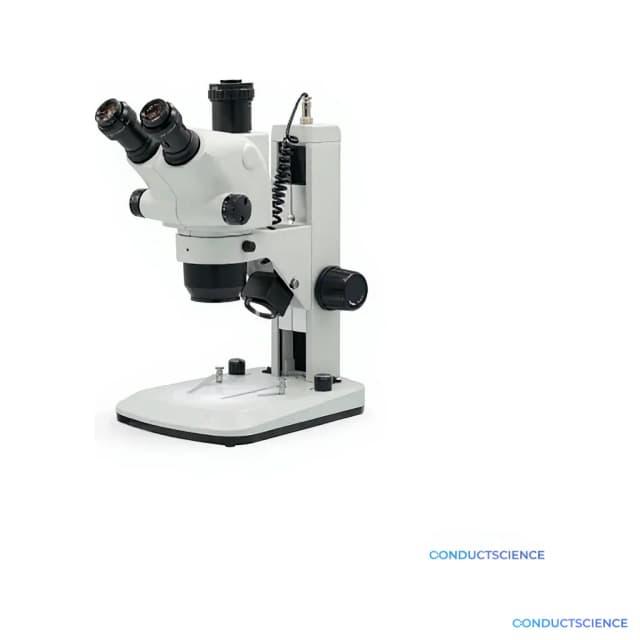
The Stereo Zoom Microscope (BIO-0508) is a variable magnification optical system designed for three-dimensional observation and manipulation of biological specimens. This stereoscopic microscope provides magnification from 7X to 45X with standard 10X eyepieces, delivering a working distance of 235mm that accommodates larger specimens and allows manipulation access during observation.
The instrument features dual optical paths with adjustable interpupillary distance (55-75mm) to accommodate different users, and a focusing bracket system with 60mm slide focusing range. Optional 2X objective and 20X eyepieces extend the magnification range from 14X to 180X when enhanced magnification is required. The substantial working distance and stereo visualization make this microscope suitable for dissection, assembly work, quality inspection, and specimen preparation across multiple research disciplines.
How It Works
Stereo zoom microscopy employs dual optical paths that present slightly offset images to each eye, creating stereoscopic depth perception similar to human binocular vision. Each optical path contains identical objective lenses and eyepieces, with the objectives positioned at a convergence angle that generates parallax between the left and right images. This parallax is interpreted by the visual cortex as three-dimensional depth information.
The zoom mechanism utilizes continuously variable magnification through internal lens groups that maintain parfocal focus across the magnification range. Light from the specimen travels through the objective system, is magnified by the zoom optics, and reaches the eyepieces where final magnification occurs. The 235mm working distance is achieved through the objective design, providing clearance for manipulation tools while maintaining optical performance.
Focus adjustment moves the entire optical head vertically using the slide focusing mechanism with 60mm range. The interpupillary distance adjustment aligns the eyepieces with individual user anatomy, ensuring comfortable viewing and proper stereo fusion for three-dimensional perception.
Features & Benefits
Shipping weight
- 8.0 lb
Shipping box
- L: 33.0 cm
- W: 49.0 cm
- H: 41.5 cm
| Feature | This Product | Typical Alternative | Advantage |
|---|---|---|---|
| Magnification Range | 7X to 45X standard (14X to 180X with options) | Entry-level models often provide fixed 10X-40X or limited zoom ranges | Variable magnification allows seamless transition from specimen overview to detailed examination without changing objectives |
| Working Distance | 235mm overall working distance | Compact models typically offer 100-150mm working distances | Extended working distance accommodates larger specimens and provides manipulation tool clearance during observation |
| Eyepiece Configuration | 10X eyepieces with Ø22mm field (20X optional) | Standard models often include 10X or 15X fixed eyepieces | Wide field eyepieces reduce specimen repositioning and optional 20X eyepieces extend magnification capabilities |
| Focusing Range | 60mm slide focusing range | Basic models may offer 30-40mm focusing travel | Extended focusing range accommodates specimens of varying heights without stage repositioning |
| Interpupillary Adjustment | 55mm to 75mm adjustment range | Standard range is typically 55-75mm across most models | Full adjustment range ensures comfortable viewing for users with different eye spacings |
This stereo zoom microscope provides variable 7X-45X magnification with extended 235mm working distance and 60mm focusing range. The combination of wide-field eyepieces, optional higher-magnification optics, and substantial manipulation clearance addresses requirements for both routine observation and precision manipulation tasks.
| Model | SKU | Listed price | Status | Shipping box |
|---|---|---|---|---|
| Standard Model — Basic Configuration | GENERIC | $425.00 | Available | 33.0 x 49.0 x 41.5 cm |
| BIO-0508 — Standard Configuration | BIO-0508 | $425.00 | Available | 33.0 x 49.0 x 41.5 cm |
Practical Tips
Verify parfocal performance by focusing at lowest magnification then zooming to highest power to check focus maintenance.
Why: Parfocal alignment ensures consistent focus across the magnification range for efficient operation.
Clean eyepieces and objectives monthly with lens tissue and appropriate optical cleaning solution, avoiding excessive pressure.
Why: Regular optical cleaning maintains image contrast and prevents damage from accumulated debris.
Adjust interpupillary distance for each new user and allow time for stereo vision adaptation before precision work.
Why: Proper interpupillary alignment and visual adaptation are essential for accurate depth perception during manipulation.
If stereo effect is lost, check that both eyepieces are properly seated and interpupillary distance matches user anatomy.
Why: Misaligned optics prevent proper stereo fusion and eliminate three-dimensional depth perception.
Use both incident and transmitted lighting simultaneously for specimens with varying transparency to enhance contrast.
Why: Combined illumination reveals both surface and internal features for comprehensive specimen assessment.
Ensure adequate clearance around the 235mm working distance when positioning specimens and manipulation tools.
Why: Proper clearance prevents collision between tools and optics while maintaining safe manipulation distances.
Start observations at lowest magnification for specimen location then zoom in for detailed examination.
Why: Progressive magnification increases field coverage efficiency and prevents losing specimen location at high power.
Protect eyepieces with caps when not in use and store in a dust-free environment to maintain optical quality.
Why: Environmental protection prevents dust accumulation and mechanical damage to precision optical surfaces.
Setup Guide
What’s in the Box
- Stereo zoom microscope body
- Pair of 10X eyepieces (Ø22mm)
- Focusing bracket with Ø76mm mounting hole
- User manual and optical specifications
- Lens cleaning kit (typical)
- Eyepiece caps (typical)
Warranty
ConductScience provides a standard one-year manufacturer warranty covering optical and mechanical components, with technical support available for setup and operational guidance.
Compliance
What is the actual magnification range achievable with standard and optional optics?
Standard configuration with 10X eyepieces provides 7X to 45X total magnification. Adding optional 2X objectives extends this to 14X-180X, while optional 20X eyepieces can achieve higher magnifications. Consult product datasheet for complete optical specifications.
How does working distance change across the magnification range?
Working distance varies from 28mm at 7X magnification to 4.3mm at 45X. The overall 235mm working distance refers to the clearance from the microscope body to the specimen, allowing manipulation tool access.
What mounting options are available for laboratory integration?
The focusing bracket features a Ø76mm mounting hole compatible with standard laboratory boom stands and articulating arms. The 60mm slide focusing range allows vertical positioning adjustment.
Can this microscope accommodate different user eye spacings?
Yes, the interpupillary distance adjusts from 55mm to 75mm to accommodate individual users and ensure proper stereo image fusion for three-dimensional perception.
What specimen sizes can be accommodated under this microscope?
The 235mm working distance and wide field eyepieces accommodate large specimens. Maximum specimen height depends on the focusing range and working distance at your chosen magnification.
Is parfocal performance maintained across the zoom range?
Stereo zoom systems typically maintain parfocal focus across the magnification range, though minor focus adjustment may be needed. Verify parfocal performance during initial setup with your specific specimens.
What illumination is required for optimal imaging?
Both incident (top) and transmitted (bottom) lighting may be needed depending on specimen type. LED ring lights or fiber optic illuminators provide even illumination for stereo observation.
Have a question about this product?
Have a question? Just ask.
Send it over and we'll email you a personalized answer — no call, no scheduling.
Prefer to talk it through?
Upgrade Options
Related Products