Surgical Handles, Blades, and Knives
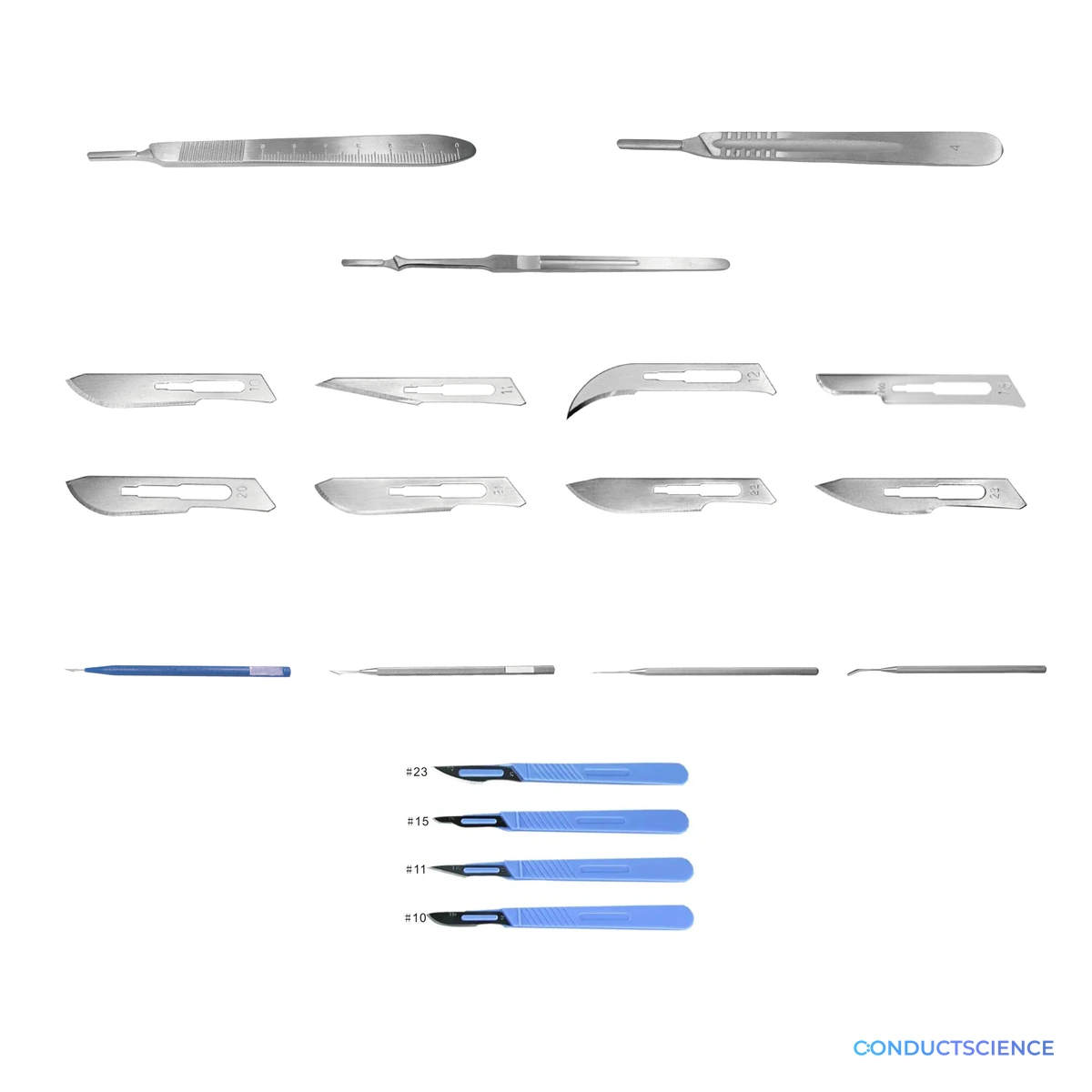
Selectable surgical handles, blade packs, disposable surgical knives, and reusable micro-knife configurations for research surgical tray buildouts, with #3, #4, and #7 ruler handles, compatible #10-#23 blade packs, disposable #10, #11, #15, and #23 knives, and 2 mm to 5 mm reusable cutting-edge options for small-animal dissection and incision planning.

Louise Corscadden, PhD
Director of Science · ConductScience
Ask Louise about Surgical Handles, Blades, and Knives fit, setup, configuration, or quote prep.
Already working with us? Sign in to connect this with My Scientist.
Key Specifications
Full details →- Model fit
- #3 and #7 handles fit #10-#15 blades; #4 handle fits #20-#23 blades
- SKU family
- CS-SRG-HANDLES-BLADES-KNIVES
- Sizing
- Model-specific dimensions confirmed from the selected configuration
- Ordering
- Online checkout and quote request available
- Category
- Surgical Instruments
- Build notes
- Confirm accessories, station layout, and support needs before purchase
Overview
The Surgical Handles, Blades, and Knives page gives a lab one place to select the cutting hardware that often sits at the front of a small-animal surgery tray: reusable ruler handles, compatible disposable blade packs, disposable surgical knives, and reusable fine surgical knives. The source family includes #3, #4, and #7 handles with ruler markings, blade packs in #10, #11, #12, #15, #20, #21, #22, and #23 sizes, disposable surgical knives in #10, #11, #15, and #23 sizes, and reusable straight or curved surgical knives with 2 mm to 5 mm cutting-edge details.
The buying value is compatibility and replenishment. The #3 and #7 ruler handles are listed for #10, #11, #12, and #15 blades, while the #4 handle is listed for #20, #21, #22, and #23 blades. That lets procurement replace a handle, add a blade pack, or choose disposable knives without splitting the decision across unrelated product pages.
Scientific Use
Scalpel handles, surgical blades, and fine surgical knives are used across rodent surgery preparation, dissection stations, incision planning, tissue trimming, necropsy, perfusion access, catheter surgery support, and general small-animal surgical tray buildouts. Blade-number choice is a practical workflow decision: smaller #10-#15 blade families are paired here with #3 or #7 handles, while larger #20-#23 blade families are paired with the #4 handle path.
The reusable surgical knife options are useful when a lab wants a dedicated 2 mm or 5 mm cutting edge rather than a replaceable scalpel blade. The curved round-edge 2.2 mm by 4 mm blade configuration gives a distinct geometry for rounded approach cuts, while the straight 5 mm and 2 mm options support direct fine cutting in compact fields.
Buying Fit
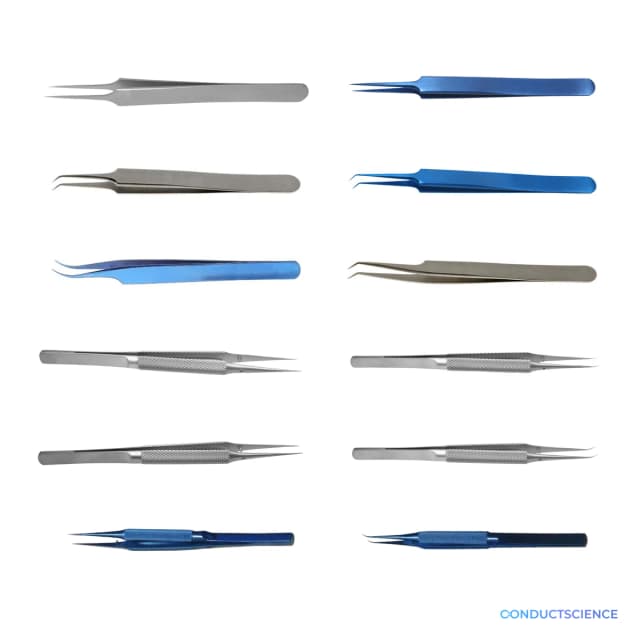
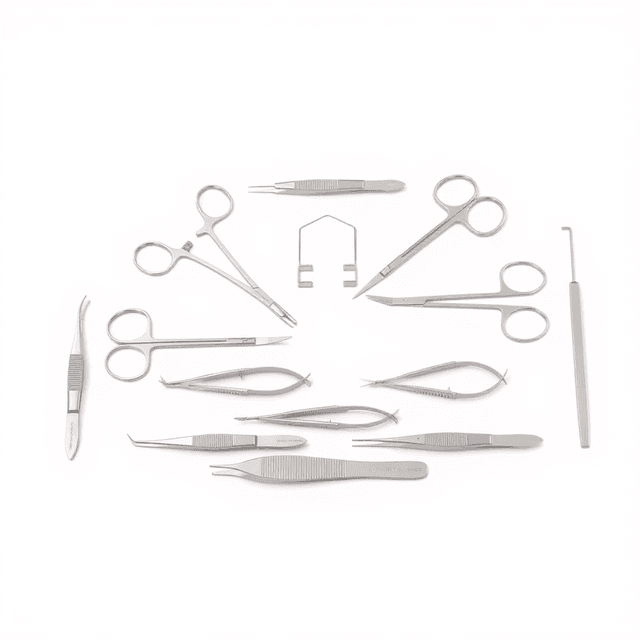
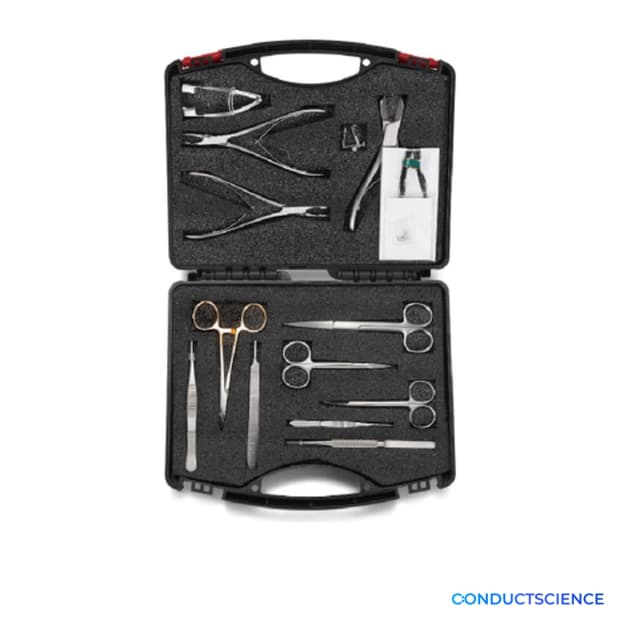
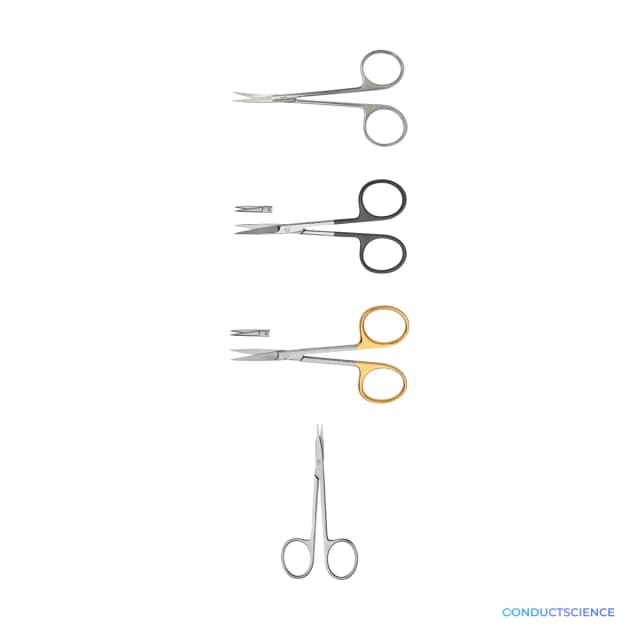
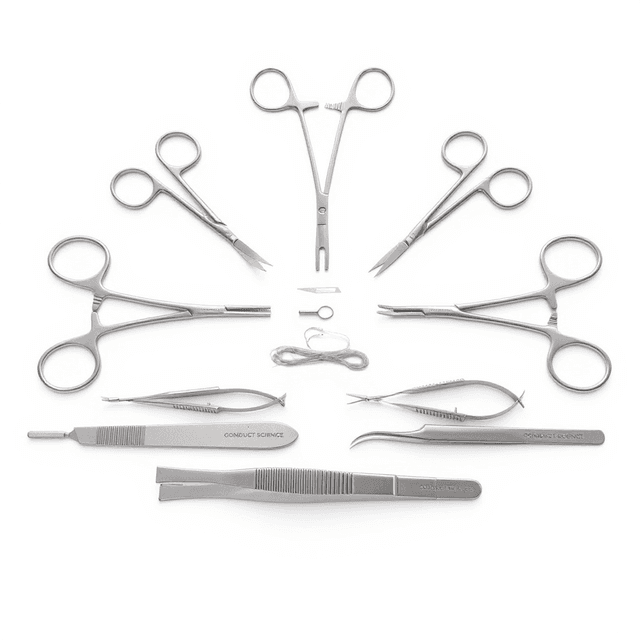
Choose this listing when the lab is building or refreshing the cutting portion of a surgical tray. Pair selected handles, blades, or knives with forceps, scissors, needle holders, sutures, magnification, anesthesia, warming, and sterile-field supplies to complete the station.
Features & Benefits
Handle compatibility
- #3 and #7 handles fit #10-#15 blades; #4 handle fits #20-#23 blades
Blade pack sizes
- #10, #11, #12, #15, #20, #21, #22, and #23 blades; pack of 100
Disposable knife sizes
- #10, #11, #15, and #23 disposable surgical knives; pack of 100
Reusable knife geometry
- Straight 5 mm cutting edge, straight 2 mm cutting edge, or curved round edge with 2.2 mm blade width and 4 mm blade length
Use fit
- Incision planning, tissue trimming, dissection, tray replenishment, and small-animal surgical station buildouts
| Model | SKU | Listed price | Status | Shipping box |
|---|---|---|---|---|
| Surgical handle with ruler #3, 12 cm, for blades #10-#15 | CS-SRG-HANDLE-RULER-3-120 | $10.99 | Available | Confirmed during quote |
| Surgical handle with ruler #7, 17 cm, for blades #10-#15 | CS-SRG-HANDLE-RULER-7-170 | $12.99 | Available | Confirmed during quote |
| Surgical handle with ruler #4, 13 cm, for blades #20-#23 | CS-SRG-HANDLE-RULER-4-130 | $10.99 | Available | Confirmed during quote |
| Surgical blades #10, pack of 100 | CS-SRG-BLADE-10-PK100 | $14.99 | Available | Confirmed during quote |
| Surgical blades #11, pack of 100 | CS-SRG-BLADE-11-PK100 | $14.99 | Available | Confirmed during quote |
| Surgical blades #12, pack of 100 | CS-SRG-BLADE-12-PK100 | $14.99 | Available | Confirmed during quote |
| Surgical blades #15, pack of 100 | CS-SRG-BLADE-15-PK100 | $14.99 | Available | Confirmed during quote |
| Surgical blades #20, pack of 100 | CS-SRG-BLADE-20-PK100 | $14.99 | Available | Confirmed during quote |
| Surgical blades #21, pack of 100 | CS-SRG-BLADE-21-PK100 | $14.99 | Available | Confirmed during quote |
| Surgical blades #22, pack of 100 | CS-SRG-BLADE-22-PK100 | $14.99 | Available | Confirmed during quote |
| Surgical blades #23, pack of 100 | CS-SRG-BLADE-23-PK100 | $14.99 | Available | Confirmed during quote |
| Disposable surgical knives #10, pack of 100 | CS-SRG-DISP-KNIFE-10-PK100 | $54.99 | Available | Confirmed during quote |
| Disposable surgical knives #11, pack of 100 | CS-SRG-DISP-KNIFE-11-PK100 | $54.99 | Available | Confirmed during quote |
| Disposable surgical knives #15, pack of 100 | CS-SRG-DISP-KNIFE-15-PK100 | $54.99 | Available | Confirmed during quote |
| Disposable surgical knives #23, pack of 100 | CS-SRG-DISP-KNIFE-23-PK100 | $54.99 | Available | Confirmed during quote |
| Reusable surgical knife, straight sharp, 5 mm cutting edge, 13 cm | CS-SRG-KNIFE-STR-5-130 | $19.99 | Available | Confirmed during quote |
| Reusable surgical knife, straight sharp, 5 mm cutting edge, 11 cm | CS-SRG-KNIFE-STR-5-110 | $18.99 | Available | Confirmed during quote |
| Reusable surgical knife, straight sharp, 2 mm cutting edge, 11.5 cm | CS-SRG-KNIFE-STR-2-115 | $18.99 | Available | Confirmed during quote |
| Reusable surgical knife, curved round edge, 2.2 mm blade width, 4 mm blade length, 12.5 cm | CS-SRG-KNIFE-CVD-ROUND-22-4-125 | $19.99 | Available | Confirmed during quote |
Practical Tips
Match #10-#15 blade packs with #3 or #7 handles and #20-#23 blade packs with the #4 handle path.
Why: The handle family is separated by blade-number compatibility so the tray can be ordered without mixing incompatible handles and blades.
Order blade packs and disposable surgical knives by expected cohort volume, then keep reusable handles and reusable knives on a separate inspection and cleaning schedule.
Why: Consumables and reusable instruments fail or run out for different reasons, so tracking them separately prevents tray shortages.
Pair cutting hardware with forceps, scissors, needle holders, sutures, sterile-field supplies, magnification, anesthesia, and warming when building a full small-animal surgery setup.
Why: Handles and blades start the cutting path, but the complete station still needs handling, closure, visualization, and animal-support equipment.
Setup Guide
What’s in the Box
- 1 x selected surgical handle, blade pack, disposable surgical knife pack, or reusable surgical knife configuration
- #3 and #7 handles are compatible with #10, #11, #12, and #15 blades
- #4 handle is compatible with #20, #21, #22, and #23 blades
- Blade and disposable-knife options are supplied as pack-of-100 configurations when selected
Warranty
Support, replacement, and fulfillment terms are confirmed with the final quote and institutional purchasing requirements.
Compliance
Which handle should I choose for #10, #11, #12, or #15 blades?
Choose the #3 ruler handle for a standard 12 cm handle path or the #7 ruler handle when the workflow benefits from the longer 17 cm handle. Both are configured for #10, #11, #12, and #15 blades.
Which handle should I choose for #20, #21, #22, or #23 blades?
Choose the #4 ruler handle. The source page lists the #4 handle at 13 cm total length and maps it to #20, #21, #22, and #23 blades.
Are blade packs sold as individual blades or packs?
The blade options on this page are pack-of-100 configurations for #10, #11, #12, #15, #20, #21, #22, and #23 blades.
When should I choose disposable surgical knives instead of blade packs?
Choose disposable surgical knives when the lab wants a handled single-use knife format. Choose blade packs when the lab already uses reusable #3, #4, or #7 handles and only needs replacement blades.
What do the reusable surgical knife options add?
The reusable knife configurations provide fixed fine cutting-edge geometry, including straight 5 mm, straight 2 mm, and curved round-edge 2.2 mm by 4 mm blade options for labs that want a dedicated fine knife rather than a replaceable scalpel blade.
Have a question about this product?
Have a question? Just ask.
Send it over and we'll email you a personalized answer — no call, no scheduling.
Prefer to talk it through?
Accessories
Enhance your setup with compatible accessories