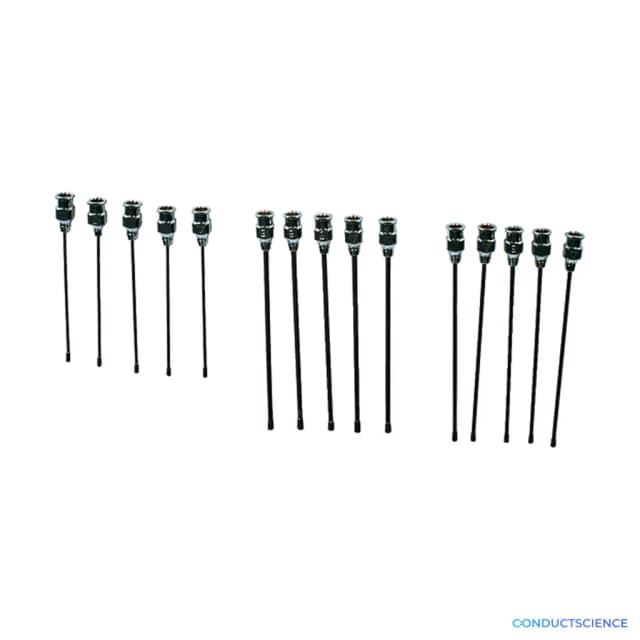
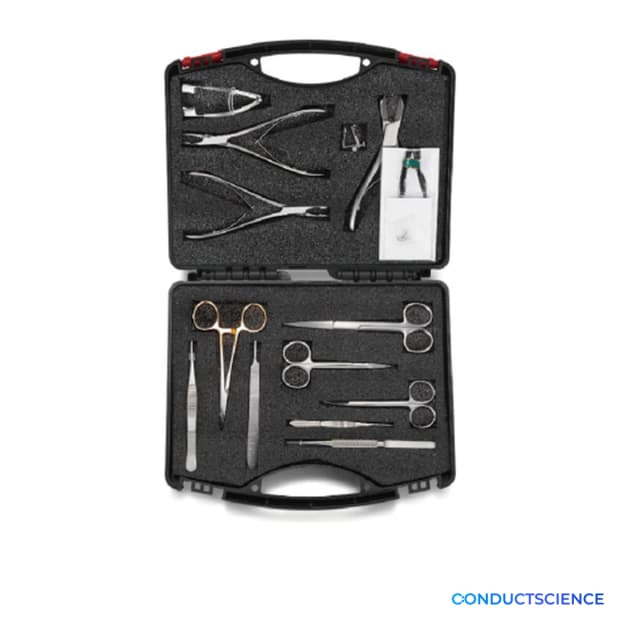
Comprehensive Surgical Kit
Blade width, thickness, length range 10-18cm for shearing dressings, animal epidermal tissues, or more rigid tissues..
: 9, 19-20/F, Building 7A, 9F Building 7D,.

Louise Corscadden, PhD
Director of Science · ConductScience
Ask Louise about Comprehensive Surgical Kit fit, setup, configuration, or quote prep.
Already working with us? Sign in to connect this with My Scientist.
Key Specifications
Full details →- Model fit
- Gerbil, Hamster, Rabbit, Mouse, Rat, Guinea pig
- SKU family
- RWD-SP0001-G
- Shipping box
- 34.0 x 39.0 x 33.0 cm
- Ordering
- Online checkout and quote request available
- Category
- Surgical Instruments
- Build notes
- S/S, SS
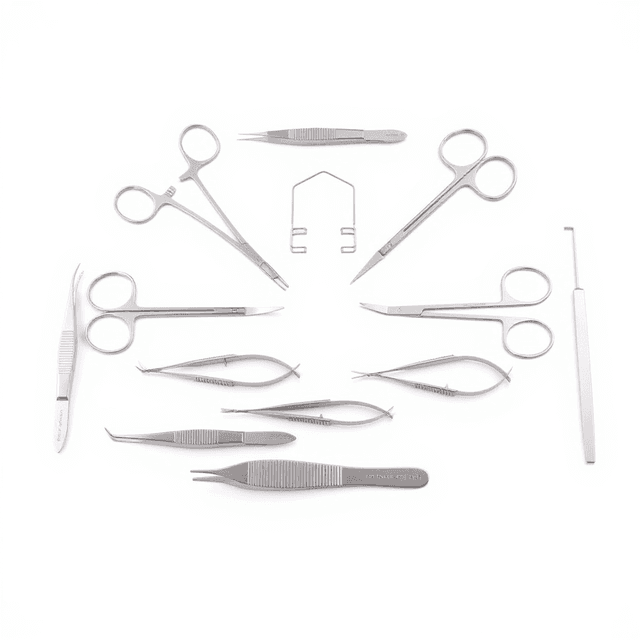
| SKU | Product Description | Qty |
| RWD-S11001-08 | Spring Scissors (Triangular)-S/S Str/5*0.1mm/8.5cm | 1 |
| RWD-S11002-08 | Spring Scissors (Triangular)-S/S Cvd/5*0.1mm/8.5cm | 1 |
| RWD-S12009-11 | IRIS-Fine Scissors (Round Type)-S/S Str/11.5cm | 1 |
| RWD-S12010-11 | IRIS-Fine Scissors (Round Type)-S/S Cvd/11.5cm | 1 |
| RWD-S12003-09 | IRIS-Fine Scissors (Round Type)-S/S Str/9.5cm | 1 |
| RWD-S12004-09 | IRIS-Fine Scissors (Round Type)-S/S Cvd/9.5cm | 1 |
| RWD-F11001-11 | Micro Forceps-Str, 0.2mm Tips, 11cm | 1 |
| RWD-F11004-11 | Micro Forceps-Cvd, 0.2mm Tips, 11.5cm | 1 |
| RWD-F12010-10 | Dressing Forceps-Str, 1.9mm Tips, 10.5cm | 1 |
| RWD-F12011-10 | Dressing Forceps-Cvd, 1.9mm Tips, 10.5cm | 1 |
| RWD-F21001-12 | HALSTED Artery Forceps-Str, 2.0mm Tips, 12.5cm | 2 |
| RWD-F21002-12 | HALSTED Artery Forceps-Cvd, 2.0mm Tips, 12.5cm | 2 |
| RWD-F22002-10 | HARTMAN Mosquito Forceps-Str, 1.0mm Tips, 10cm | 2 |
| RWD-F22003-10 | HARTMAN Mosquito Forceps-Cvd, 1.0mm Tips, 10cm | 2 |
| RWD-F31047-12 | OLSEN-HEGAR Needle Holders with Scissors-Str, 12cm | 1 |
| RWD-S13029-14 | MAYO-STILLE Dissecting & Operating Scissors-B/B Str/14cm | 1 |
| RWD-S15001-11 | SPENCER Ligature Scissors (Slender Type-11cm | 1 |
| RWD-S21010-15 | BOHLER Rongeurs (Double)-Light Cvd/2mm Cup/15.5cm | 1 |
| RWD-S22004-11 | Bone Cutters with Flat Blades (SGL)-11.5cm | 1 |
| RWD-S14014-12 | Operating Scissors (Round Type)-S/S Str/12.5cm | 1 |
| RWD-S31011-01 | 11# Scalpel Blades (Box of 100pcs) | 1 |
| RWD-S32001-12 | Scalpel Handles 3# Solid-12cm | 1 |
| RWD-S33009-06 | Scalpel Blade Remover-6.5cm | 1 |
| RWD-F13019-12 | ADSON 1×2 Teeth Tissue Forceps, 1.5mm, 12cm | 1 |
| RWD-R21027-12 | STEVENS Hooks, 1 Angled Tooth (5mm long), 12.5cm | 1 |
| RWD-R22009-01 | ALM 4×4 Teeth Retractors-Blunt, 7cm | 1 |
| RWD-R22005-45 | 3×3 Teeth Retractors-Blunt, 4.5cm | 1 |
| RWD-R51003-11 | Micro Spatula w/tip W. 2mm x Thk. 0.3mm – Cvd/11cm | 1 |
| RWD-F35205-60 | Sutures w/Needle-△3/8/2.5×7/30cm/6-0 | 10 |
| RWD-F35305-50 | PGA Sutures w/Needle-○1/2/4×10/90cm/5-0 | 10 |
| RWD-R31006-06 | SS Micro Clamps-Cvd/L*W 6*1mm/17mm | 5 |
| RWD-R31005-06 | SS Micro Clamps-Str/L*W 6*1mm/15mm | 5 |
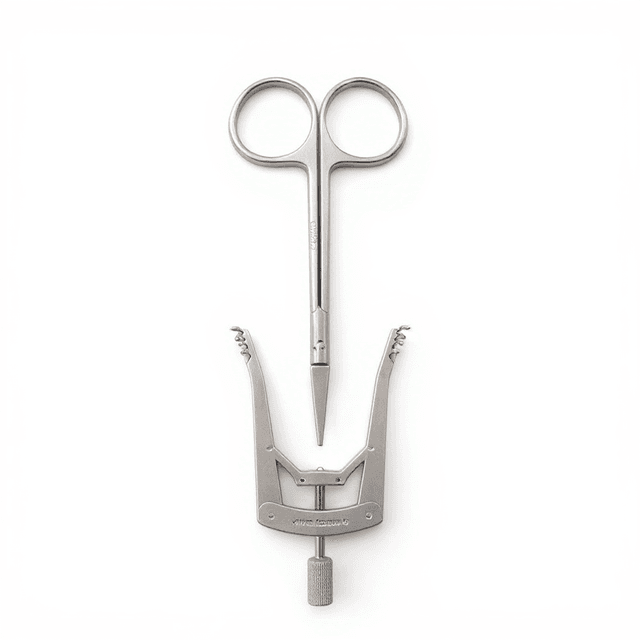
| RWD-R34001-14 | Clip Applicator for R31005- and R31006-Clamps-14cm | 1 |
| RWD-SP0000-P | Instrument Storage Portfolio, 32*22cm | 1 |
How It Works
The surgical instruments in this kit operate on fundamental mechanical principles optimized for precision tissue manipulation. Spring scissors utilize spring-loaded mechanisms to maintain consistent cutting pressure while reducing hand fatigue during extended procedures. The triangular blade geometry of spring scissors concentrates cutting force along precise edges, enabling clean tissue separation with minimal crushing artifacts.
Forceps designs incorporate different tip configurations for specific grasping requirements: micro forceps (0.2mm tips) provide point contact for individual cell manipulation, while dressing forceps (1.9mm tips) offer broader surface contact for tissue retraction. Halsted artery forceps feature serrated jaws with locking mechanisms for sustained hemostatic pressure, while Hartman mosquito forceps provide fine vascular control in small vessels.
The curved instrument variants follow anatomical contours, allowing access to surgical sites with restricted approach angles. Straight instruments provide direct linear access and maximum precision for surface procedures. All instruments maintain sharp cutting edges and precise tip alignment through heat treatment and quality control processes specific to microsurgical applications.
Features & Benefits
Storage Portfolio Dimensions
- 32*22cm
Scissor Lengths
- 8.5cm, 9.5cm, 11.5cm, 12.5cm, 14cm
Forceps Lengths
- 10cm, 10.5cm, 11cm, 11.5cm, 12cm, 12.5cm
Tip Sizes
- 0.1mm, 0.2mm, 1.0mm, 1.5mm, 1.9mm, 2.0mm
Scalpel Blade Size
- 11#
Scalpel Handle Size
- 3#
Suture Specifications
- △3/8/2.5×7/30cm/6-0, ○1/2/4×10/90cm/5-0
Micro Clamp Dimensions
- L*W 6*1mm
Micro Clamp Lengths
- 15mm, 17mm
Retractor Teeth
- 3×3, 4×4
Hook Tooth Length
- 5mm
Spatula Tip Specs
- W. 2mm x Thk. 0.3mm
Automation Level
- manual
Material
- S/S
- SS
Brand
- RWD
Research Domain
- Behavioral Pharmacology
- Cancer Research
- Cardiovascular
- Developmental Biology
- Histopathology
- Neuroscience
- Toxicology
Species
- Gerbil
- Hamster
- Rabbit
- Mouse
- Rat
- Guinea pig
Shipping weight
- 8.27 lb
Shipping box
- L: 34.0 cm
- W: 39.0 cm
- H: 33.0 cm
| Feature | This Product | Typical Alternative | Advantage |
|---|---|---|---|
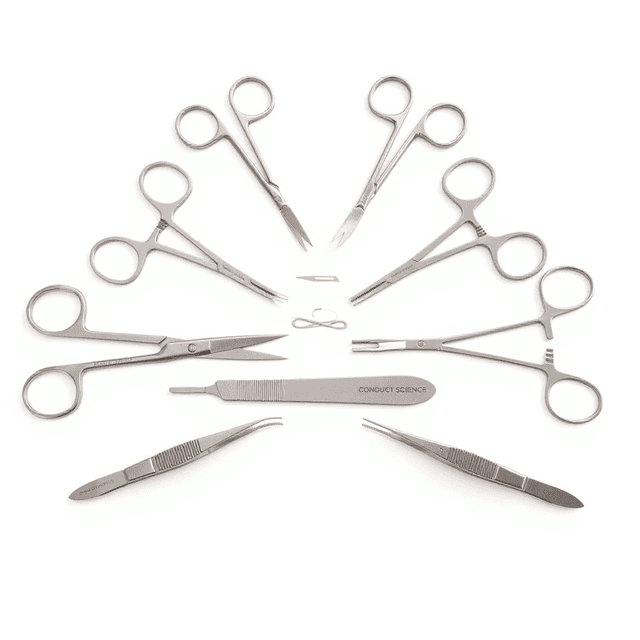
| Instrument Variety | 32 pieces including 6 scissor types, 8 forceps configurations, plus accessories | Basic surgical kits often contain 15-20 pieces with limited size options | Comprehensive selection eliminates need for separate purchases and ensures appropriate tools for diverse surgical procedures. |
| Tip Precision Range | 0.1mm to 2.0mm tip sizes across instrument types | Standard kits often limited to 1-2 tip size options | Enables precise matching of instrument precision to specific tissue types and surgical requirements. |
| Scissor Mechanism | Spring-loaded triangular and IRIS fine scissors with multiple lengths | Conventional scissors without spring assistance | Reduces hand fatigue and provides consistent cutting pressure during extended microsurgical procedures. |
| Storage Organization | Dedicated 32×22cm portfolio case with organized compartments | Generic cases or loose instrument storage | Maintains instrument sterility and enables rapid identification during surgical procedures. |
This kit offers comprehensive instrumentation with precision manufacturing and organized storage, providing researchers with a complete surgical solution for small animal procedures across multiple research domains.
Practical Tips
Clean instruments with enzymatic detergent immediately after use to prevent biological material from adhering to joint mechanisms and cutting surfaces.
Why: Dried biological material can impair instrument function and create sterilization challenges.
Select scissor length based on incision depth requirements: shorter instruments provide better control for superficial work, longer instruments reach deeper anatomical structures.
Why: Proper instrument length matching improves surgical precision and reduces tissue trauma.
Always pass sharp instruments in neutral zones or with verbal communication to prevent accidental injury during collaborative procedures.
Why: Microsurgical instruments have extremely sharp points that can cause significant injury if handled improperly.
Use micro forceps for tissue sampling to minimize crushing artifacts that can compromise histological analysis.
Why: Precision instruments preserve tissue architecture and cellular morphology essential for accurate pathological assessment.
If spring scissors become stiff, disassemble and clean the spring mechanism thoroughly before lubrication with instrument-grade lubricants.
Why: Spring mechanisms can accumulate debris that impairs smooth operation and cutting consistency.
Test forceps alignment and scissors cutting precision on practice materials before each surgical session to ensure optimal performance.
Why: Instrument misalignment or dullness can compromise surgical outcomes and increase procedure duration.
Organize instruments in anticipated order of use before beginning procedures to minimize surgical field disruption.
Why: Systematic instrument arrangement reduces procedure time and maintains sterile field integrity.
Store instruments in the portfolio case with tips protected and joints slightly open to prevent stress corrosion and maintain spring tension.
Why: Proper storage positioning extends instrument lifespan and preserves optimal mechanical function.
Setup Guide
What’s in the Box
- Spring Scissors (Triangular) - Straight and Curved, 5×0.1mm tips, 8.5cm (2 pieces)
- IRIS Fine Scissors (Round Type) - Straight and Curved, 9.5cm and 11.5cm (4 pieces)
- Micro Forceps - Straight and Curved, 0.2mm tips, 11-11.5cm (2 pieces)
- Dressing Forceps - Straight and Curved, 1.9mm tips, 10.5cm (2 pieces)
- HALSTED Artery Forceps - Straight and Curved, 2.0mm tips, 12.5cm (4 pieces)
- HARTMAN Mosquito Forceps - Straight and Curved, 1.0mm tips, 10cm (4 pieces)
- Scalpel Handle #3 and Blade #11
- Suture materials (6-0 and 5-0 specifications)
- Micro clamps (6×1mm, 15mm and 17mm lengths)
- Retractors with 3×3 and 4×4 teeth configurations
- Hook and spatula accessories
- 32×22cm portfolio storage case
- Instrument inventory checklist (typical)
Warranty
ConductScience provides a standard one-year manufacturer warranty covering defects in materials and workmanship, with technical support for proper instrument care and maintenance protocols.
Compliance
What sterilization methods are compatible with these instruments?
All stainless steel instruments are compatible with steam autoclaving, ethylene oxide sterilization, and cold sterilization solutions. Avoid prolonged exposure to acidic solutions that may cause pitting.
How do I select appropriate scissor and forceps sizes for different animal species?
Use 8.5-9.5cm instruments for mice, 9.5-11.5cm for rats, and 11.5-14cm for larger species like rabbits. Match tip size to tissue delicacy: 0.1-0.2mm for neural tissue, 1.0-1.9mm for general soft tissue, 2.0mm for vascular work.
What maintenance is required to preserve cutting edge sharpness?
Clean instruments immediately after use, avoid cutting through bone or metal, and store with tips protected. Professional sharpening services should be used when cutting performance degrades rather than attempting field sharpening.
Can these instruments be used for survival surgeries?
Yes, when properly sterilized and used with appropriate aseptic technique. The precision tips and smooth operation minimize tissue trauma, supporting successful recovery outcomes in survival procedures.
How do spring scissors compare to standard scissors for microsurgery?
Spring scissors reduce hand fatigue during extended procedures and provide more consistent cutting pressure. The spring mechanism also allows one-handed operation, freeing the other hand for tissue manipulation.
What is the expected lifespan of these instruments with regular use?
With proper care and maintenance, stainless steel surgical instruments typically provide 5-10 years of service. Cutting instruments may require periodic professional sharpening to maintain optimal performance.
Are replacement parts available for individual instruments?
Individual instruments can be purchased separately using the specific SKU numbers provided in the kit inventory. This allows replacement of frequently used or damaged instruments without purchasing the complete kit.
Have a question about this product?
Have a question? Just ask.
Send it over and we'll email you a personalized answer — no call, no scheduling.
Prefer to talk it through?
Accessories
Enhance your setup with compatible accessories