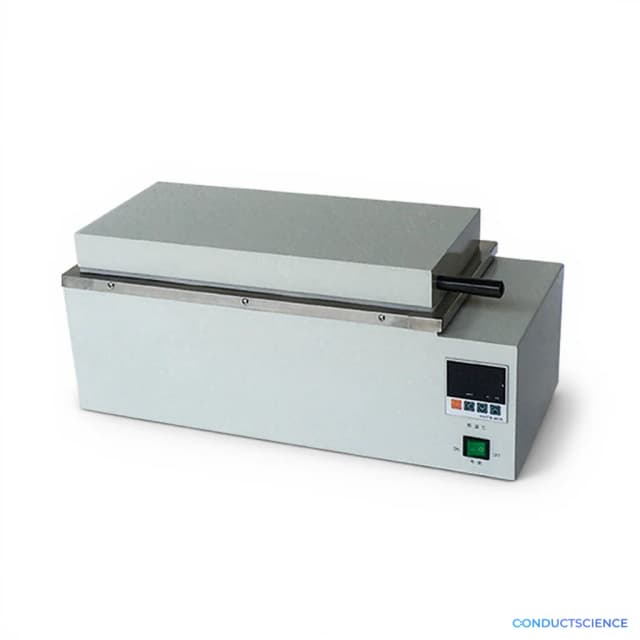
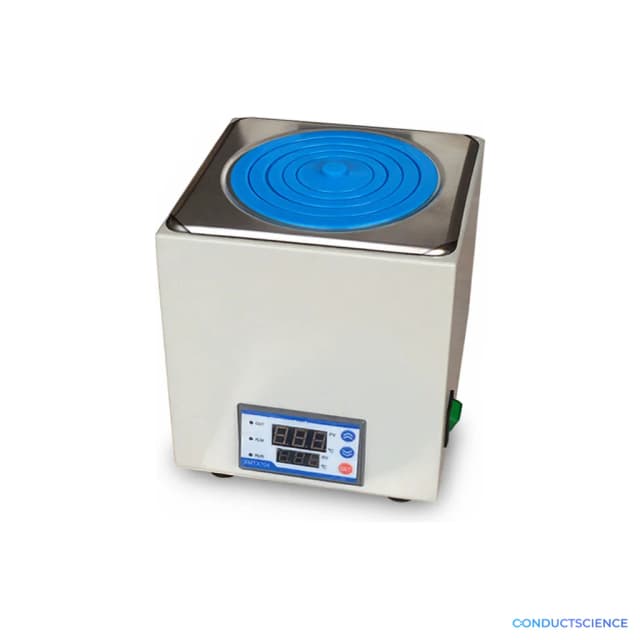
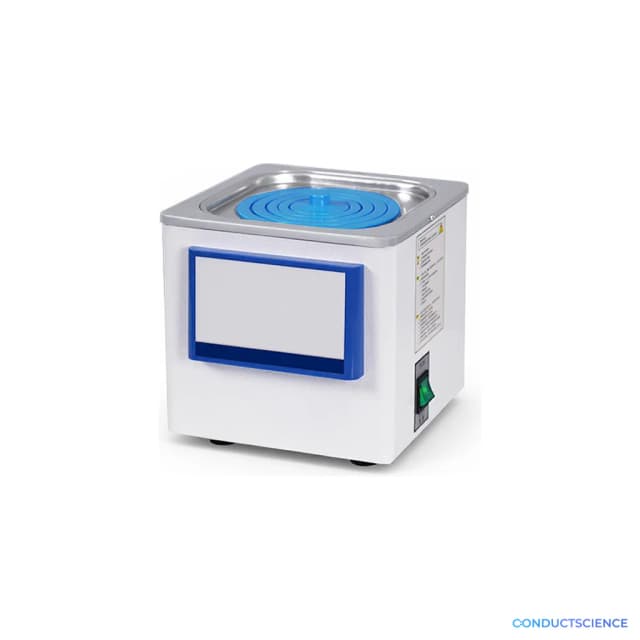
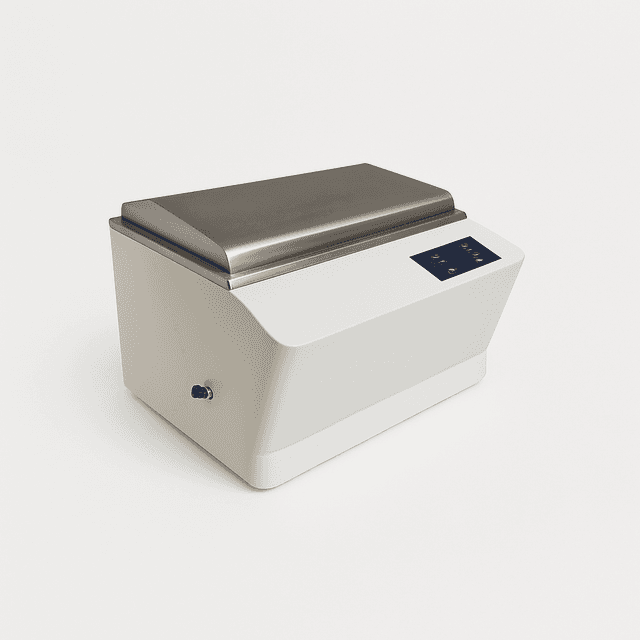
Thermostatic Water Tank 15L 19L 30L 37L 100L
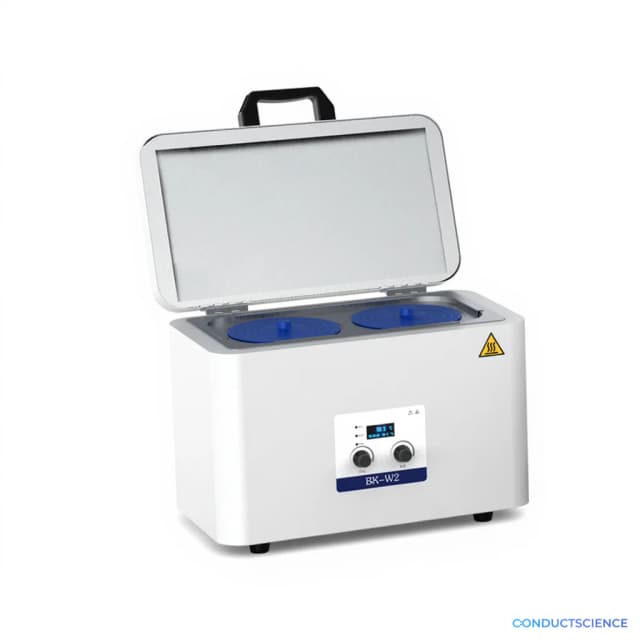
Thermostatic water tank in five capacities (15–100 L, models WT-420 to WT-100), RT+5–100 °C, ±0.5 °C fluctuation, 1500–2000 W, and 1–9999 min timer.
Multiple lid sizes (Φ37–Φ120 mm) for different vessel configurations.

Louise Corscadden, PhD
Director of Science · ConductScience
Ask Louise about Thermostatic Water Tank 15L 19L 30L 37L 100L fit, setup, configuration, or quote prep.
Already working with us? Sign in to connect this with My Scientist.
Key Specifications
Full details →- Model fit
- Configured during quote
- SKU family
- BIO-0662
- Shipping box
- 20.4 x 42.0 x 18.0 cm
- Ordering
- Online checkout and quote request available
- Category
- Water Baths
- Build notes
- Confirm accessories, station layout, and support needs before purchase
The Thermostatic Water Tank provides stable temperature control for laboratory incubation, chemical reactions, and temperature-sensitive experiments across five capacity options from 15 L to 100 L. Digital temperature control with 0.1 °C precision and programmable timing up to 9999 minutes (or continuous) supports both short-duration assays and extended protocols. Multiple lid sizes accommodate a wide range of vessel diameters.
Technical Specifications
| Model | Capacity |
|---|---|
| WT-420 | 15 L |
| WT-24 | 19 L |
| WT-26 | 30 L |
| WT-28 | 37 L |
| WT-100 | 100 L |
| Common Parameters | Value |
|---|---|
| Temperature Range | RT+5–100 °C |
| Temperature Fluctuation | ±0.5 °C (smaller models); ≤±1 °C (larger models) |
| Temperature Uniformity | ±0.5 °C (smaller models); ≤±2 °C (larger models) |
| Temperature Precision | 0.1 °C |
| Timing Range | 1–9999 min or continuous |
| Power Consumption | 1500–2000 W |
| Power Supply | AC 220 V, 50/60 Hz (standard); AC 110 V, 50/60 Hz (optional) |
| Lid Sizes | Φ37, Φ58, Φ79, Φ100, Φ120 mm |
Key Features
- Five capacity options from 15 L to 100 L
- Multiple lid sizes (Φ37–Φ120 mm) for diverse vessel types
- 0.1 °C temperature precision with programmable timer up to 9999 min
- AC 110/220 V dual-voltage compatibility
How It Works
The thermostatic water tank operates on the principle of convective heat transfer through a water medium. The system uses a 1500W heating element positioned to create uniform circulation patterns within the tank, ensuring consistent temperature distribution throughout the water volume. Digital temperature sensors continuously monitor the water temperature and provide feedback to the control system, which modulates heating power to maintain the setpoint within ±0.5°C.
Temperature uniformity is achieved through strategic placement of heating elements and internal baffling that promotes natural convection currents. The digital control system samples temperature at high frequency and employs proportional control algorithms to minimize temperature overshoot and hunting. Programmable timing functions allow for automated temperature profiles and extended unattended operation, while the multi-hole lid configurations accommodate various vessel sizes and experimental layouts.
Features & Benefits
Automation Level
- semi-automated
WT-24
- WT-26
WT-28
- WT-100
Type
- 1 row, 2 holes
2 rows, 4 holes
- 2 rows, 6 holes
2 rows, 8 holes
- /
19L
- 30L
37L
- 100L
Temp. Range
- RT+5~100℃(Normal atmosphere)
Temp. Fluctuation
- ±0.5℃
Temp. Uniformity
- ±0.5℃
Temp. Precision
- 0.1℃
Time Range
- 1~9999/continuous
Consumption
- 1500W
Brand
- ConductScience
Research Domain
- Analytical Chemistry
- Cell Biology
- Environmental Monitoring
- Materials Science
- Microbiology
- Pharmaceutical QC
Capacity
- 15L
Shipping weight
- 8.8 lb
Shipping box
- L: 20.4 cm
- W: 42.0 cm
- H: 18.0 cm
| Feature | This Product | Typical Alternative | Advantage |
|---|---|---|---|
| Temperature Range | RT+5°C to 100°C with ±0.5°C stability | Basic models often provide ±1-2°C stability | Tighter temperature control improves reproducibility for temperature-sensitive assays and enzymatic reactions |
| Temperature Precision | 0.1°C display resolution | Entry-level units typically show 1°C increments | Precise temperature setting enables accurate documentation and method compliance requirements |
| Capacity Options | Five sizes from 15L to 100L available | Limited size options with most offering 1-2 capacities | Allows optimal sizing for laboratory space and experimental volume requirements |
| Heating Power | 1500W heating element | Lower-cost models often use 800-1000W elements | Faster temperature recovery and better stability when adding samples or opening the lid frequently |
| Lid Configurations | Multiple options: 2, 4, 6, and 8-hole patterns | Fixed lid designs with limited vessel accommodation | Versatile vessel compatibility allows optimization for specific experimental setups and sample throughput |
| Timer Programming | 1-9999 minutes or continuous operation | Basic timers often limited to shorter durations | Supports extended unattended protocols and automated experimental sequences |
This thermostatic water tank system provides superior temperature stability and precision compared to entry-level models, with multiple capacity options and flexible lid configurations. The combination of 1500W heating power and ±0.5°C temperature control makes it suitable for demanding laboratory applications requiring thermal precision and reliability.
Practical Tips
Verify temperature accuracy monthly using a NIST-traceable thermometer placed in the center of the water volume.
Why: Temperature drift over time can affect experimental reproducibility and regulatory compliance.
Clean the tank weekly with mild laboratory detergent and rinse thoroughly to prevent biofilm formation.
Why: Bacterial growth in water baths can contaminate samples and affect temperature uniformity.
Allow 30 minutes for temperature equilibration after major temperature changes before placing samples.
Why: Thermal equilibrium ensures accurate and uniform temperature exposure across all samples.
Never operate the unit without adequate water level and avoid overfilling above the maximum mark.
Why: Insufficient water can damage the heating element while overfilling creates spillage and electrical hazards.
Record water bath temperature at the start and end of each experimental session for documentation.
Why: Temperature logs provide traceability and help identify equipment drift or malfunction.
If temperature fluctuations increase, check for mineral deposits on the heating element and clean if necessary.
Why: Scale buildup reduces heat transfer efficiency and can cause temperature instability.
Use vessel holders or racks to prevent containers from contacting the bottom heating element directly.
Why: Direct contact with the heating surface can create hot spots and thermal stress in glassware.
Replace water with fresh distilled water if it becomes cloudy or develops odors, regardless of scheduled changes.
Why: Contaminated water affects temperature uniformity and can introduce experimental artifacts.
Setup Guide
What’s in the Box
- Thermostatic water tank main unit
- Selected lid configuration (hole pattern as specified)
- Power cord
- User manual and operating instructions
- Temperature calibration documentation (typical)
- Drain valve and accessories (typical)
Warranty
ConductScience provides a standard one-year manufacturer warranty covering defects in materials and workmanship, with technical support available for installation, operation, and maintenance guidance.
Compliance
What is the temperature stability and how does it compare to standard laboratory heating requirements?
The system maintains ±0.5°C fluctuation and uniformity, which exceeds typical laboratory heating requirements of ±1-2°C and is suitable for temperature-sensitive biochemical assays and analytical procedures.
How do I select the appropriate capacity and lid configuration for my application?
Choose capacity based on total volume requirements and vessel sizes. Lid configurations accommodate different numbers of vessels: 2-hole for large flasks, 4-6 holes for medium vessels, or 8-hole for multiple small containers.
What type of water should be used and how often should it be changed?
Use distilled or deionized water to prevent mineral buildup and contamination. Change water weekly for routine use or more frequently for applications requiring high purity or when visible contamination occurs.
Can the system handle thermal cycling or rapid temperature changes?
The 1500W heating element provides good thermal response, but the system is optimized for stable temperature maintenance rather than rapid cycling. Large thermal transitions may require 30-45 minutes for equilibration.
What safety features are included for unattended operation?
The system includes programmable timing with automatic shutoff, digital temperature monitoring, and over-temperature protection. However, consult the product datasheet for specific safety certifications and features.
How does this compare to dry heating blocks or oil baths for temperature control?
Water baths provide superior temperature uniformity compared to dry blocks and are safer than oil baths at moderate temperatures, though oil baths can achieve higher temperatures above 100°C.
What maintenance is required for long-term reliable operation?
Regular cleaning with laboratory detergents, periodic water changes, and annual temperature calibration verification are recommended. The heating element should be inspected for mineral deposits that could affect performance.
Can multiple vessels of different sizes be used simultaneously?
Yes, the various lid configurations allow simultaneous use of different vessel sizes, provided they fit the hole patterns and do not exceed the tank capacity or compromise temperature uniformity.
Have a question about this product?
Have a question? Just ask.
Send it over and we'll email you a personalized answer — no call, no scheduling.
Prefer to talk it through?
Accessories
Enhance your setup with compatible accessories
Frequently Bought Together