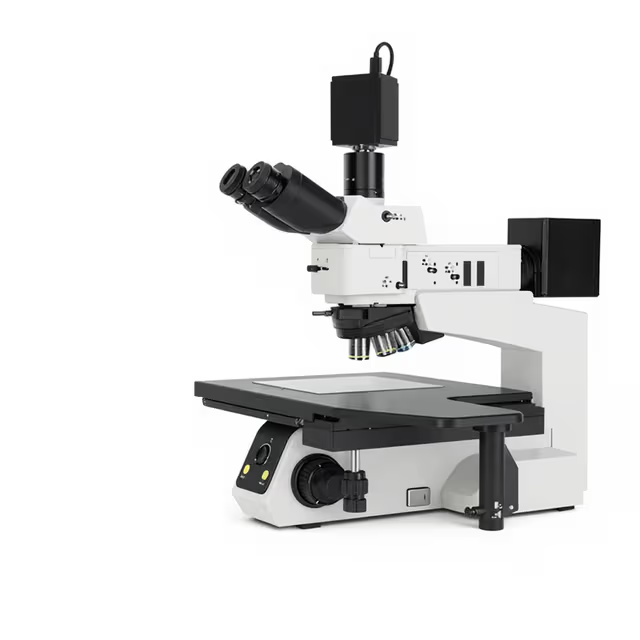
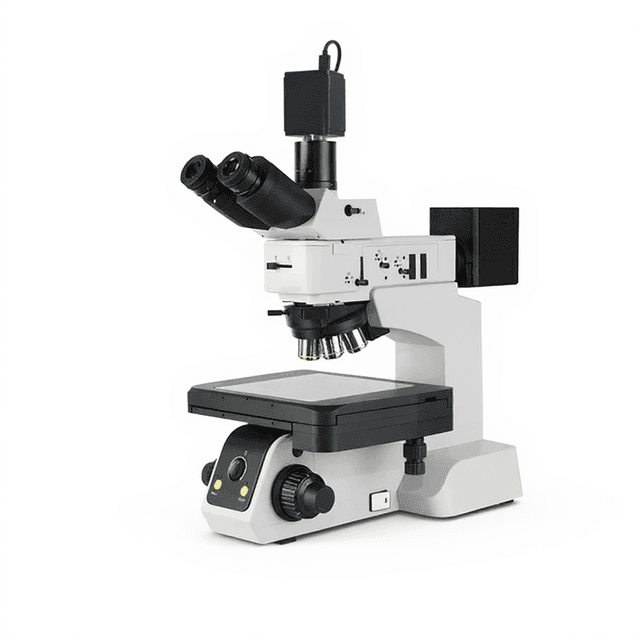
Upright Research Grade Metallurgical Microscope for Metallographic Materials Testing
Research-grade upright metallurgical microscope with infinite optical system, 50x-500x magnification, and integrated reflected/transmitted LED illumination for materials analysis and metallographic examination.

Louise Corscadden, PhD
Director of Science · ConductScience
Ask Louise about Upright Research Grade Metallurgical Microscope for Metallographic Materials Testing fit, setup, configuration, or quote prep.
Already working with us? Sign in to connect this with My Scientist.
Key Specifications
Full details →- Model fit
- Configured during quote
- SKU family
- MCX-0024
- Shipping box
- 4.9 x 6.6 x 6.6 cm
- Ordering
- Online checkout and quote request available
- Category
- Microscopy
- Build notes
- Confirm accessories, station layout, and support needs before purchase
The Upright Research Grade Metallurgical Microscope (MCX-0024) employs an infinite chromatic aberration correction optical system designed for metallographic analysis and materials characterization. This brightfield/darkfield microscope features a binocular observation head with adjustable interpupillary distance (50-76mm) and delivers optical magnifications from 50x to 500x standard, expandable to 2000x with optional components. The instrument integrates both reflected and transmitted LED illumination systems with variable aperture control and polarization capabilities.
The microscope incorporates a long working distance BD semi-apochromatic objective (5x/NA0.15/WD15mm) mounted in a 5-position nosepiece with DIC compatibility. The mechanical stage provides 150mm x 100mm travel with coaxial X-Y adjustment across a 310 x 240mm platform area. An optional digital imaging system enables magnifications up to 3000x when coupled with a 12MP camera and 100x objective on a 22-inch display.
How It Works
The microscope operates on the principle of reflected light illumination for opaque specimens, where light from the LED source passes through the objective lens to illuminate the sample surface. Reflected light returns through the same objective, creating an image that reveals surface topography, grain boundaries, and microstructural features. The infinite chromatic aberration correction system ensures consistent image quality across the magnification range by correcting for wavelength-dependent focal shifts.
The integrated polarization assembly enables analysis of optically anisotropic materials by controlling light polarization states. The analyzer and polarizer can be crossed at 90° to extinguish isotropic materials while highlighting birefringent structures. The DIC (Differential Interference Contrast) capability provides enhanced contrast for transparent specimens by converting phase differences into amplitude variations, revealing fine structural details not visible in brightfield illumination.
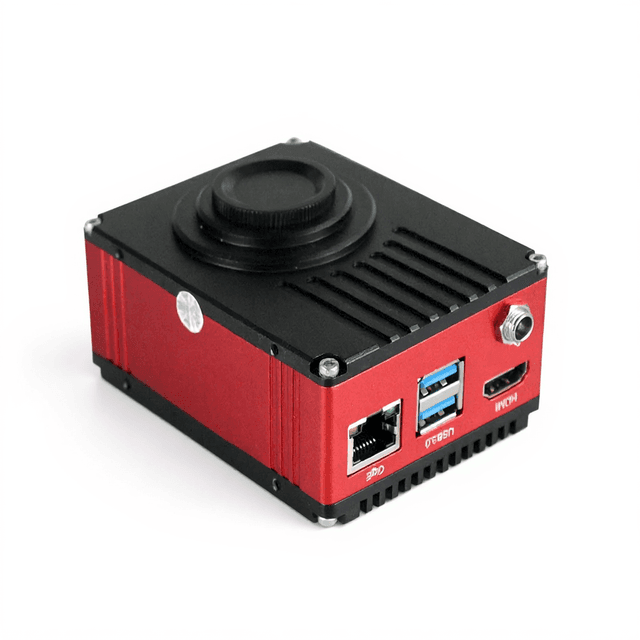
Digital imaging integration allows real-time observation and documentation through the camera port. The 0.65x camera adapter adjusts the magnification to optimize the field of view for the sensor format, enabling measurements and image analysis workflows.
Features & Benefits
Automation Level
- manual
Product Type
- Microscope
Microscope Type
- Metallurgical
Application
- Laboratory Research
- Materials Science
- Quality Control
Skill Level
- Professional / Research
Brand
- ConductScience
Research Domain
- Analytical Chemistry
- Environmental Monitoring
- Food Science
- Industrial Hygiene
- Materials Science
- Pharmaceutical QC
Shipping weight
- 1.9 lb
Shipping box
- L: 4.9 cm
- W: 6.6 cm
- H: 6.6 cm
| Feature | This Product | Typical Alternative | Advantage |
|---|---|---|---|
| Optical System Design | Infinite chromatic aberration correction optical system | Finite optical systems with limited color correction | Eliminates chromatic aberration across magnification ranges and enables consistent image quality for color-critical phase identification. |
| Working Distance | 15mm working distance with 5x objective (NA 0.15) | Standard objectives often provide 3-8mm working distance | Accommodates irregular specimens and thick samples that cannot be analyzed with short working distance objectives. |
| Stage Travel Range | 150mm x 100mm mechanical travel on 310x240mm platform | Entry-level models typically offer 50-75mm travel ranges | Enables systematic mapping of large specimens and batch analysis without specimen repositioning. |
| Illumination Flexibility | Dual 5W LED systems for reflected and transmitted light | Basic models often include reflected light only | Supports analysis of both opaque metallurgical specimens and semi-transparent samples without external light sources. |
| Magnification Range | 50x-500x standard, expandable to 2000x optical | Limited magnification ranges in basic instruments | Covers both macro and microstructural examination requirements in a single instrument configuration. |
| Digital Integration | 150x-3000x digital magnification with 12MP camera capability | Basic digital options or separate camera requirements | Integrated digital documentation and measurement capabilities for quantitative analysis workflows. |
This microscope combines infinite optics, long working distance objectives, and comprehensive illumination options in a research-grade platform. The dual LED illumination and integrated polarization assembly provide analytical versatility beyond basic metallurgical microscopes.
Practical Tips
Calibrate the digital measurement system using a certified stage micrometer at each magnification setting.
Why: Ensures measurement accuracy across the full magnification range and accounts for camera adapter magnification factors.
Clean optical surfaces monthly using lens tissue and appropriate solvents, working from center outward in circular motions.
Why: Prevents accumulation of contaminants that degrade image quality and contrast in critical applications.
Establish Köhler illumination by centering the condenser and adjusting field/aperture diaphragms for optimal contrast.
Why: Provides uniform illumination across the field and maximizes resolution for detailed microstructural analysis.
If polarized light extinction is incomplete, check polarizer-analyzer alignment and clean optical components.
Why: Complete extinction is essential for quantitative polarized light analysis and accurate birefringence measurements.
Use consistent illumination intensity settings when comparing specimens to ensure reproducible image contrast.
Why: Standardized illumination conditions are crucial for comparative analysis and quantitative image measurements.
Avoid exposing LED illumination directly to eyes and ensure proper electrical grounding of the microscope base.
Why: LED sources can cause eye strain or damage with direct exposure, and proper grounding prevents electrical hazards.
Allow 15-minute warm-up period before critical measurements to ensure LED output stability.
Why: LED sources require thermal equilibration to achieve consistent color temperature and intensity output.
Store objectives in dust-free environment and cap when not in use to prevent contamination.
Why: Contaminated objective lenses significantly impact resolution and image quality in high-magnification applications.
Setup Guide
What’s in the Box
- Upright metallurgical microscope base unit
- Binocular observation head with adjustable interpupillary distance
- PL10x/23mm wide-field eyepieces (pair)
- BD semi-apochromatic 5x objective (NA0.15, WD15mm)
- 5-position objective nosepiece with DIC slot
- Mechanical stage with coaxial X-Y controls
- Reflected light illuminator with LED source
- Transmitted light illuminator with LED source
- Roll-out achromatic condenser (NA 0.9)
- Polarizer and analyzer assembly
- Power cord and documentation (typical)
- Camera adapter (0.65x C-mount) - if specified
Warranty
ConductScience provides a standard one-year manufacturer warranty covering defects in materials and workmanship, with technical support for optical alignment and troubleshooting procedures.
Compliance
References
Background reading relevant to this product:
What is the resolution limit with the standard 5x objective?
The BD semi-apochromatic 5x objective with NA 0.15 provides theoretical resolution of approximately 2.3 μm using white light illumination, suitable for grain boundary analysis and macrostructural examination.
Can this microscope perform quantitative polarized light analysis?
Yes, the integrated polarization assembly includes 360° rotatable polarizer and analyzer components, enabling quantitative measurements of birefringence, extinction angles, and optical orientation.
What specimen thickness can be accommodated on the mechanical stage?
The stage design accommodates specimens up to the working distance limit of 15mm with the standard 5x objective, suitable for most metallographic mounts and bulk samples.
Is the camera system calibrated for dimensional measurements?
The 0.65x camera adapter provides image scaling that requires calibration using a stage micrometer for accurate dimensional measurements in imaging software.
How does the DIC capability enhance contrast?
The DIC slot in the nosepiece accommodates differential interference contrast prisms that convert phase variations into intensity differences, revealing surface topography and internal structures not visible in brightfield.
What maintenance is required for the LED illumination systems?
LED sources require minimal maintenance but benefit from periodic cleaning of optical surfaces and verification of light distribution uniformity across the field of view.
Can the microscope be used for automated image acquisition?
While the microscope supports camera integration, automated acquisition requires compatible software and motorized stage accessories not included in the standard configuration.
Have a question about this product?
Have a question? Just ask.
Send it over and we'll email you a personalized answer — no call, no scheduling.
Prefer to talk it through?
Accessories
Enhance your setup with compatible accessories
Frequently Bought Together
Upgrade Options
Related Products