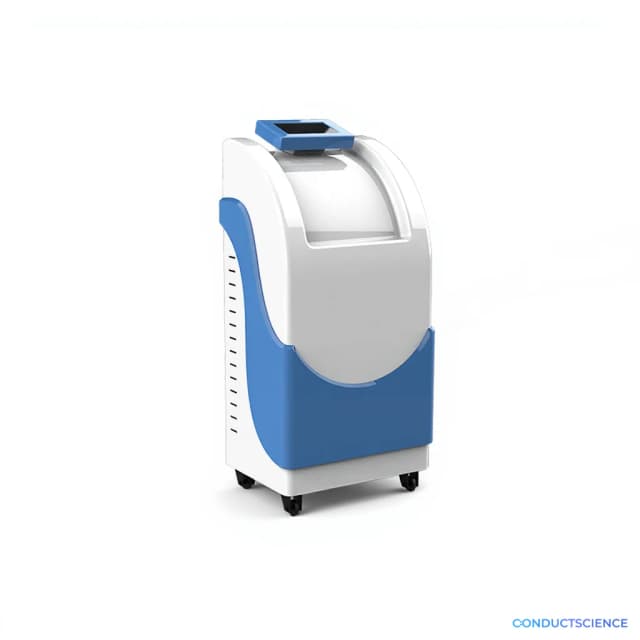
UV Disinfection Trolley
Mobile dual-lamp UV disinfection system delivering germicidal 253.7nm radiation with programmable timing for laboratory and healthcare surface sterilization.

Louise Corscadden, PhD
Director of Science · ConductScience
Ask Louise about UV Disinfection Trolley fit, setup, configuration, or quote prep.
Already working with us? Sign in to connect this with My Scientist.
Key Specifications
Full details →- Model fit
- Configured during quote
- SKU family
- BIO-0169
- Shipping box
- 41.73 x 37.8 x 8.66 cm
- Ordering
- Online checkout and quote request available
- Category
- Sterilizers
- Build notes
- Confirm accessories, station layout, and support needs before purchase
The UV Disinfection Trolley provides mobile germicidal irradiation for laboratory and healthcare environments using dual 30W low-pressure mercury lamps emitting at 253.7nm. This wavelength corresponds to peak DNA absorption, enabling effective inactivation of bacteria, viruses, and fungi through photochemical disruption of nucleic acids. The mobile design with 960mm lamp arms allows positioning for surface and air disinfection in areas where fixed UV systems are impractical.
The unit features programmable timing from 0-120 minutes, enabling standardized disinfection protocols. The trolley configuration provides flexibility for treating multiple locations while maintaining consistent UV dose delivery. Applications include laboratory bench surfaces, equipment decontamination, and supplementary air treatment in controlled environments.
How It Works
UV-C radiation at 253.7nm corresponds to peak absorption by DNA and RNA nucleotides, particularly thymine and uracil bases. When microorganisms absorb this energy, it induces formation of thymine dimers and other photoproducts that disrupt normal base pairing and transcription processes. This photochemical damage prevents cellular replication and leads to microbial inactivation.
The dual 30W low-pressure mercury lamps generate monochromatic 253.7nm output with minimal heat production. The 960mm lamp arms provide coverage area while maintaining appropriate distance for effective irradiance levels. Dose delivery depends on intensity, exposure time, and surface characteristics, with the programmable timer enabling consistent protocol implementation.
Mobile positioning allows treatment of various surfaces and confined spaces where fixed installations are unsuitable. The trolley design enables systematic coverage of multiple treatment zones while maintaining operator safety through proper positioning protocols.
Features & Benefits
Automation Level
- semi-automated
UV Lamp Life
- 1000h
Length of Lamp Arm
- 960mm±3
Timing Range
- 0~120min
UV Lamp
- 30W*2
UV Wavelength
- 253.7nm
Package Size(W*D*H)mm
- 1060*220*310
Gross Weight(kg)
- 7
Brand
- ConductScience
Research Domain
- Clinical Diagnostics
- Environmental Monitoring
- Food Science
- Microbiology
- Pharmaceutical QC
Power/Voltage
- AC220V, 50Hz
Shipping weight
- 15.43 lb
Shipping box
- L: 41.73 cm
- W: 37.8 cm
- H: 8.66 cm
| Feature | This Product | Typical Alternative | Advantage |
|---|---|---|---|
| UV Lamp Configuration | Dual 30W lamps at 253.7nm | Single lamp systems often provide lower total output | Higher irradiance enables faster treatment cycles and improved coverage uniformity |
| Lamp Arm Length | 960mm lamp arms | Compact units often have shorter reach | Extended reach allows treatment of larger equipment and confined spaces |
| Timer Range | 0-120 minute programmable timer | Basic models may offer limited timing options | Extended timing range accommodates protocols requiring longer exposures for resistant organisms |
| Mobility | Mobile trolley design | Fixed installations require permanent mounting | Enables treatment of multiple locations and equipment with single unit |
| Lamp Life | 1000-hour rated lamp life | Varies by model and lamp quality | Extended operational periods reduce maintenance frequency and replacement costs |
This dual-lamp mobile system provides flexible positioning with extended 960mm reach and programmable timing up to 120 minutes. The 1000-hour lamp life and trolley design offer practical advantages for multi-location disinfection protocols.
Practical Tips
Use a UV-C meter to verify lamp output periodically, especially after 500+ hours of operation.
Why: UV output gradually decreases over lamp life, affecting disinfection efficacy.
Clean lamp surfaces monthly with isopropyl alcohol to remove dust and organic residues.
Why: Surface contamination can reduce UV transmission by 10-20% or more.
Allow lamps to warm up for 2-3 minutes before starting timed disinfection cycles.
Why: UV output reaches maximum intensity after initial warm-up period in mercury lamps.
Install physical barriers or interlocks when using in areas with potential personnel access.
Why: UV-C exposure can cause severe eye and skin damage within seconds.
Document lamp hours and replacement dates to track output degradation over time.
Why: Consistent record-keeping enables predictive maintenance and protocol validation.
If lamps flicker or fail to start, check power connections and lamp seating before replacement.
Why: Poor electrical connections can cause intermittent operation that appears as lamp failure.
Position unit to minimize shadows from equipment and fixtures in treatment area.
Why: UV requires direct line-of-sight exposure and cannot disinfect shadowed surfaces.
Store unit in dry environment when not in use to prevent moisture damage to electrical components.
Why: Humidity can cause corrosion and electrical faults in UV lamp systems.
Setup Guide
What’s in the Box
- UV Disinfection Trolley main unit
- Dual 30W UV-C lamps (253.7nm)
- Power cord (AC220V)
- User manual and safety instructions
- Lamp replacement guide (typical)
Warranty
ConductScience provides a standard one-year manufacturer warranty covering defects in materials and workmanship. Technical support is available for installation guidance and operational questions.
Compliance
What is the effective coverage area for the 960mm lamp arms?
Coverage depends on required dose and surface characteristics. For typical laboratory surfaces, effective treatment occurs within 1-2 meters of the lamps. Consult UV dose calculations for specific protocol requirements.
How do I determine appropriate exposure times for different microorganisms?
Exposure time depends on target organism, surface material, and required log reduction. Start with published UV dose requirements for specific pathogens and adjust based on lamp distance and surface reflectance.
What safety precautions are required during operation?
UV-C radiation can cause eye and skin damage. Ensure area is clear of personnel during operation, use appropriate PPE if maintenance is required, and post warning signs. Never look directly at illuminated lamps.
How often should the lamps be replaced?
Lamps are rated for 1000 hours of operation. UV output gradually decreases over time, so replacement may be needed before complete failure to maintain disinfection efficacy. Monitor performance with UV meter if available.
Can this unit be used for air disinfection as well as surfaces?
While primarily designed for surface treatment, the unit can provide some air disinfection in the immediate vicinity of the lamps. However, air exchange rates and residence time significantly affect efficacy.
What maintenance is required to maintain UV output?
Regular cleaning of lamp surfaces with alcohol removes dust and residue that can reduce output. Check lamp connections and housing for damage. Replace lamps when output drops below required levels.
Is the unit suitable for cleanroom environments?
The trolley can be used in cleanrooms but consider particle generation from wheels and housing materials. Clean unit thoroughly before introduction and follow facility protocols for equipment qualification.
How does this compare to chemical disinfection methods?
UV provides residue-free disinfection without chemical compatibility concerns. However, it requires direct line-of-sight exposure and does not penetrate shadows or porous materials like some chemical methods.
Have a question about this product?
Have a question? Just ask.
Send it over and we'll email you a personalized answer — no call, no scheduling.
Prefer to talk it through?
Accessories
Enhance your setup with compatible accessories