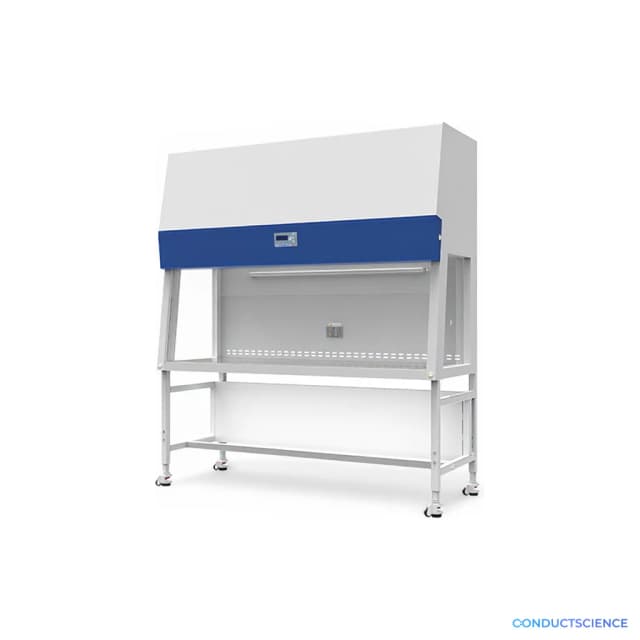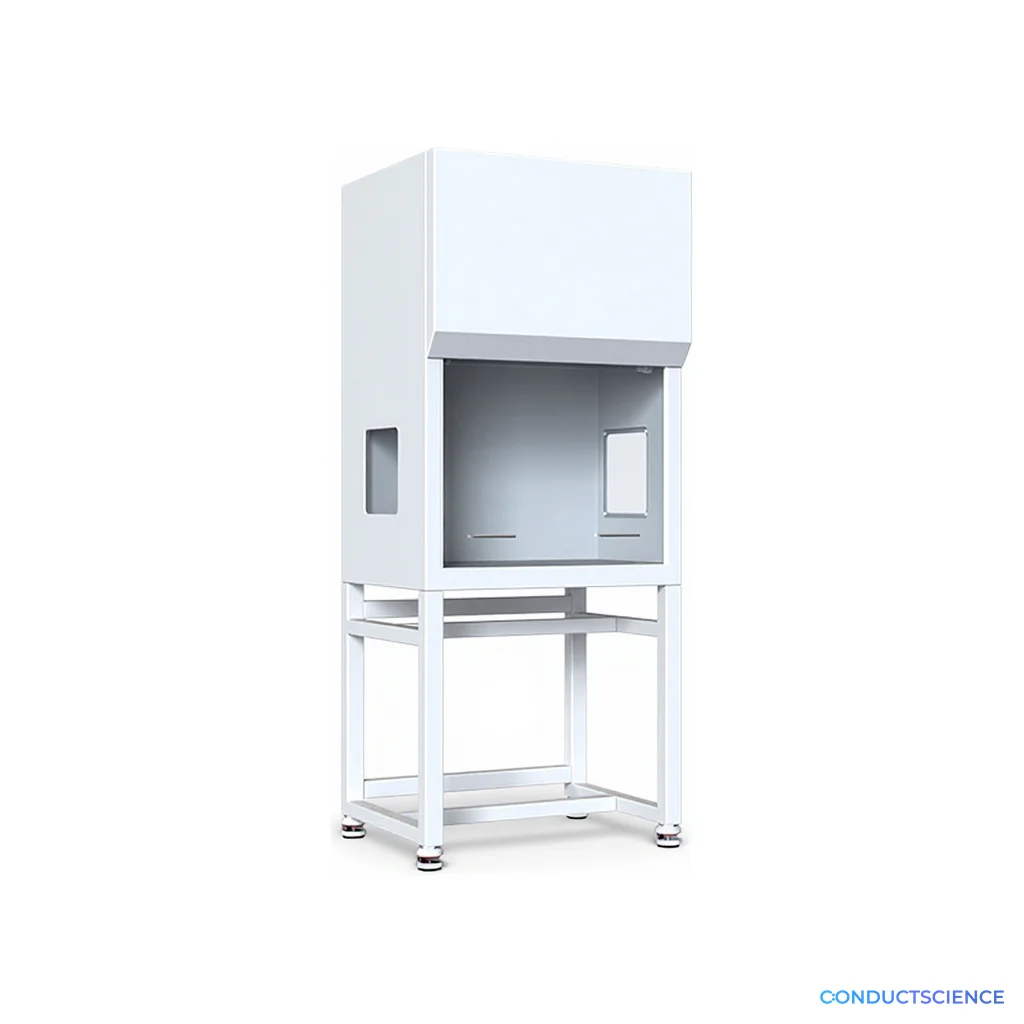
Vertical Laminar Flow Cabinet - Class II Biosafety
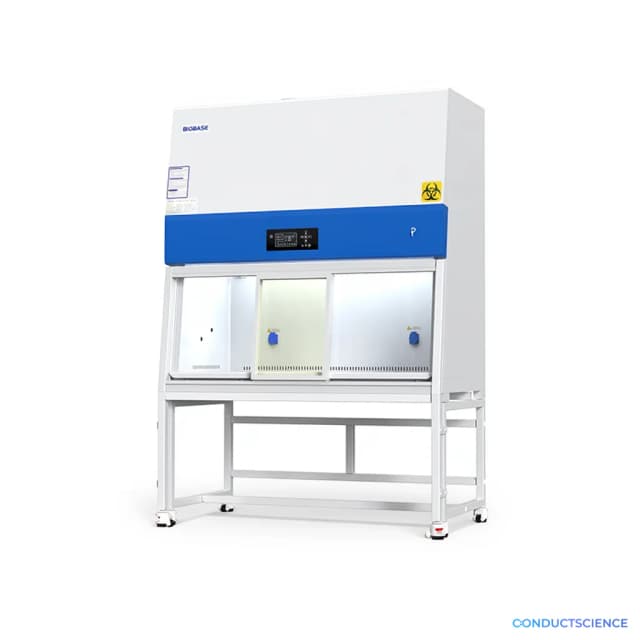
Class II vertical laminar flow cabinet with 99.995% HEPA filtration efficiency and 0.30-0.45 m/s airflow velocity for sterile microbiological work in a 940×650×615mm workspace.

Louise Corscadden, PhD
Director of Science · ConductScience
Ask Louise about Vertical Laminar Flow Cabinet - Class II Biosafety fit, setup, configuration, or quote prep.
Already working with us? Sign in to connect this with My Scientist.
Key Specifications
Full details →- Model fit
- 1 selectable configurations
- SKU family
- BIO-0902
- Shipping box
- 185.0 x 110.0 x 76.0 cm
- Ordering
- Online checkout and quote request available
- Category
- Clean Benches & Fume Hoods
- Build notes
- Confirm accessories, station layout, and support needs before purchase
The ConductScience Vertical Laminar Flow Cabinet (BIO-0898) provides Class II biological safety cabinet protection for microbiological work requiring sterile conditions. The unit features unidirectional HEPA-filtered airflow at 0.30-0.45 m/s velocity, creating a sterile work environment within a 940×650×615mm internal workspace. A single HEPA filter achieves 99.995% efficiency at 0.3μm particle size, while polyester fiber pre-filtration extends filter life and maintains consistent airflow patterns.
The cabinet incorporates a manual front window with adjustable safety height (200-350mm) and maximum opening of 400mm for ergonomic access. An LCD display provides real-time system monitoring, while LED illumination delivers ≥300lx work surface lighting. Operating at ≤65dB(A) noise levels with ≤5μm(rms) vibration, the unit maintains laboratory environmental standards. Microbial containment performance achieves ≤0.5 CFU/30min colony count, supporting aseptic technique protocols in research and quality control applications.
How It Works
Vertical laminar flow cabinets operate on the principle of unidirectional airflow to create a sterile work environment. Room air enters through the polyester fiber pre-filter, which removes larger particles and extends HEPA filter life. The air then passes through a single HEPA filter rated at 99.995% efficiency for 0.3μm particles, removing virtually all viable microorganisms and particulate matter.
The filtered air flows vertically downward at a controlled velocity of 0.30-0.45 m/s, creating a uniform air curtain across the work surface. This laminar (non-turbulent) airflow sweeps contaminants away from the work area and prevents their entry from the surrounding environment. The manual front window allows operator access while maintaining the integrity of the sterile airspace through proper safety height adjustment.
Continuous air circulation maintains positive pressure within the cabinet relative to the laboratory environment. The LCD display monitors critical parameters including airflow velocity and filter status, while the low-vibration design (≤5μm rms) prevents disturbance of sensitive procedures. The system achieves microbial containment performance of ≤0.5 CFU/30min, quantifying its effectiveness in preventing contamination.
Features & Benefits
Shipping weight
- 195.0 lb
Shipping box
- L: 185.0 cm
- W: 110.0 cm
- H: 76.0 cm
| Feature | This Product | Typical Alternative | Advantage |
|---|---|---|---|
| HEPA Filter Efficiency | 99.995% at 0.3μm (single filter) | Entry-level models often provide 99.97% efficiency or dual-filter systems | Higher efficiency removes more submicron particles for enhanced sterile conditions in critical applications. |
| Airflow Velocity Range | 0.30-0.45 m/s | Basic units may offer fixed velocity or narrower adjustment ranges | Adjustable velocity allows optimization for different procedures while maintaining laminar flow characteristics. |
| Internal Workspace Volume | 940×650×615mm working area | Compact models typically offer smaller work surfaces | Larger workspace accommodates multiple samples and standard laboratory equipment simultaneously. |
| Vibration Control | ≤5μm (rms) vibration specification | Many units do not specify vibration limits | Low vibration prevents disturbance of cell cultures and enables stable microscopic work within the cabinet. |
| Display System | LCD display for system monitoring | Basic models may use LED indicators or analog gauges | Digital display provides clearer system status information for better operational awareness and maintenance scheduling. |
| Microbial Performance | ≤0.5 CFU/30min colony specification | Performance metrics vary by manufacturer and testing protocols | Quantified microbial containment provides measurable sterility assurance for critical research applications. |
This cabinet offers comprehensive sterile workspace capabilities with high-efficiency HEPA filtration, adjustable airflow velocity, and quantified microbial containment performance. The LCD monitoring system and low-vibration design support both routine microbiological work and specialized research applications requiring precise environmental control.
Practical Tips
Verify airflow velocity at multiple points across the work surface using a calibrated anemometer after installation and during routine maintenance intervals.
Why: Uniform airflow distribution ensures consistent sterile conditions throughout the workspace and helps identify filter loading or airflow restrictions.
Replace the polyester pre-filter based on visual inspection and pressure differential rather than fixed time intervals to optimize HEPA filter life.
Why: Pre-filter replacement based on actual loading prevents premature HEPA filter deterioration and maintains consistent airflow performance.
Allow the cabinet to operate for at least 15 minutes before beginning sterile work and maintain the manual window at consistent height during procedures.
Why: System stabilization ensures proper airflow establishment while consistent window positioning maintains laminar flow integrity throughout the procedure.
Work at least 6 inches inside the front opening and avoid rapid arm movements that could disrupt laminar airflow patterns.
Why: Proper hand placement and movement control prevent turbulence that could allow contaminants to enter the sterile workspace.
Document LCD display readings and conduct periodic settle plate tests to verify continued sterile performance for quality assurance records.
Why: Regular monitoring provides objective evidence of cabinet performance for regulatory compliance and research data integrity.
If airflow seems reduced, check pre-filter loading before assuming HEPA filter replacement is needed.
Why: Pre-filter restriction is the most common cause of reduced airflow and is much less expensive to address than HEPA filter replacement.
Ensure proper decontamination of work surfaces between different organisms or samples using appropriate disinfectants for your application.
Why: Cross-contamination prevention is critical for research data validity and laboratory biosafety, especially when working with multiple organisms.
Keep the LCD display clean and check that all indicator lights function properly during daily startup procedures.
Why: Functional monitoring systems provide early warning of performance issues before they affect sterile conditions or research results.
Setup Guide
What’s in the Box
- Vertical laminar flow cabinet main unit
- HEPA filter (pre-installed)
- Polyester fiber pre-filter
- Power cable
- User manual and documentation
- Performance certification (typical)
- Installation hardware kit (typical)
Warranty
ConductScience provides a standard one-year manufacturer warranty covering defects in materials and workmanship, with technical support available for installation guidance and operational questions.
Compliance
What is the effective sterile workspace size and how does it compare to standard culture plate arrangements?
The internal workspace measures 940×650×615mm (W×D×H), providing sufficient area for multiple standard 90mm petri dishes or larger culture flasks. The 650mm depth accommodates most laboratory equipment while maintaining proper laminar flow patterns.
How frequently does the HEPA filter require replacement and what factors affect its lifespan?
HEPA filter lifespan depends on usage frequency and environmental conditions, typically 12-24 months with normal laboratory use. The polyester pre-filter extends HEPA life by capturing larger particles and should be replaced more frequently based on visible loading.
Can the airflow velocity be adjusted for different applications or is it fixed?
Based on the specifications, airflow velocity operates within the 0.30-0.45 m/s range. Consult product datasheet for specific adjustment capabilities and recommended velocities for different sterile procedures.
What decontamination procedures are recommended between different sample types or organisms?
Standard protocols include 70% isopropanol surface wiping followed by UV irradiation if equipped. For high-risk organisms, formaldehyde fumigation or other validated decontamination methods may be required depending on institutional biosafety requirements.
How does the manual window operation affect workflow compared to motorized alternatives?
Manual operation provides direct control over opening height (200-350mm range) without dependency on electrical systems, though it requires operator attention to maintain proper safety height during procedures.
What monitoring capabilities does the LCD display provide for quality assurance documentation?
The LCD display shows real-time system parameters including airflow status and filter conditions. For detailed performance documentation and data logging capabilities, consult product datasheet for available monitoring features.
Is the cabinet suitable for work with volatile solvents or only aqueous solutions?
This vertical laminar flow cabinet is designed for microbiological applications with minimal solvent use. For extensive solvent work, a chemical fume hood with appropriate ventilation would be more suitable.
What are the power requirements and can the unit operate in different international electrical systems?
Consult product datasheet for specific electrical requirements including voltage, frequency, and current draw. International installations may require voltage conversion or electrical modifications.
Have a question about this product?
Have a question? Just ask.
Send it over and we'll email you a personalized answer — no call, no scheduling.
Prefer to talk it through?
Accessories
Enhance your setup with compatible accessories