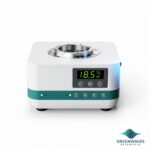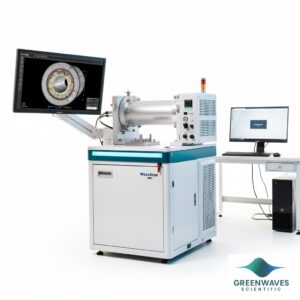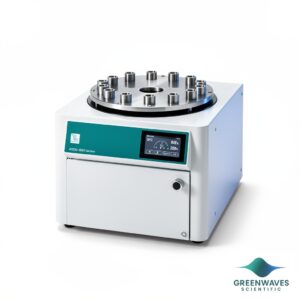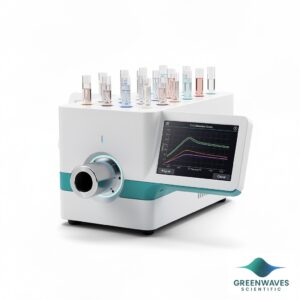
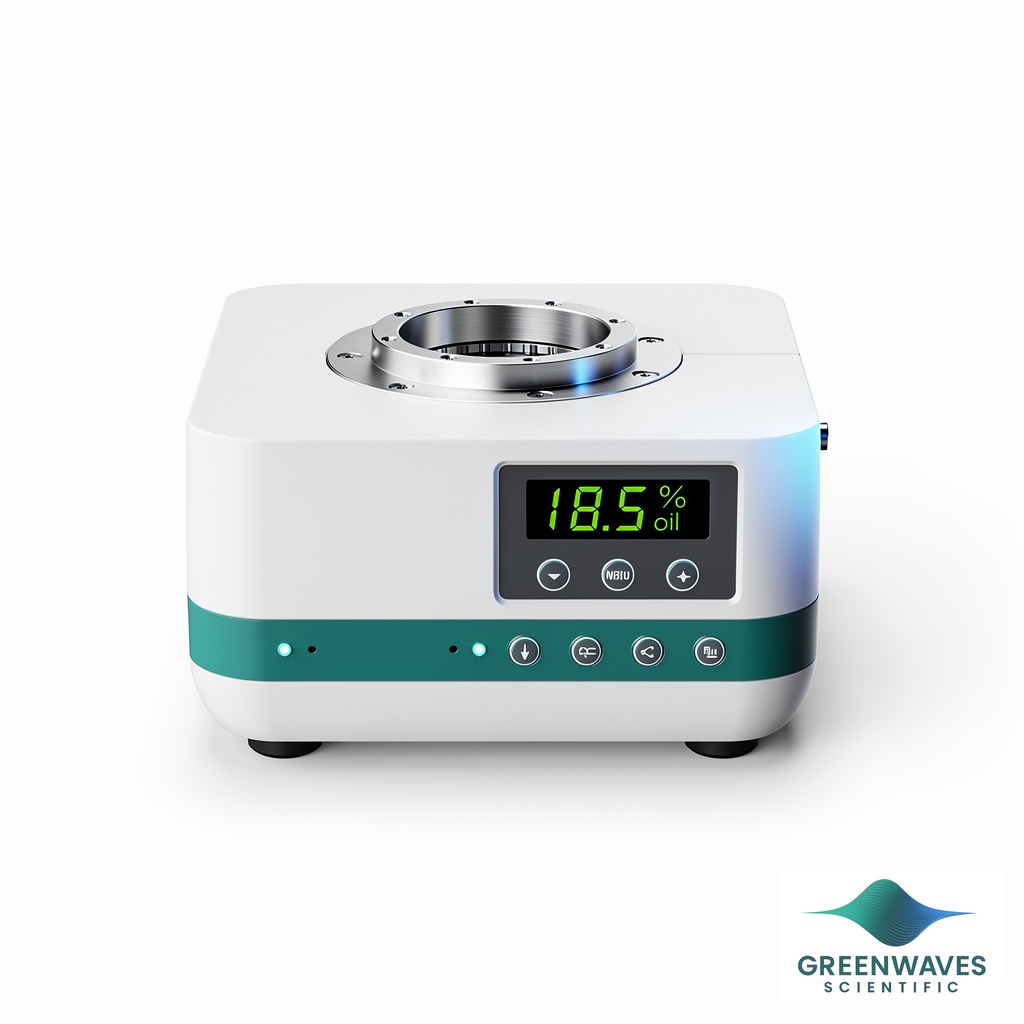
Benchtop 0.5 Tesla NMR analyzer providing rapid, non-destructive seed oil content analysis with ±0.5% accuracy in 1-2 minutes per sample, featuring automatic sampling and specialized software for agricultural applications.
The Benchtop NMR Analyzer for Seed Oil Content Analysis represents a specialized nuclear magnetic resonance spectroscopy solution designed for rapid, non-destructive quantification of oil content in seeds and plant materials. Built around a 0.5 Tesla permanent magnet system with automatic sampling capabilities, this analyzer employs time-domain NMR techniques to deliver oil content measurements within 1-2 minutes per sample with ±0.5% accuracy.
The system integrates a complete NMR spectrometer including pulse sequence generator, direct digital frequency synthesis, and high-resolution analog-to-digital conversion within a benchtop format suitable for routine laboratory use. The 40mm flat probe coil accommodates standard 45×240mm NMR tubes, while the dedicated Seed Oil Content Testing Software provides automated analysis protocols optimized for agricultural and food science applications. The instrument requires a 30-minute warmup period and connects via USB interface for data transfer and system control.
This analyzer addresses the need for rapid, non-destructive seed oil analysis in plant breeding programs, quality control laboratories, and agricultural research facilities where preservation of seed viability is essential. Unlike traditional extraction methods requiring sample destruction, this NMR approach enables quantitative oil content determination while maintaining seed integrity for subsequent germination or genetic studies.
Nuclear magnetic resonance (NMR) spectroscopy for oil content analysis operates on the principle of detecting hydrogen nuclei (1H) present in oil molecules when subjected to a strong magnetic field. The 0.5 Tesla permanent magnet aligns hydrogen nuclear spins, and radiofrequency pulses generated by the pulse sequence generator cause nuclear excitation. The subsequent relaxation of these nuclei produces detectable signals that correlate directly with oil content.
In time-domain NMR analysis, the instrument measures free induction decay (FID) signals following radiofrequency pulse excitation. Oil molecules exhibit characteristic relaxation times (T1 and T2) that differ from water and other seed components, enabling selective quantification. The direct digital frequency synthesis system ensures precise frequency control, while the high-resolution analog-to-digital converter captures the decay signals with sufficient accuracy for quantitative analysis.
The flat probe coil design optimizes signal detection from the sample volume within the 45×240mm NMR tubes. The specialized software applies calibration algorithms specific to seed oil analysis, converting raw NMR signal intensities to oil content percentages through correlation with known standards. This approach eliminates the need for chemical extraction while providing accuracy comparable to traditional gravimetric methods.
| Feature | This Product | Category Context |
|---|---|---|
| Magnetic Field Strength | 0.5 Tesla permanent magnet | Entry-level TD-NMR systems often use 0.2-0.3 Tesla fields |
| Sample Processing | Automatic sampling module | Manual sample insertion common in basic systems |
| Measurement Time | 1-2 minutes per sample | Basic systems may require 3-5 minutes per measurement |
| Accuracy Specification | ±0.5% accuracy | Lower-cost models may specify ±1.0% or greater |
| Probe Design | 40mm flat probe coil | Smaller probe volumes in compact systems |
| Software Integration | Dedicated Seed Oil Content Testing Software | Generic NMR software requiring method development |
This analyzer combines higher magnetic field strength with automated sampling and specialized software to deliver research-grade performance in a benchtop format. The 0.5 Tesla magnet and dedicated oil analysis protocols provide quantitative accuracy suitable for demanding agricultural research applications while maintaining the convenience of rapid, non-destructive measurements.
Perform calibration verification using certified oil content standards at the beginning of each analysis session.
Ensures measurement accuracy remains within specification throughout the day's analyses.
Clean NMR tubes thoroughly with appropriate solvents and dry completely before use.
Residual moisture or contaminants can interfere with NMR signals and reduce measurement accuracy.
Allow samples to equilibrate to room temperature before analysis if stored at different temperatures.
Temperature variations can affect NMR relaxation times and impact oil content calculations.
If signal quality decreases, check probe connections and verify the tube is properly positioned in the sampling module.
Poor electrical connections or sample misalignment are common causes of signal degradation.
Run duplicate measurements on critical samples and investigate any results differing by more than 0.3%.
Reproducibility checks identify potential sample preparation issues or system performance problems.
Maintain safe distances from the magnet with ferromagnetic objects and medical devices.
The 0.5 Tesla field can affect pacemakers and attract metal objects, creating safety hazards.
Record ambient temperature and humidity during critical measurements for experimental documentation.
Environmental conditions can influence NMR measurements and may be relevant for data interpretation.
Maintain a log of calibration standards with known oil contents verified by independent analytical methods.
Traceable reference materials ensure measurement accuracy and enable method validation for regulatory compliance.
ConductScience provides a comprehensive one-year manufacturer warranty covering all hardware components and software support. Technical support includes installation guidance, method development assistance, and troubleshooting for optimal system performance.
The following papers provide general scientific background on measurement techniques relevant to this product category. They are not validation studies of this specific instrument.
What sample preparation is required for seed oil analysis?
Seeds should be cleaned of debris and placed in standard 45×240mm NMR tubes with consistent packing density. No grinding or chemical treatment is required, preserving seed viability. Tubes must be sealed with the provided rubber stoppers.
How does measurement accuracy compare to traditional Soxhlet extraction?
The system provides ±0.5% accuracy, which correlates well (r>0.98) with conventional extraction methods. The advantage is non-destructive analysis completed in 1-2 minutes versus hours for traditional extraction.
What is the effective sample size range for analysis?
The 40mm probe coil accommodates the full volume of 45×240mm tubes. Consult product datasheet for minimum sample volumes required for accurate measurements and recommended filling protocols.
Can the system analyze different seed types without recalibration?
The software includes protocols for various seed types, but specific calibrations may be needed for optimal accuracy with new species. Validation against known standards is recommended for new applications.
What data formats does the system export?
Data output formats should be confirmed in product datasheet. The USB interface enables connectivity to laboratory information systems, though specific file formats require verification.
How stable are measurements over extended analysis sessions?
After the 30-minute warmup period, the temperature control systems maintain stable magnet conditions. Measurement drift should be minimal, but periodic standard checks are recommended for critical applications.
What maintenance schedule is required for optimal performance?
Routine maintenance includes cleaning NMR tubes, checking probe connections, and periodic calibration verification. The permanent magnet design eliminates liquid helium or nitrogen requirements.