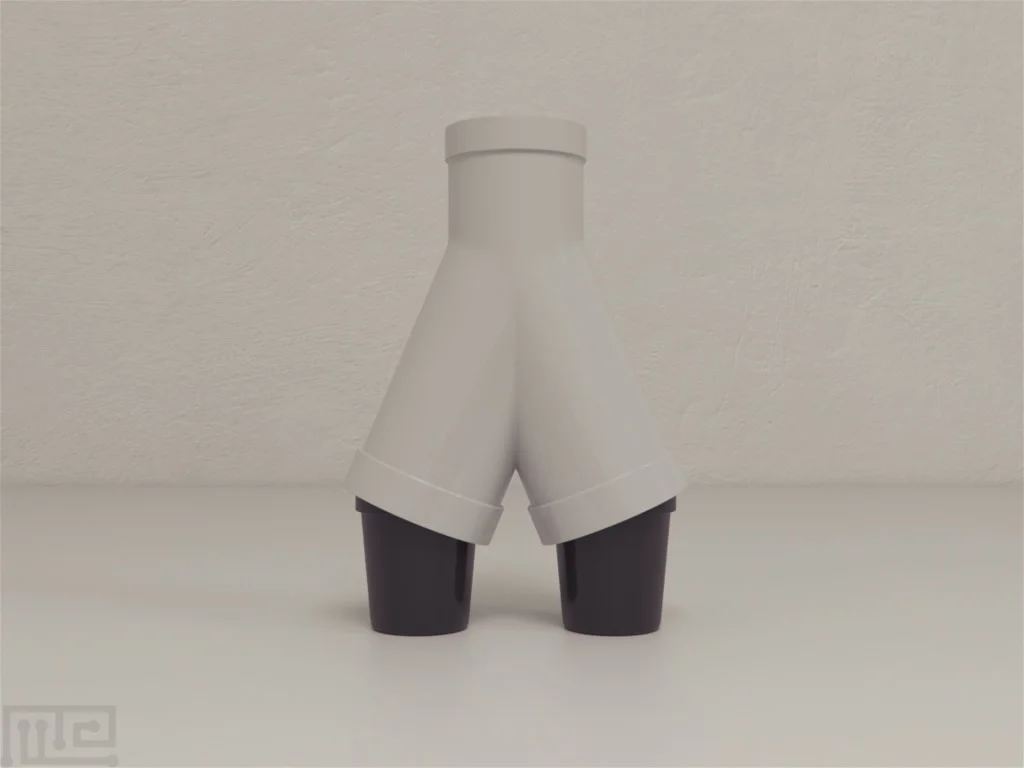
The Y-maze designed for studying plant rooting behavior, initially developed with Pisum sativum as the model organism, serves as a versatile tool for investigating how roots perceive and respond to water and various stimuli. Crafted from durable PVC plastic, this apparatus allows for soil filling and includes two snugly fitting small black plastic pots along with two transparent rectangular plastic trays positioned at each lower end.
Two transparent rectangular plastic trays 9.0 cm × 7.0 cm × 4.0 cm
Introduction
The Plant Y-Maze serves as a tool for studying foraging behaviors in plants, akin to the Y-Maze commonly used in animal research for spatial learning and memory tasks. Designed to exploit plants' phototropic and hydrotropic tendencies, this maze allows researchers to observe learned behaviors in response to these stimuli.
This apparatus can be configured as an upright 'Y' to assess phototropic responses or inverted to study hydrotropic responses during foraging behaviors. Beyond light and water, the Y-Maze enables investigation into how environmental factors like temperature, wind, and sound influence plant behaviors.
Constructed from a 'Y' shaped pipe, the Plant Y-Maze facilitates observation of both root and shoot growth under varying conditions and stimuli. It includes opaque plastic pots and clear trays for experimentation. Other notable apparatuses in plant research include the Mimosa Habituation and Plant Communication Apparatus.
Apparatus and Equipment
The Plant Y-Maze apparatus is composed of a 'Y' shaped PVC pipe, accompanied by two small black plastic pots and two clear plastic trays. The Y-Maze stands at a height of 10.5 cm, with the arms branching off at 6.5 cm from the base. The base arm features a diameter of 5.5 cm, while the bifurcating arms measure 6 cm in diameter and extend 4 cm in length. These arms are set at a 45-degree angle from each other, and the junction boasts an overall width of 9.5 cm. The black plastic pots have a depth of 4.5 cm and snugly fit around the maze tubings with their 5.5 cm diameter. Positioned beneath the pots are two plastic trays measuring 9 x 7 x 4.0 cm each.
Training Protocol
The germination and growing conditions of the seeds used in the experiment should be consistent in order to achieve accurate results. Seeds that have not germinated should be discarded and not used in the experiments. The germination and growing conditions will vary depending on the type of plant and the experimental requirements.
Prior to use, the Y-Maze apparatus must be cleaned to limit the influence of any residual stimuli on the behaviors of the plants.
Garden pea seedlings were evaluated using a classical conditioning paradigm in the Y-Maze. For the investigation, a fan blowing air served as the conditioned stimulus, and a blue LED served as the unconditioned stimulus. The seedlings were divided into 2 experimental groups that either received exposure to both fan and light in the same maze arm (F+L) or in opposite arms (F vs. L), prior to being tested. The conditioning was done for 3 sessions per day for 3 days using a forward delay conditioning wherein the fan stimuli always preceded the light stimuli by an hour and overlapped for 30 minutes. Also, to prevent predictability of the direction of the light stimulus, the positions of the stimuli were alternated between the arms for every session. In the test sessions, the fan was placed in the arm opposite to the last light exposure for the F+L group and in the arm that received light exposure last for F vs. L group. It was observed that 62% of the seedlings in the F+L group grew towards the fan arm while 69% in the F vs. L group grew in the arm opposite to the fan. Thus, it was concluded that the plants were able to form associations to modify their behaviors for successful foraging. (Gangliano, Vyazovskiy, Borbély, Grimonprez & Depczynski, 2016)
Garden pea seedlings were observed for their hydrotropic response when presented with the sound of running water without actual access to water. A baseline experiment was conducted prior to the actual test in which seedlings were evaluated for their hydrotropic response to actual water gradient in one of the Y-Maze pots. The response to the sound of water was investigated by wrapping a flexible tubing, that had continuous water flow, around the base of one of the pots in the Plant Y-Maze. The other pot did not receive any treatment. The primary root directional growth frequency of this experiment was compared with the baseline experiment on day 5. The seedlings showed similar success to baseline test in locating the pot associated with water despite the absence of actual water in the soil. Based on the observations made, it was concluded that plants are capable of responding to the acoustic vibrations of flowing water. (Gangliano, Grimonprez, Depczynski & Renton, 2017)
Garden pea seedlings were evaluated for their root directional response to recordings of flowing water and presence of actual water. This experiment involved an investigation of whether the plant was able to distinguish between the acoustic vibrations and sensory information available to reach the actual water. The pea seedlings were placed in the stalk of the Y-Maze in which one pot received recorded audio treatment while the other pot had water placed in the transparent tray underneath it. A significant number of seedling roots directed growth towards the pot that had access to actual water. The result suggested that, although the acoustic vibrations do rapidly convey the location of flowing water, plants are able to choose the most advantageous cue. (Ganglino et al., 2017)
Garden pea seedlings were evaluated using a classical conditioning paradigm in the Y-Maze. For the investigation, a fan blowing air served as the conditioned stimulus, and a blue LED served as the unconditioned stimulus. The seedlings were divided into 2 experimental groups that either received exposure to both fan and light in the same maze arm (F+L) or in opposite arms (F vs. L), prior to being tested. The conditioning was done for 3 sessions per day for 3 days using a forward delay conditioning wherein the fan stimuli always preceded the light stimuli by an hour and overlapped for 30 minutes. Also, to prevent predictability of the direction of the light stimulus, the positions of the stimuli were alternated between the arms for every session. In the test sessions, the fan was placed in the arm opposite to the last light exposure for the F+L group and in the arm that received light exposure last for F vs. L group. It was observed that 62% of the seedlings in the F+L group grew towards the fan arm while 69% in the F vs. L group grew in the arm opposite to the fan. Thus, it was concluded that the plants were able to form associations to modify their behaviors for successful foraging. (Gangliano, Vyazovskiy, Borbély, Grimonprez & Depczynski, 2016)
Garden pea seedlings were observed for their hydrotropic response when presented with the sound of running water without actual access to water. A baseline experiment was conducted prior to the actual test in which seedlings were evaluated for their hydrotropic response to actual water gradient in one of the Y-Maze pots. The response to the sound of water was investigated by wrapping a flexible tubing, that had continuous water flow, around the base of one of the pots in the Plant Y-Maze. The other pot did not receive any treatment. The primary root directional growth frequency of this experiment was compared with the baseline experiment on day 5. The seedlings showed similar success to baseline test in locating the pot associated with water despite the absence of actual water in the soil. Based on the observations made, it was concluded that plants are capable of responding to the acoustic vibrations of flowing water. (Gangliano, Grimonprez, Depczynski & Renton, 2017)
Garden pea seedlings were evaluated for their root directional response to recordings of flowing water and presence of actual water. This experiment involved an investigation of whether the plant was able to distinguish between the acoustic vibrations and sensory information available to reach the actual water. The pea seedlings were placed in the stalk of the Y-Maze in which one pot received recorded audio treatment while the other pot had water placed in the transparent tray underneath it. A significant number of seedling roots directed growth towards the pot that had access to actual water. The result suggested that, although the acoustic vibrations do rapidly convey the location of flowing water, plants are able to choose the most advantageous cue. (Ganglino et al., 2017)
Data Analysis
The Plant Y-Maze is employed primarily for studying plant foraging behaviors, focusing on observing how roots or shoots grow and their direction in response to various treatments and stimuli. To analyze these behaviors, plants are removed from the apparatus, and their roots are washed to visually assess their responses.
Strengths and Limitations
The Plant Y-Maze facilitates the study of plant foraging behaviors under varying stimuli and growth conditions. It is versatile for evaluating responses to environmental factors like water scarcity and exploring the impacts of noise, air, water, and soil pollution. Furthermore, researchers can observe how different drugs and compounds affect growth behaviors. Constructing and operating the Plant Y-Maze is straightforward, with plastic pots ensuring a secure fit in any maze arm configuration.
The Plant Y-Maze does not perfectly replicate the natural environment of plants, potentially introducing unintended stimuli that could influence experimental outcomes. Protocol constraints may restrict the accurate measurement of plant growth rates. When assessing hydrotropic behavior, it’s important to acknowledge the possible involvement of other responses like gravitropism and magnetotropism. Consistently maintaining experimental conditions such as temperature and humidity is essential to ensure accurate and reliable results.
The Plant Y-Maze facilitates the study of plant foraging behaviors under varying stimuli and growth conditions. It is versatile for evaluating responses to environmental factors like water scarcity and exploring the impacts of noise, air, water, and soil pollution. Furthermore, researchers can observe how different drugs and compounds affect growth behaviors. Constructing and operating the Plant Y-Maze is straightforward, with plastic pots ensuring a secure fit in any maze arm configuration.
The Plant Y-Maze does not perfectly replicate the natural environment of plants, potentially introducing unintended stimuli that could influence experimental outcomes. Protocol constraints may restrict the accurate measurement of plant growth rates. When assessing hydrotropic behavior, it's important to acknowledge the possible involvement of other responses like gravitropism and magnetotropism. Consistently maintaining experimental conditions such as temperature and humidity is essential to ensure accurate and reliable results.
Summary
Plant Y-Maze is used in the observation of foraging behaviors in plants.
The maze utilizes the principles of phototropism and hydrotropism.
Plant Y-Maze can be used to investigate the effects of environmental conditions, drugs and chemical compounds on the growth behaviors of plants.
References
Gagliano, M., Grimonprez, M., Depczynski, M., & Renton, M. (2017). Tuned in: plant roots use sound to locate water. Oecologia. 184(1):151-160. doi: 10.1007/s00442-017-3862-z.
Gagliano, M., Vyazovskiy, V. V., Borbély, A. A., Grimonprez, M., & Depczynski, M. (2016). Learning by Association in Plants. Sci Rep. 6:38427. doi: 10.1038/srep38427.