$5,900.00–$6,900.00Price range: $5,900.00 through $6,900.00
The rodent tremor monitor system from Maze Engineers serves to assess tremors in rodents, which are involuntary, rhythmic muscle contractions triggered by various factors. These include neurological conditions like stroke, multiple sclerosis, traumatic brain injury, or Parkinson’s disease; pharmacological issues such as mercury poisoning; and metabolic disturbances like hypoglycemia. This system is instrumental in diagnosing tremors definitively and monitoring their real-time response to treatment. It offers multiple chamber configurations with customizable specifications and dimensions.
Key parameters measurable with the rodent tremor monitor system include the type of tremor, its severity, and how it responds to treatment.
Here are some of the benefits of using a rodent tremor monitor system:
Accurate tremor measurement: The rodent tremor monitor system is a very accurate way to measure tremors. The system can detect tremors that are too subtle to be seen with the naked eye.
Quantitative tremor analysis: The rodent tremor monitor system can be used to quantitatively analyze tremors. This means that the system can be used to measure the severity of the tremor, the frequency of the tremor, and the amplitude of the tremor.
Tremor monitoring over time: The rodent tremor monitor system can be used to monitor tremors over time. This means that the system can be used to track the progression of tremors and assess the response of tremors to treatment.
Take advantage of Neuralynx, Ethovision Integration, SMS and Email integration with the Conductor Science Software. No I/O Boxes Required
Learn More
Features
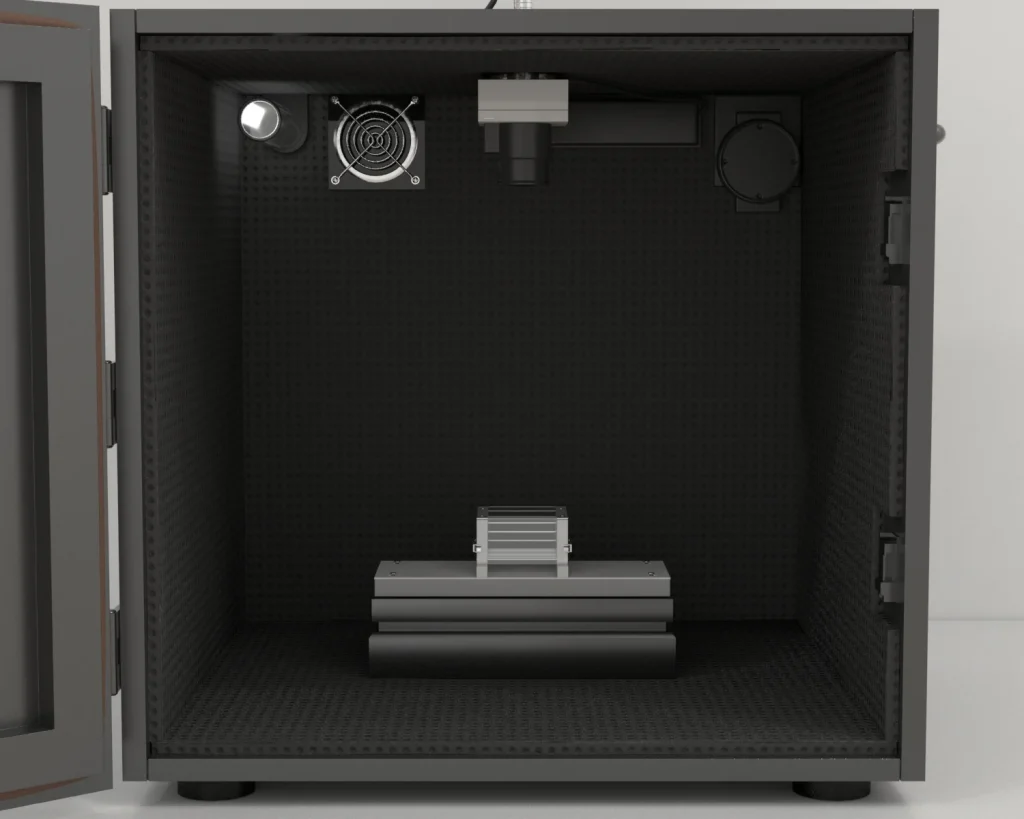
Sound Attenuating Cubicle
55cm x 42cm x 55cm (width x depth x height) (dimensions are customizable, please request)
Multi-layer sound-proof insulation material that attenuates environmental disturbance
LED house light (manual)
Automated IR light
Automated air circulation fan
Camera mount
Pull-out floor shelf (optional)
Rodent Enclosure
Acrylic cage with lid
Dimensions: mouse 17 x 17 x 25cm (width x depth x height) cm and rat 26 x 26 x 30 cm (width x depth x height)
Front circular door – The door open in the middle
Feces and urine tray – removable for feces and urine removal
Control Box
Support up to eight Tremor Monitor stations: Each station has one control box that controls its operations
The main control box connects to up to 16 chamber control boxes via wireless communication. The wireless
eliminates many cable connections between the main control box and all (up to 8) stations
The main controller connects to the PC via a USB (RS-232) cable and communicates with Maze Engineers
Conduct Tremor software on the PC
Conduct Software
No TTL is required
Export real-time recorded data from the control box to PC
The Conduct Tremor software is used to configure and run experiments. The software is intuitive and precise
with easy installation
The user can specify frequencies (for example at 128Hz) to be monitored
The data are presented and charted for analysis via FFT that shows the most powerful frequency recorded
The ability to run up to 60 minutes and the data can be reviewed in adjustable intervals such as 1-minute or 2-
minutes
Support up to 8 stations simultaneously
Tremor sensor
Ultra-sensitive piezoelectric disk
Record continuous movement waveforms at 1 to 128 (Hz) in real-time for up to 60 minutes
Apparatus and Equipment
The design of the Rodent Tremor Chamber integrates a sound-attenuating enclosure, rodent support apparatus, tremor detection sensor, and software suite for recording, analyzing, and exporting data.
Rodents modeled for tremors and control strains are securely positioned within the holder to facilitate precise tremor analysis.
For accurate rodent positioning, advanced video tracking software solutions like Noldus EthoVision, ANY-Maze, or BehaviorCloud can be utilized to monitor rodent movements within the chamber.
Training Protocol
Set up protocol parameters using the Conduct software package, including experimental timing and other variables.
Introduce subjects into the rodent enclosure and provide a 10-minute habituation period.
Initiate tremor measurement using the Conduct software.
Record tremor frequencies and event counts, exporting the data to a PC for further analysis.
Data Analysis
The following parameters can be measured using te rodent temor chamber:
Number of tremors in a given time
Type of tremor
The severity of the tremor
Response of the tremor to treatment.
Literature Review
The research aimed to explore the impact of harmaline, a naturally occurring compound, on tremor activity in mice. The investigators conducted experiments to assess harmaline’s tremor-inducing properties and to delve into the underlying mechanisms.
In the study, harmaline was administered to mice, and their tremor activity was monitored using specialized equipment. Significant increases in tremor activity were observed post-harmaline administration, affirming its ability to induce tremors.
To delve deeper into the mechanisms, various pharmacological agents were administered to the mice prior to harmaline dosing. This approach allowed researchers to evaluate how these agents influenced tremor activity. They focused on compounds targeting neurotransmitter systems like serotonin, glutamate, and GABA, all critical for motor control.
Results unveiled that some pharmacological agents exerted inhibitory effects on harmaline-induced tremor activity. For instance, serotonin-targeting compounds mitigated tremor intensity. Conversely, agents impacting the glutamate system intensified tremor activity.
The findings offer valuable insights into the pharmacological underpinnings of harmaline-induced tremors in mice. By scrutinizing how different compounds affect tremor severity, the study illuminates the intricate interactions among neurotransmitter systems crucial to motor function.
Overall, this research enhances comprehension of tremor disorders and may potentially guide the development of therapeutic strategies for conditions marked by aberrant tremor activity.
This study focuses on the discovery and identification of specific compounds, known as indole diterpenes, found in two plant species: Ipomoea asarifolia and Ipomoea muelleri. The study also investigates the biological activity of these compounds, particularly their ability to induce tremors.
The researchers conducted an extensive analysis of the chemical composition of the plants through various techniques, including chromatography and spectroscopy. They successfully isolated and identified several indole diterpenes from both Ipomoea asarifolia and Ipomoea muelleri.
Next, the researchers evaluated the tremor-inducing properties of these indole diterpenes. They administered the isolated compounds to laboratory animals and monitored their tremor activity using specialized equipment. The results demonstrated that these indole diterpenes indeed induced tremors in the animals, confirming their tremorgenic activity.
Furthermore, the study focused on a specific compound called 6,7-dehydro-11-hydroxy-12,13-epoxyterpendole A. The researchers isolated this compound and conducted detailed analysis to elucidate its chemical structure. By employing various spectroscopic techniques, they successfully determined the precise structure of 6,7-dehydro-11-hydroxy-12,13-epoxyterpendole A.
The discovery and identification of these tremorgenic indole diterpenes contribute to our understanding of the chemical diversity present in plants like Ipomoea asarifolia and Ipomoea muelleri. Additionally, the characterization of 6,7-dehydro-11-hydroxy-12,13-epoxyterpendole A provide a specific compound of interest for further investigations.
Overall, this research sheds light on the chemical properties and tremorgenic activity of indole diterpenes derived from Ipomoea asarifolia and Ipomoea muelleri. It may have implications in pharmacology and drug development, potentially leading to the discovery of new compounds or therapeutic strategies targeting tremor-related conditions.
The research aimed to explore the impact of harmaline, a naturally occurring compound, on tremor activity in mice. The investigators conducted experiments to assess harmaline's tremor-inducing properties and to delve into the underlying mechanisms.
In the study, harmaline was administered to mice, and their tremor activity was monitored using specialized equipment. Significant increases in tremor activity were observed post-harmaline administration, affirming its ability to induce tremors.
To delve deeper into the mechanisms, various pharmacological agents were administered to the mice prior to harmaline dosing. This approach allowed researchers to evaluate how these agents influenced tremor activity. They focused on compounds targeting neurotransmitter systems like serotonin, glutamate, and GABA, all critical for motor control.
Results unveiled that some pharmacological agents exerted inhibitory effects on harmaline-induced tremor activity. For instance, serotonin-targeting compounds mitigated tremor intensity. Conversely, agents impacting the glutamate system intensified tremor activity.
The findings offer valuable insights into the pharmacological underpinnings of harmaline-induced tremors in mice. By scrutinizing how different compounds affect tremor severity, the study illuminates the intricate interactions among neurotransmitter systems crucial to motor function.
Overall, this research enhances comprehension of tremor disorders and may potentially guide the development of therapeutic strategies for conditions marked by aberrant tremor activity.
This study focuses on the discovery and identification of specific compounds, known as indole diterpenes, found in two plant species: Ipomoea asarifolia and Ipomoea muelleri. The study also investigates the biological activity of these compounds, particularly their ability to induce tremors.
The researchers conducted an extensive analysis of the chemical composition of the plants through various techniques, including chromatography and spectroscopy. They successfully isolated and identified several indole diterpenes from both Ipomoea asarifolia and Ipomoea muelleri.
Next, the researchers evaluated the tremor-inducing properties of these indole diterpenes. They administered the isolated compounds to laboratory animals and monitored their tremor activity using specialized equipment. The results demonstrated that these indole diterpenes indeed induced tremors in the animals, confirming their tremorgenic activity.
Furthermore, the study focused on a specific compound called 6,7-dehydro-11-hydroxy-12,13-epoxyterpendole A. The researchers isolated this compound and conducted detailed analysis to elucidate its chemical structure. By employing various spectroscopic techniques, they successfully determined the precise structure of 6,7-dehydro-11-hydroxy-12,13-epoxyterpendole A.
The discovery and identification of these tremorgenic indole diterpenes contribute to our understanding of the chemical diversity present in plants like Ipomoea asarifolia and Ipomoea muelleri. Additionally, the characterization of 6,7-dehydro-11-hydroxy-12,13-epoxyterpendole A provide a specific compound of interest for further investigations.
Overall, this research sheds light on the chemical properties and tremorgenic activity of indole diterpenes derived from Ipomoea asarifolia and Ipomoea muelleri. It may have implications in pharmacology and drug development, potentially leading to the discovery of new compounds or therapeutic strategies targeting tremor-related conditions.
Summary
The Rodent Tremor Chamber allows for ultra-sensitive measurements of tremor in rat and mouse models.
The apparatus is composed of a sound-attenuating chamber, rodent enclosure, tremor sensor, control box, and Conduct software.
Continuous movement waveforms can be recorded at 1-128 Hz in real-time for up to 60 minutes.
References
Gardner, D. R., Welch, K. D., Lee, S. T., Cook, D., & Riet-Correa, F. (2018). Tremorgenic Indole Diterpenes from Ipomoea asarifolia and Ipomoea muelleri and the Identification of 6,7-Dehydro-11-hydroxy-12,13-epoxyterpendole A. Journal of Natural Products, 81(7), 1682–1686. doi:10.1021/acs.jnatprod.8b00257
Paterson, N. E., Malekiani, S. A., Foreman, M. M., Olivier, B., & Hanania, T. (2009). Pharmacological characterization of harmaline-induced tremor activity in mice. European Journal of Pharmacology, 616(1-3), 73–80. doi:10.1016/j.ejphar.2009.05.031
Material
Acrylic
Multi-layer sound-proof insulation material
Dimensions
55cm x 42cm x 55cm
Mouse Cage Dimensions
17 x 17 x 25cm (width x depth x height)
Rat Cage Dimensions
26 x 26 x 30cm (width x depth x height)
Frequency Range
1 to 128 Hz
Recording Duration
up to 60 minutes
Stations Supported
up to 8 stations
Control Boxes Supported
up to 16 chamber control boxes
Sensor Type
Ultra-sensitive piezoelectric disk
connectivity
USB (RS-232) cable
Wireless Communication
between main control box and chamber control boxes
Data Intervals
adjustable intervals such as 1-minute or 2-minutes

 Take advantage of Neuralynx, Ethovision Integration, SMS and Email integration with the Conductor Science Software. No I/O Boxes Required
Learn More
Take advantage of Neuralynx, Ethovision Integration, SMS and Email integration with the Conductor Science Software. No I/O Boxes Required
Learn More