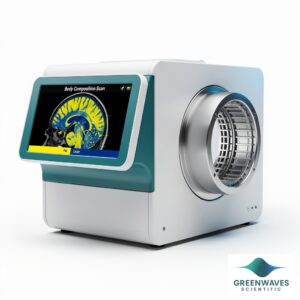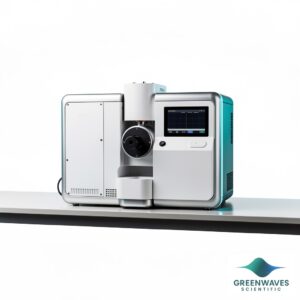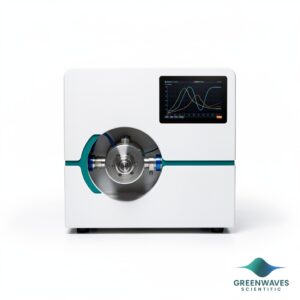
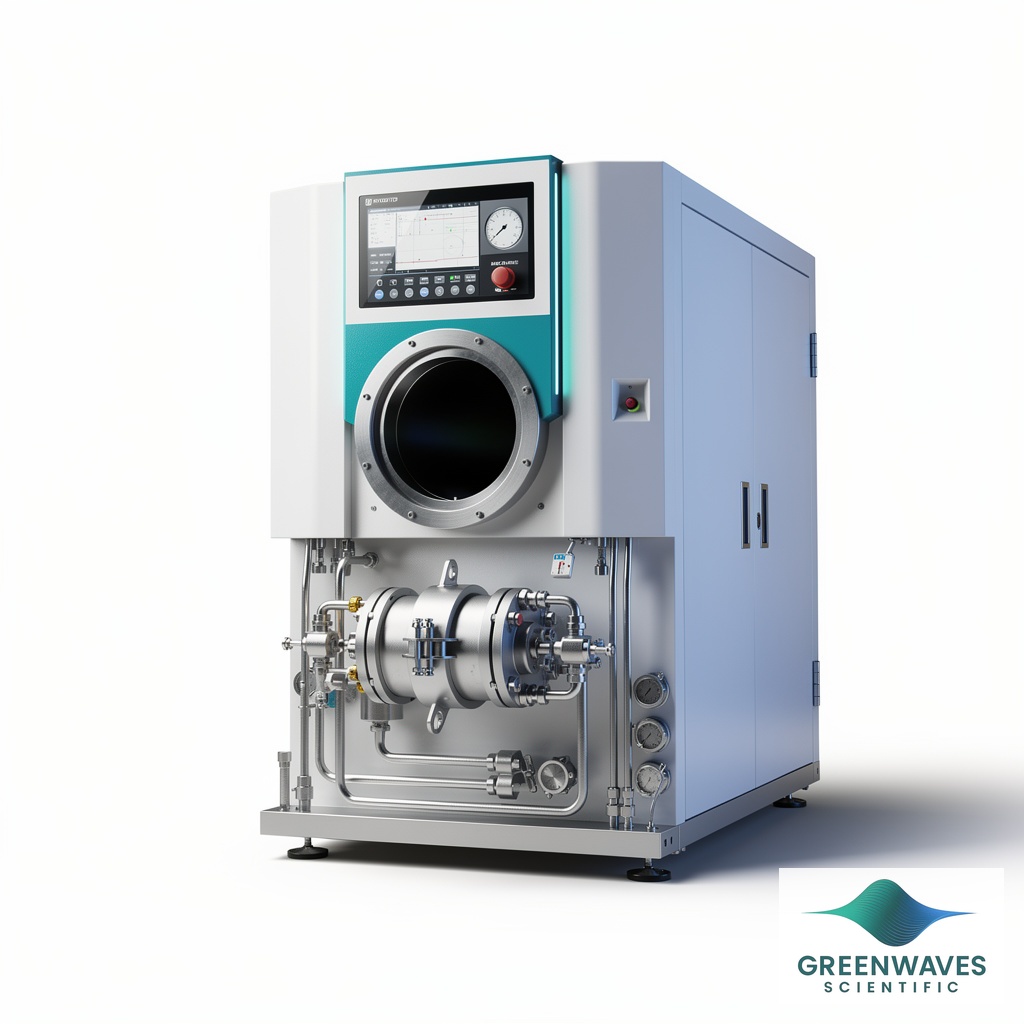
High-pressure NMR analyzer for full-diameter core samples up to 40 MPa, measuring T1, T2, and diffusion parameters for petroleum reservoir characterization.
The HTHP Large-Bore NMR Core Analyzer operates at pressures up to 40 MPa to enable in-situ nuclear magnetic resonance analysis of full-diameter core samples under simulated formation conditions. This permanent magnet system provides a 150 mm bore diameter with 0.3 T field strength (12 MHz resonance frequency) for comprehensive petrophysical characterization of petroleum reservoir rocks.
The instrument measures T1 longitudinal relaxation, T2 transverse relaxation, T1-T2 correlation maps, and diffusion coefficients to quantify porosity distribution, fluid saturations, and pore size distributions in core samples. High-pressure capability enables simulation of downhole conditions for accurate assessment of movable versus bound fluid fractions and wettability characteristics under reservoir stress conditions.
Nuclear magnetic resonance relaxometry measures the decay of magnetization in hydrogen-containing fluids within rock pore spaces. When core samples are placed in the 0.3 T permanent magnetic field, hydrogen nuclei in pore fluids align with the field direction. Radiofrequency pulses at 12 MHz excite these nuclei, and their subsequent relaxation behavior provides information about pore size distribution and fluid properties.
T1 relaxation reflects the recovery of longitudinal magnetization and correlates with pore surface-to-volume ratios, while T2 relaxation measures transverse magnetization decay influenced by pore size and surface relaxivity. The high-pressure capability enables measurement under confining pressures up to 40 MPa, simulating downhole stress conditions that affect pore geometry and fluid distribution. T1-T2 correlation experiments separate overlapping signals from different fluid phases, enabling quantitative analysis of bound versus free fluid fractions.
Diffusion measurements utilize pulsed field gradient sequences to determine molecular mobility, distinguishing between restricted diffusion in small pores and bulk fluid diffusion. The 150 mm bore accommodates full-diameter core samples, preserving natural heterogeneity and providing representative measurements of reservoir rock properties.
| Feature | This Product | Category Context |
|---|---|---|
| Maximum Operating Pressure | 40 MPa | Benchtop systems typically operate at atmospheric pressure only |
| Bore Diameter | 150 mm | Standard NMR systems accommodate 25-50 mm sample tubes |
| Magnetic Field Strength | 0.3 T (12 MHz) | Low-field systems often operate at 0.05-0.1 T |
| Measurement Types | T1, T2, T1-T2 Correlation, Diffusion | Basic systems may offer only T2 measurements |
| Magnet Type | Permanent NdFeB | Superconducting systems require cryogen cooling |
This analyzer combines high-pressure capability with large-bore permanent magnet design for comprehensive core analysis under formation conditions. The 0.3 T field strength and multi-parameter measurement capability provide detailed petrophysical characterization while maintaining operational simplicity.
Perform weekly calibration checks using water-saturated reference cores with known porosity.
Ensures measurement accuracy and detects any system drift affecting quantitative analysis.
Keep permanent magnet surfaces clean and monitor for any metallic debris accumulation.
Foreign materials can create field distortions affecting measurement homogeneity and accuracy.
Allow cores to equilibrate at measurement pressure for at least 30 minutes before data acquisition.
Pressure equilibration ensures stable pore fluid distribution and reproducible relaxation measurements.
Check RF pulse calibration if T1 measurements show unexpectedly long relaxation times.
Incorrect pulse angles can lead to incomplete saturation and systematic errors in relaxation time determination.
Acquire multiple T2 datasets with different echo spacing to identify and correct for diffusion effects.
Diffusion attenuation can bias T2 distributions toward shorter times if not properly accounted for.
Maintain 1-meter exclusion zone around magnet and use non-ferromagnetic tools during operation.
Strong permanent magnet creates safety hazards for personnel with implants and can damage electronic equipment.
Record detailed sample history including fluid saturations, pressure history, and storage conditions.
Sample history affects initial fluid distributions and enables proper interpretation of relaxation signatures.
ConductScience provides a one-year manufacturer warranty covering parts and technical support. Extended service contracts available for specialized NMR system maintenance and calibration services.
The following papers provide general scientific background on measurement techniques relevant to this product category. They are not validation studies of this specific instrument.
What core sample sizes can be analyzed in the 150 mm bore?
The 150 mm bore accommodates full-diameter core samples typically 4-6 inches in diameter and up to 12 inches in length, depending on pressure vessel configuration.
How does high pressure affect T1 and T2 relaxation measurements?
Confining pressure reduces pore volume and alters pore geometry, typically shortening T2 relaxation times. T1 measurements are less affected but may show changes due to fluid redistribution under stress.
What measurement time is required for reliable T1-T2 correlation data?
T1-T2 measurements typically require 2-8 hours depending on sample porosity, fluid content, and desired signal-to-noise ratio for quantitative fluid typing.
Can the system measure cores with mixed wettability conditions?
Yes, T1-T2 correlation maps can distinguish between oil-wet and water-wet pore surfaces based on different relaxation signatures of fluids in contact with rock surfaces.
What diffusion coefficient range can be measured?
The system measures diffusion coefficients from 10^-12 to 10^-8 m²/s, covering the range from restricted pore diffusion to bulk fluid diffusion in petroleum systems.
How is the permanent magnet system maintained?
Permanent magnets require no active maintenance but must be kept clean and protected from mechanical shock. Temperature stability is important for field homogeneity.
What sample preparation is required before measurement?
Cores should be cleaned, dried, and saturated with known fluids under controlled conditions. Sample orientation and pressure vessel sealing are critical for accurate measurements.