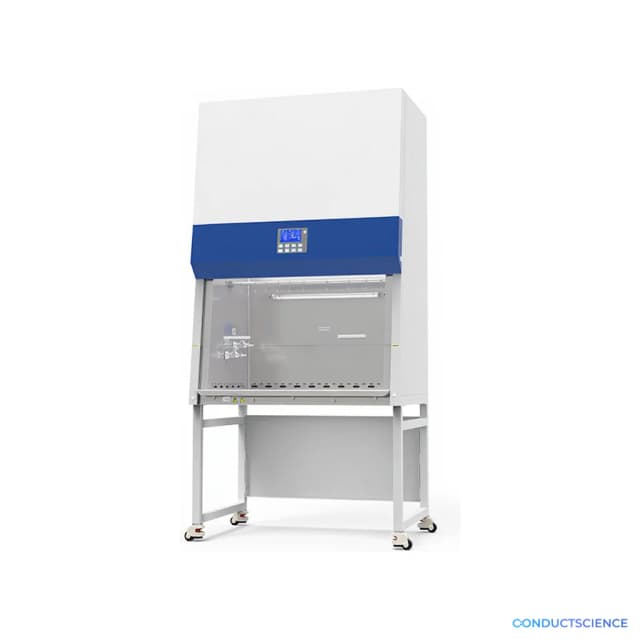
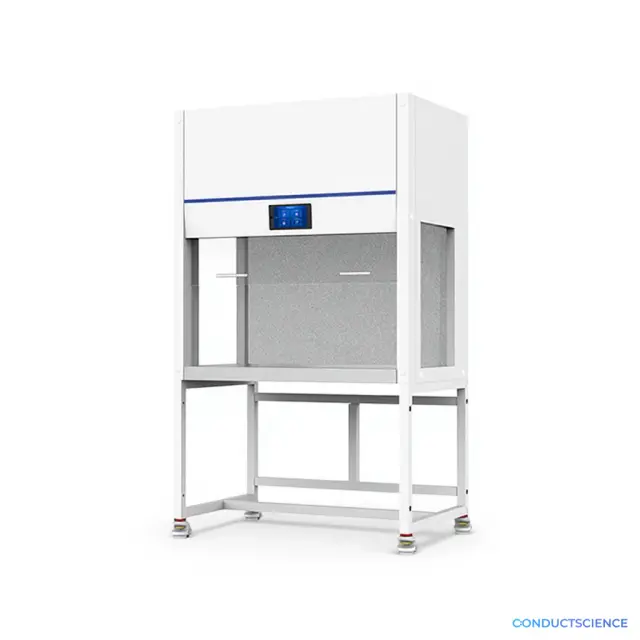
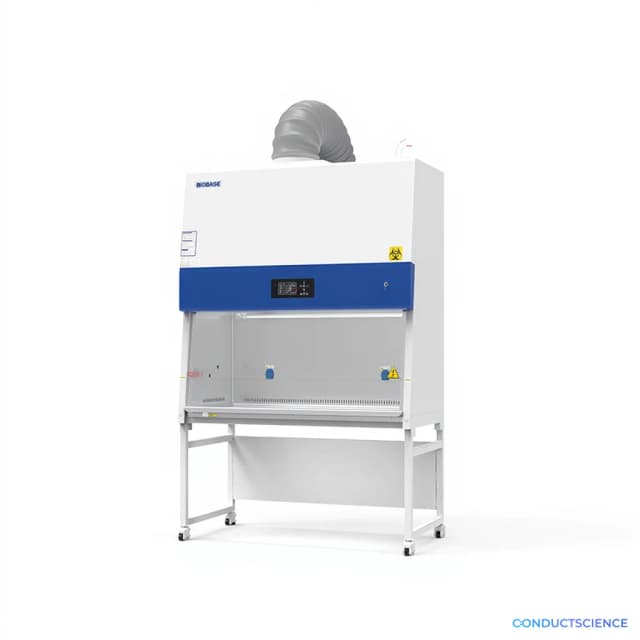
Compounding Hood BBS-V500,V600,V700 BYKG-V Series
Vertical laminar flow clean bench series with adjustable airflow (0.3-0.8 m/s) and LED display controls, available in four size configurations for pharmaceutical compounding and contamination-sensitive laboratory procedures.

Louise Corscadden, PhD
Director of Science · ConductScience
Ask Louise about Compounding Hood BBS-V500,V600,V700 BYKG-V Series fit, setup, configuration, or quote prep.
Already working with us? Sign in to connect this with My Scientist.
Key Specifications
Full details →- Model fit
- Configured during quote
- SKU family
- BIO-0045
- Shipping box
- 42.0 x 43.6 x 38.0 cm
- Ordering
- Online checkout and quote request available
- Category
- Clean Benches & Fume Hoods
- Build notes
- Confirm accessories, station layout, and support needs before purchase
Compounding Hood BBS-V Series
Professional laboratory fume hood designed for safe work with hazardous chemicals and vapors. Features vertical laminar airflow with HEPA filtration and comprehensive operator protection in compliance with laboratory safety standards.
Key Features:
- Vertical laminar airflow design
- HEPA filtration system
- Multiple size configurations
- Durable construction materials
- Safety monitoring systems
- Operator-friendly controls
How It Works
The BYKG-V Series operates on vertical laminar airflow principles, drawing ambient air through a pre-filter system before passing through HEPA filtration. The filtered air flows downward in parallel streams at controlled velocities, creating a sterile workspace that continuously sweeps particles and contaminants away from the work surface and out of the chamber.
Airflow velocity is electronically controlled and displayed on the LED interface, allowing operators to adjust flow rates between 0.3 and 0.8 m/s depending on application requirements. Lower velocities minimize sample disturbance for powder handling, while higher velocities provide enhanced protection for more contamination-sensitive procedures.
The enclosed design with front opening access maintains positive pressure within the work chamber relative to the surrounding environment, preventing ingress of unfiltered air during operation while allowing normal hand and equipment movement within the workspace.
Features & Benefits
Automation Level
- semi-automated
BYKG-VII
- BBS-V600
BYKG-VIII
- BBS-V700
BYKG-IX
- BYKG-X
External Size(W*D*H)mm
- 550*460*700
600*580*1060
- 700*620*1150
1000*620*1150
- 1200*620*1150
Internal Size(W*D*H)mm
- 480*340*370
580*520*610
- 640*550*700
940*550*700
- 1140*550*700
LCD display
- LED display
Airflow Velocity
- 0.3~0.5m/s
≥0.5m/s
- 0.3~0.5m/s
0.3~0.8m/s
- 0.3~0.5m/s
Brand
- ConductScience
Research Domain
- Analytical Chemistry
- Clinical Diagnostics
- Food Science
- Materials Science
- Microbiology
- Pharmaceutical QC
Display Type
- LED display
Shipping weight
- 57.0 lb
Shipping box
- L: 42.0 cm
- W: 43.6 cm
- H: 38.0 cm
| Feature | This Product | Typical Alternative | Advantage |
|---|---|---|---|
| Airflow Velocity Range | 0.3-0.8 m/s variable control | Fixed velocity systems often operate at single speeds | Enables optimization of protection level versus sample disturbance for different procedures. |
| Display Interface | LED display with digital readout | Basic models use analog gauges or indicator lights | Provides precise airflow monitoring and enables accurate velocity adjustment during operation. |
| Size Configuration Options | Four size configurations from 480×340×370 mm to 1140×550×700 mm internal | Limited size options in most product lines | Allows selection of optimal workspace size for specific throughput requirements without oversizing. |
| Flow Design | Vertical laminar flow with front access | Horizontal flow designs are common in basic units | Provides better containment and personnel protection while maintaining ergonomic operation. |
| Unit Weight | 57 kg | Varies by model and construction | Indicates substantial construction for stability during operation while remaining manageable for installation. |
The BYKG-V Series offers variable airflow control with LED display monitoring across four size configurations, providing flexibility for different workspace requirements. The vertical laminar flow design with front access combines effective contamination control with ergonomic operation for pharmaceutical and laboratory applications.
Practical Tips
Verify airflow velocity at nine points across the work surface monthly using a calibrated thermal anemometer.
Why: Ensures uniform air distribution and identifies filter loading or system performance changes before they affect sterility.
Monitor differential pressure across HEPA filters weekly and replace when readings exceed manufacturer specifications.
Why: Maintains optimal airflow velocity and prevents system strain from overloaded filtration.
Allow 15-30 minutes of operation before beginning critical procedures to establish stable airflow conditions.
Why: Temperature and airflow equilibration ensures consistent protection levels throughout the work session.
If airflow velocity drops unexpectedly, check for obstructions in air intake areas before assuming filter replacement is needed.
Why: Simple blockages can mimic filter loading symptoms and are easily resolved without unnecessary filter changes.
Document airflow measurements and filter change dates in a logbook for performance trending and validation documentation.
Why: Regulatory environments often require documented evidence of equipment performance for quality assurance purposes.
Position materials toward the back of the work surface to maximize exposure to filtered airflow before reaching the operator.
Why: Ensures maximum residence time in the sterile air stream for optimal contamination protection.
Use smooth, deliberate movements within the work zone to avoid disrupting laminar airflow patterns.
Why: Rapid or turbulent movements can create air currents that compromise the protective airflow barrier.
Clean work surfaces with appropriate disinfectants before each use, working from back to front toward the air exit.
Why: Removes surface contaminants while working with the airflow direction to prevent recontamination of cleaned areas.
Setup Guide
What’s in the Box
- Compounding hood main unit (typical)
- HEPA filter assembly (typical)
- LED display control module (typical)
- Power cord and electrical connections (typical)
- Installation hardware and mounting brackets (typical)
- User manual and operating procedures (typical)
- Performance verification certificate (typical)
Warranty
ConductScience provides a standard 1-year manufacturer warranty covering defects in materials and workmanship, with technical support for installation and operational guidance.
Compliance
What airflow velocity should I use for different types of compounding procedures?
Use 0.3-0.5 m/s for powder handling and weighing to minimize sample disturbance, and 0.5-0.8 m/s for liquid preparations and procedures requiring maximum contamination protection. The LED display allows real-time adjustment based on your specific application requirements.
How do I verify that the unit maintains proper air cleanliness levels?
Perform particle counting at multiple points across the work surface using a calibrated particle counter. The unit should maintain ISO Class 5 conditions (≤3,520 particles ≥0.5 μm per cubic meter) when properly maintained with clean HEPA filters.
What maintenance is required to ensure consistent performance?
Replace HEPA filters based on differential pressure readings or at manufacturer-specified intervals. Clean work surfaces with appropriate disinfectants before each use, and perform monthly airflow velocity verification using a calibrated anemometer.
Can the unit handle hazardous drug compounding applications?
This vertical laminar flow unit provides personnel protection through containment design, but consult USP <800> requirements for specific hazardous drug applications which may require additional containment features or specialized equipment.
How do the different size models compare for workspace requirements?
The V500 (480×340×370 mm internal) suits small-scale preparations, V600 (580×520×610 mm) handles moderate volumes, V700 (640×550×700 mm) accommodates larger preparations, and BYKG-X (1140×550×700 mm) provides maximum workspace for high-throughput operations.
What type of procedures should not be performed in this unit?
Avoid procedures generating significant heat, open flames, or volatile solvents that could damage HEPA filters or create safety hazards. The unit is designed for particulate contamination control, not chemical fume extraction.
How long can the unit operate continuously?
The unit is designed for continuous operation during working hours. Allow periodic shutdown for maintenance access and filter replacement, with startup time of approximately 15-30 minutes to establish stable airflow conditions.
Have a question about this product?
Have a question? Just ask.
Send it over and we'll email you a personalized answer — no call, no scheduling.
Prefer to talk it through?