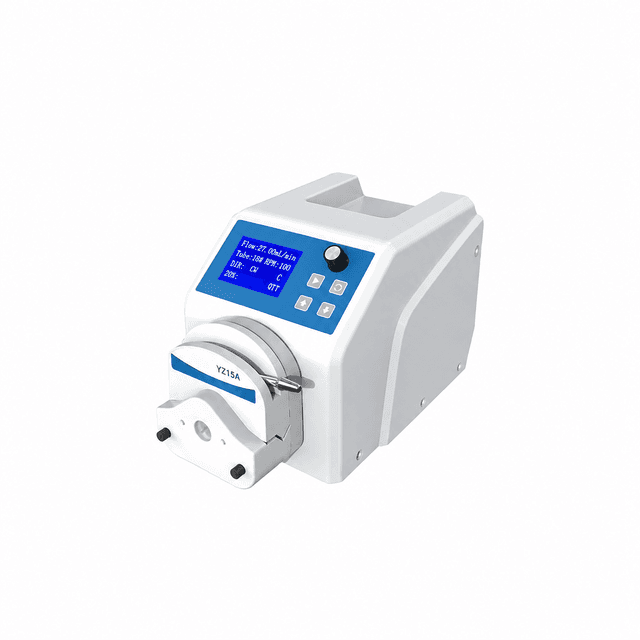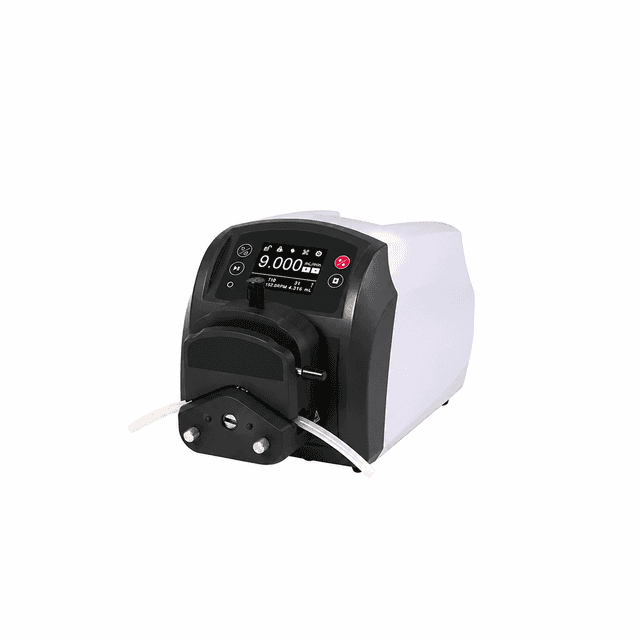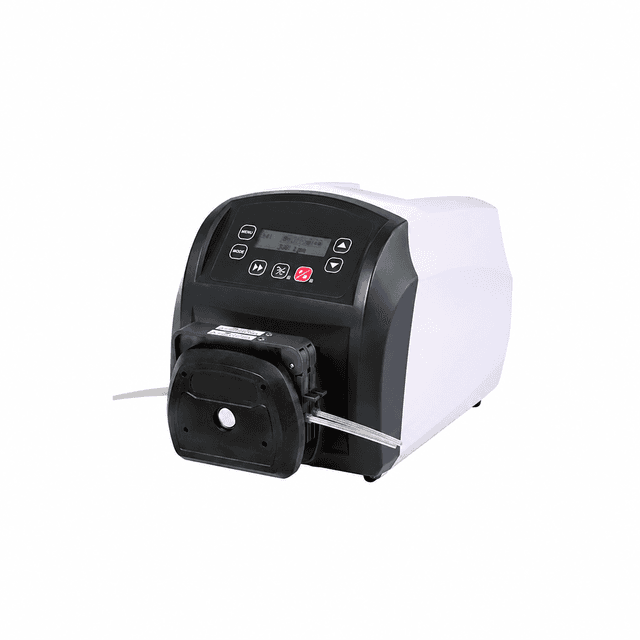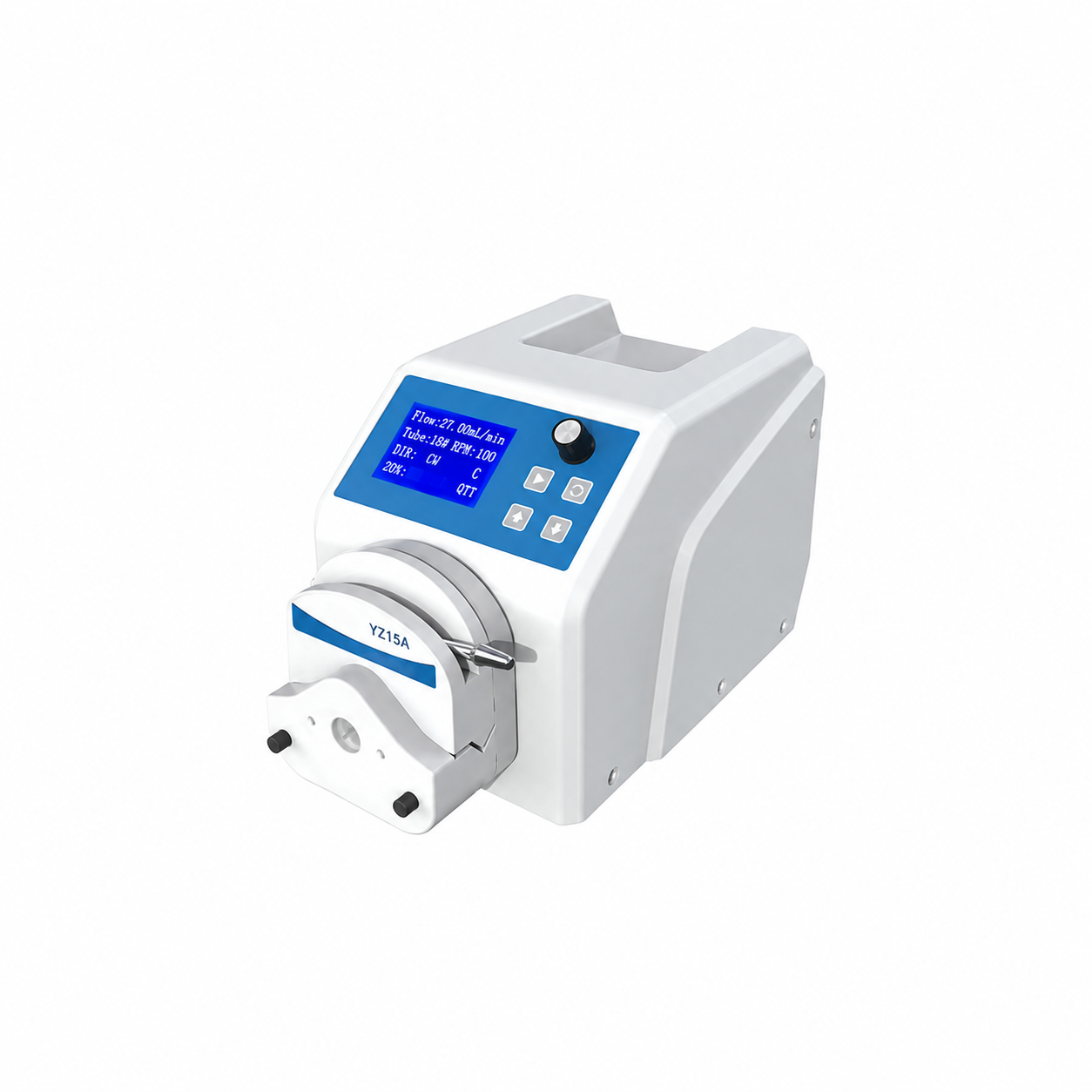
Dispensing Peristaltic Pump
Precision peristaltic pump for contamination-free liquid dispensing with programmable volume control from 0.01 mL to 9.99 L and comprehensive external control integration.

Louise Corscadden, PhD
Director of Science · ConductScience
Ask Louise about Dispensing Peristaltic Pump fit, setup, configuration, or quote prep.
Already working with us? Sign in to connect this with My Scientist.
Key Specifications
Full details →- Model fit
- Configured during quote
- SKU family
- BIO-0734
- Shipping box
- 18.9 x 30.0 x 17.1 cm
- Ordering
- Online checkout and quote request available
- Category
- Pumps
- Build notes
- Confirm accessories, station layout, and support needs before purchase
Description
Advanced Dispensing Peristaltic Pump (DPP-100-BF) for precise fluid dispensing and transfer in laboratory settings.
Specifications
• Speed: //cdn.bootcss.com/video.js/7.5.4/alt/video-js-cdn.min.css" rel="stylesheet">
• Dimensions: 14px; text-wrap-mode: wrap;">
• Weight: 0px; border-collapse: collapse;">
Key Features
• Precision engineering for accurate measurements
• Durable construction for long-term laboratory use
• Reliable performance under various conditions
• Easy operation and maintenance
• Suitable for a wide range of fluids
Model Comparison
• DPP-600-BF"/>
• DPP-100-BF
• BT-F
• BT-L
• BT-S
• DPP-600-BF","description":"Introduction:rnPeristaltic
• DPP-600-BF">
• DPP-600-BF
Applications
• Laboratory fluid handling and dispensing
• Research and scientific analysis
• Sample preparation and transfer
• Chromatography applications
• Biotechnology and pharmaceutical research
Physical Specifications
16px; color: rgb(0, 0, 0);">Dispensed Number | 16px; color: rgb(0, 0, 0);">Speed Resolution | 16px; color: rgb(0, 0, 0);">Dispensed Fluid Volume
Setup & Support
For setup instructions and troubleshooting, please refer to the product documentation or contact our technical support team.
Documentation
Complete product documentation is available from our support team.
Q&A
Have questions? Contact our support team for assistance.
How It Works
Peristaltic pumps operate by compressing flexible tubing in a sequential manner using rotating rollers or shoes. As the rotor turns, it creates a moving seal point that pushes fluid forward through the tubing while simultaneously creating a partial vacuum behind it to draw more fluid into the tube. This mechanism ensures that the pumped fluid never contacts the pump mechanism itself, eliminating cross-contamination and enabling sterile fluid transfer.
The pump speed directly controls flow rate, with precise motor control enabling accurate volume dispensing. The system uses feedback control to maintain consistent speed regardless of back pressure variations, ensuring reproducible flow characteristics. Programmable dispensing functions allow for complex protocols including timed dispensing cycles, multiple aliquot delivery, and suction back capabilities to prevent dripping between cycles.
External control integration enables automated operation through analog signals and digital inputs, allowing the pump to respond to process control systems, sensors, or automated laboratory equipment for synchronized fluid handling operations.
Features & Benefits
Automation Level
- semi-automated
DPP-300-BF
- DPP-600-BF
Speed Range
- 0.1~100rpm
0.1~300rpm
- 0.1~600rpm
Speed Resolution
- 0.1rpm
0.1rpm
- 0.1rpm
Flow Range
- 0.16μL/min~500mL/min
1.6μL/min~1.5L/min
- 0.052~3000ml/min
Dispensed Fluid Volume
- 0.01mL~9.99L
Dispensed Number
- 0~9999
Dispensing Interval Time
- 0.1s~99.9min
Suction Back Time
- 0~99.9s
External Control Input
- 4~20Ma, 0~5V, 0~10V, 0~10KHz flow control, forward and reverse, start and stop control
External Control Output
- Start/stop, direction signal, speed signal
Brand
- ConductScience
Research Domain
- Analytical Chemistry
- Cell Biology
- Environmental Monitoring
- Materials Science
- Microbiology
- Pharmaceutical QC
Power/Voltage
- 90~264V, 50Hz/60Hz
Shipping weight
- 3.2 lb
Shipping box
- L: 18.9 cm
- W: 30.0 cm
- H: 17.1 cm
| Feature | This Product | Typical Alternative | Advantage |
|---|---|---|---|
| Speed Control Resolution | 0.1 rpm resolution across 0.1-100 rpm range | Basic models often provide 1 rpm or coarser resolution | Enables fine-tuned flow rate control for applications requiring precise delivery rates |
| Dispensing Volume Range | 0.01 mL to 9.99 L programmable volumes | Entry-level pumps often limited to smaller volume ranges | Accommodates both microvolume precision and large-scale preparation within single instrument |
| External Control Options | Multiple analog inputs (4-20mA, 0-5V, 0-10V) plus frequency control | Basic models may offer limited or no external control capability | Facilitates integration with automated systems and process control equipment |
| Cycle Programming | Up to 9999 programmable dispensing cycles | Manual pumps require operator intervention for each cycle | Automates repetitive dispensing tasks and enables overnight or extended protocols |
| Timing Control | Interval timing from 0.1 seconds to 99.9 minutes | Fixed timing or limited programmability in basic models | Supports complex experimental protocols requiring precise temporal control |
| Suction Back Function | Programmable suction back up to 99.9 seconds | Many pumps lack anti-drip functionality | Prevents cross-contamination and waste between dispensing cycles |
This pump combines broad volume range capability with precise control resolution and comprehensive automation features. The extensive external control options and programmable parameters support both manual operation and automated integration for complex experimental workflows.
Practical Tips
Perform volume calibration using the actual fluid and temperature conditions of your experiments rather than water at room temperature.
Why: Fluid viscosity and density variations affect pump accuracy and calibration factors.
Replace pump tubing before visible wear or cracking occurs, particularly for applications involving aggressive chemicals or extended continuous operation.
Why: Tubing failure can cause flow irregularities, contamination, or complete flow stoppage mid-experiment.
Use the suction back function when dispensing between different solutions to prevent cross-contamination and reduce waste.
Why: Even small amounts of fluid remaining in the tubing tip can affect subsequent dispensing accuracy and introduce contamination.
If flow rate becomes irregular, check for air bubbles in the tubing and re-prime the system completely.
Why: Air bubbles compress under pressure and cause erratic flow patterns that affect dispensing precision.
Document tubing type, age, and fluid compatibility for each experimental series to ensure reproducible results.
Why: Tubing characteristics affect flow rates and may change over time or with different chemical exposures.
Always verify chemical compatibility between your solutions and the selected tubing material before use.
Why: Incompatible chemicals can cause tubing degradation, contamination, or hazardous material release.
Program interval timing to allow complete fluid settlement between dispensing cycles when working with suspensions or particulate solutions.
Why: Adequate settling time prevents particle segregation and ensures consistent composition across multiple dispensing cycles.
Recalibrate dispensing volume after changing tubing, pump speed settings, or when switching between significantly different fluid viscosities.
Why: These changes affect the relationship between pump rotation and actual dispensed volume.
Setup Guide
What’s in the Box
- Dispensing peristaltic pump main unit
- Power cord
- User manual and programming guide
- Sample tubing set (typical)
- Quick start guide (typical)
- Calibration documentation (typical)
Warranty
ConductScience provides a standard 1-year manufacturer warranty covering defects in materials and workmanship, with technical support for installation, programming, and troubleshooting assistance.
Compliance
What tubing materials are compatible with this pump?
Consult product datasheet for specific tubing compatibility. Peristaltic pumps typically accommodate various materials including silicone, PVC, and specialized chemical-resistant tubing depending on fluid compatibility requirements.
How do I calibrate dispensing volume accuracy?
Perform gravimetric calibration by dispensing known volumes and measuring actual delivery using analytical balance. Adjust pump parameters based on measured vs. programmed volumes to achieve required accuracy.
Can the pump handle viscous solutions?
Flow rate decreases with increasing fluid viscosity. Higher viscosity fluids may require reduced speed settings and larger bore tubing to maintain adequate flow characteristics.
What external control signals are supported?
The pump accepts 4-20 mA, 0-5V, 0-10V analog inputs and 0-10 kHz frequency control for flow modulation, plus digital signals for forward/reverse and start/stop control.
How accurate is the volume dispensing?
Consult product datasheet for specific accuracy specifications. Accuracy depends on tubing selection, fluid properties, speed settings, and calibration procedures.
Can I program complex dispensing protocols?
Yes, the pump supports programmable volume (0.01 mL-9.99 L), cycle count (0-9999), interval timing (0.1s-99.9 min), and suction back time (0-99.9s) for complex protocols.
How do I prevent tubing wear and failure?
Regularly inspect tubing for wear, use appropriate durometer tubing for your application, avoid over-tightening the pump head, and replace tubing based on usage patterns and fluid compatibility.
Is the pump suitable for sterile applications?
The peristaltic mechanism prevents fluid contact with pump internals, enabling sterile operation when used with sterile tubing and proper aseptic technique.
Have a question about this product?
Have a question? Just ask.
Send it over and we'll email you a personalized answer — no call, no scheduling.
Prefer to talk it through?