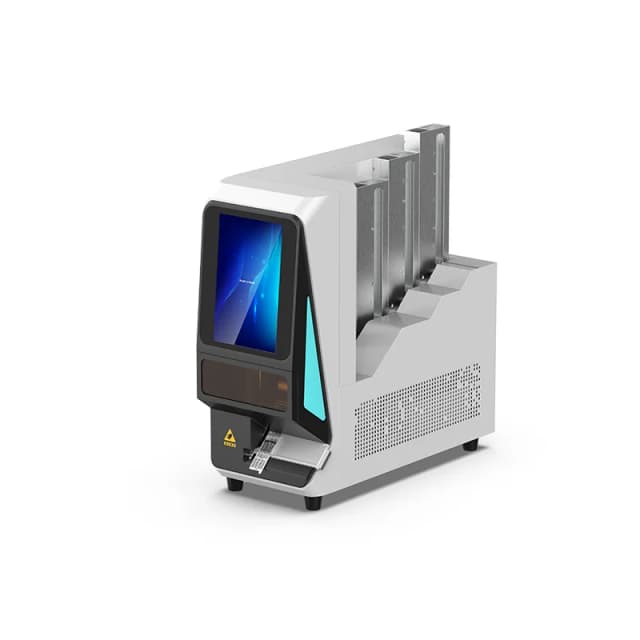
Dual-Channel Continuous Perfusion Pump
Dual-channel continuous perfusion pump with bidirectional flow capability for cell culture and organ-on-chip applications requiring precise fluidic control.

Louise Corscadden, PhD
Director of Science · ConductScience
Ask Louise about Dual-Channel Continuous Perfusion Pump fit, setup, configuration, or quote prep.
Already working with us? Sign in to connect this with My Scientist.
Key Specifications
Full details →- Model fit
- Configured during quote
- SKU family
- WHM-0031
- Shipping box
- 250.0 x 200.0 x 350.0 cm
- Ordering
- Online checkout and quote request available
- Category
- Lab Equipment
- Build notes
- Confirm accessories, station layout, and support needs before purchase
The Dual-Channel Continuous Perfusion Pump delivers precise fluidic control for advanced cell culture and microfluidic applications. This vertical-configuration system provides bidirectional, continuous flow through two independent channels, enabling simultaneous perfusion of multiple cell culture chambers or organ-on-chip devices. The pump supports both forward and reverse flow directions, allowing researchers to establish complex perfusion protocols including media exchange, gradient generation, and waste removal.
Designed for applications requiring sustained fluidic delivery, this perfusion system maintains stable flow rates over extended experimental periods. The dual-channel architecture permits independent control of each flow path, supporting comparative studies or multi-condition experiments within a single setup. The compact vertical footprint (250×200×350 mm, 8 kg) fits standard laboratory benchtops while providing the precision required for cell biology research and microfluidic device operation.
How It Works
The perfusion pump operates through precision motor-driven mechanisms that create controlled positive and negative pressure differentials across the fluidic system. Each channel contains independent pump heads that can generate both forward (positive pressure) and reverse (negative pressure) flow, allowing bidirectional fluid movement. The continuous flow capability eliminates pulsation artifacts common in peristaltic systems, providing steady-state conditions critical for cellular experiments.
Flow control is achieved through variable-speed motor control coupled with precision flow sensors that provide real-time feedback. The bidirectional capability allows the system to perform complex protocols including backflushing to prevent clogging, creating oscillatory flows for enhanced mixing, and establishing counter-current gradients. The vertical orientation minimizes the system footprint while ensuring proper bubble management through gravity-assisted air separation.
The dual-channel design enables independent operation of each flow path, supporting applications requiring simultaneous delivery of different media, creation of parallel experimental conditions, or sequential perfusion protocols. Channel-to-channel isolation prevents cross-contamination while allowing coordinated flow patterns when experimental protocols require synchronized delivery.
Features & Benefits
Number of Channels
- 2
Orientation
- Vertical
Flow Mode
- Bidirectional, continuous
Automation Level
- semi-automated
Brand
- ConductScience
Research Domain
- Analytical Chemistry
- Cancer Research
- Cardiovascular Research
- Cell Biology
- Developmental Biology
- Pharmaceutical QC
Shipping weight
- 8.0 lb
Shipping box
- L: 250.0 cm
- W: 200.0 cm
- H: 350.0 cm
| Feature | This Product | Typical Alternative | Advantage |
|---|---|---|---|
| Number of Channels | 2 independent channels | Entry-level models often offer single channel operation | Enables comparative studies and multi-condition experiments within a single setup. |
| Flow Direction | Bidirectional continuous flow | Most pumps provide unidirectional flow only | Supports complex protocols including backflushing and gradient generation. |
| System Orientation | Vertical configuration | Horizontal designs are more common | Minimizes benchtop footprint while facilitating gravity-assisted bubble management. |
| Flow Characteristics | Continuous, pulsation-free operation | Peristaltic systems create pulsatile flow | Provides steady-state conditions critical for cellular experiments and sensitive measurements. |
| Form Factor | Compact 250×200×350 mm design | Multi-channel systems often require larger footprints | Integrates easily with existing equipment while providing dual-channel capability. |
| Application Focus | Cell perfusion and organ-on-chip applications | General-purpose pumps may lack specialized features | Optimized specifically for biological applications requiring precise fluidic control. |
This perfusion pump combines dual-channel independence with bidirectional flow capability in a compact vertical design. The continuous flow operation eliminates pulsation artifacts while the bidirectional capability enables complex experimental protocols not possible with conventional unidirectional pumps.
Practical Tips
Calibrate flow rates using the actual media and tubing that will be used in experiments, as viscosity and tubing compliance affect flow characteristics.
Why: Different media viscosities and tubing materials can significantly alter flow rates from water-based calibrations.
Replace tubing regularly and inspect pump heads for wear, especially when using cell suspensions or particulate-containing media.
Why: Particulate matter can cause wear and affect flow accuracy over time.
Prime the system thoroughly and establish steady flow before connecting to experimental samples to ensure stable conditions from the start.
Why: Air bubbles and flow fluctuations during startup can disrupt sensitive cell culture experiments.
If flow rates become inconsistent, check for air bubbles in the tubing and verify proper tubing routing through pump heads.
Why: Air bubbles and improper tube positioning are the most common causes of flow irregularities.
Monitor flow rates periodically during long experiments and document any adjustments made to maintain experimental traceability.
Why: Flow drift over time can affect experimental results and data interpretation.
Use appropriate personal protective equipment when handling biological media and ensure proper containment for potentially hazardous materials.
Why: Perfusion systems can create aerosols and potential exposure risks during setup and maintenance.
Utilize the bidirectional capability for system cleaning by reversing flow to remove debris and prevent tubing blockages.
Why: Reverse flow can dislodge particles and extend tubing life while maintaining system performance.
Verify calibration accuracy at multiple flow rates across the operating range to ensure precision throughout the experimental range.
Why: Pump accuracy may vary across different flow rates, and experiments often require multiple flow conditions.
Setup Guide
What’s in the Box
- Dual-channel perfusion pump (main unit)
- Power adapter and cable
- Tubing starter kit (typical)
- User manual and quick start guide
- Calibration certificate (typical)
- Mounting hardware (typical)
Warranty
ConductScience provides a standard one-year manufacturer warranty covering defects in materials and workmanship, with technical support available for setup assistance and troubleshooting.
Compliance
References
Background reading relevant to this product:
What flow rate range can each channel deliver?
Flow rate specifications depend on tubing diameter and viscosity. Consult product datasheet for specific flow rate ranges with different tubing configurations and media viscosities.
What tubing materials and sizes are compatible?
The system accommodates standard laboratory tubing materials including silicone and PVC. Tubing compatibility specifications for diameter ranges and wall thicknesses are detailed in the technical datasheet.
How precise is the flow rate control and repeatability?
Flow rate precision and repeatability specifications vary with operating conditions. Detailed accuracy specifications and calibration procedures are provided in the technical documentation.
Can the pump handle viscous media or cell suspensions?
The bidirectional continuous flow design can handle various media viscosities. Specific viscosity limits and recommendations for cell suspension handling are outlined in the operating manual.
What maintenance is required for long-term operation?
Regular maintenance includes tubing replacement, pump head cleaning, and periodic flow calibration verification. Detailed maintenance schedules are provided in the user documentation.
Is the system compatible with sterile culture conditions?
The pump supports sterile applications when used with appropriate sterile tubing and aseptic connection techniques. Sterilization recommendations are detailed in the protocol documentation.
How does this compare to peristaltic pumps for cell culture?
Unlike peristaltic pumps, this system provides continuous flow without pulsation artifacts and offers bidirectional capability, making it suitable for applications requiring steady-state conditions and complex flow protocols.
What data logging or control interfaces are available?
Control interface specifications and data logging capabilities are detailed in the technical specifications. Consult product documentation for connectivity and software integration options.
Have a question about this product?
Have a question? Just ask.
Send it over and we'll email you a personalized answer — no call, no scheduling.
Prefer to talk it through?
Frequently Bought Together