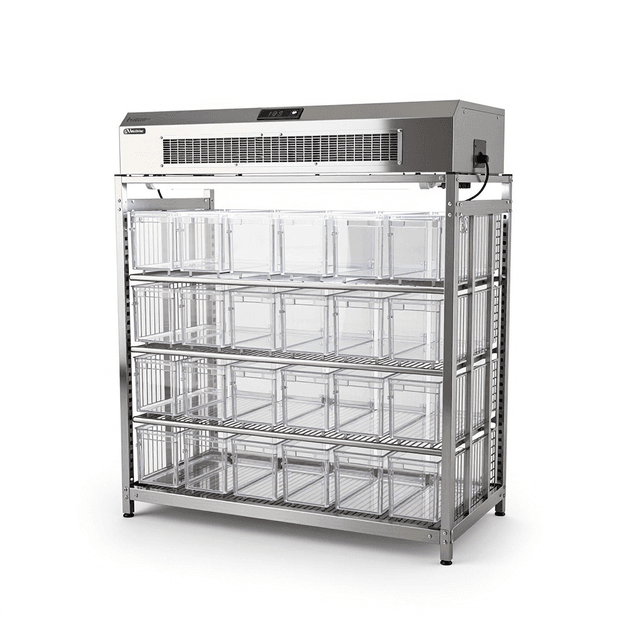
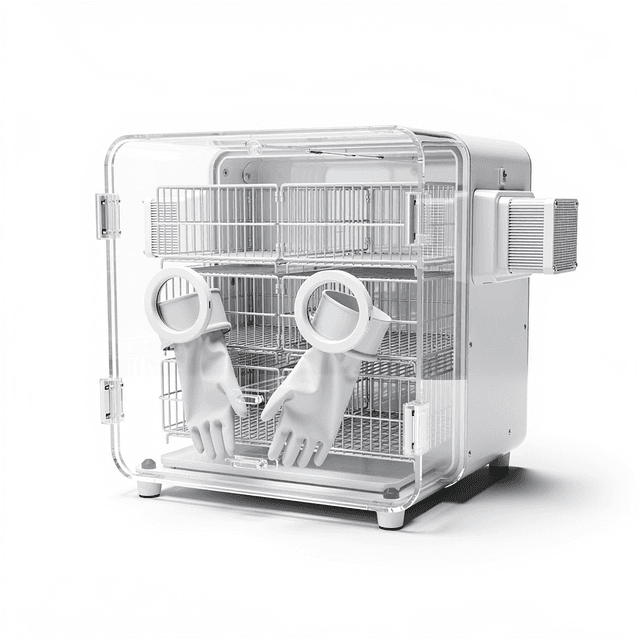
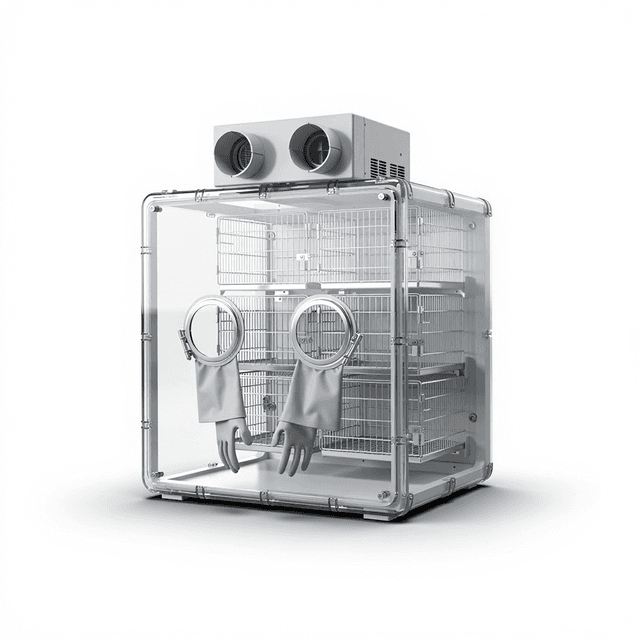
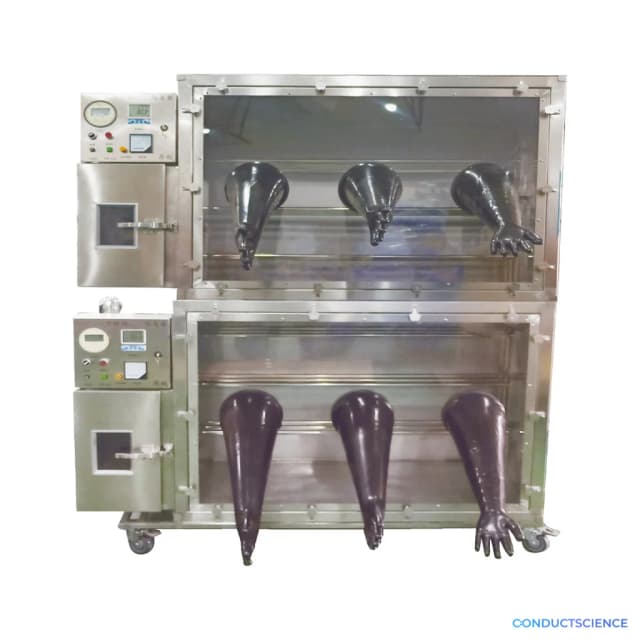
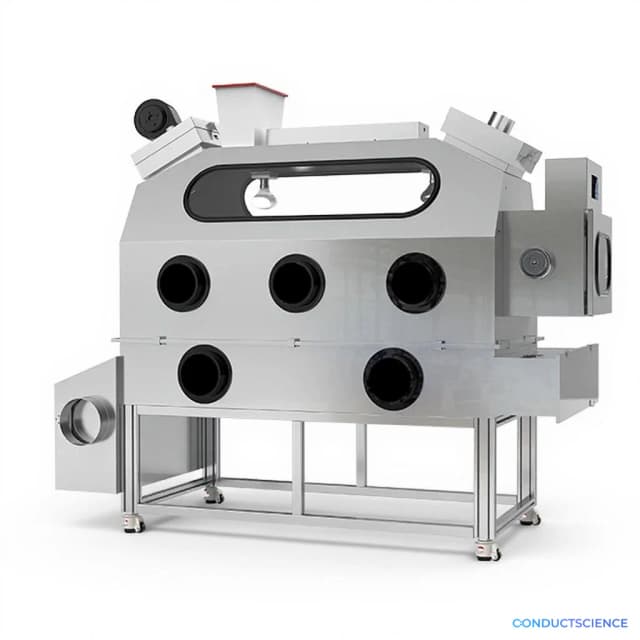
Laboratory Rabbit Isolator
Large-format flexible-film isolator with dual HEPA filtration for maintaining aseptic conditions in rabbit research programs, featuring integrated glove ports and pass-through chambers.

Louise Corscadden, PhD
Director of Science · ConductScience
Ask Louise about Laboratory Rabbit Isolator fit, setup, configuration, or quote prep.
Already working with us? Sign in to connect this with My Scientist.
Key Specifications
Full details →- Model fit
- Rabbit
- SKU family
- PTY-0029
- Shipping box
- 65.0 x 32.0 x 82.0 cm
- Ordering
- Online checkout and quote request available
- Category
- Isolators
- Build notes
- Confirm accessories, station layout, and support needs before purchase
The Laboratory Rabbit Isolator is a flexible-film containment system engineered for maintaining aseptic conditions in rabbit research programs. This large-format isolator incorporates dual HEPA filtration on both supply and exhaust air streams to establish a controlled microenvironment suitable for sensitive immunological and reproductive studies.
The system provides primary containment for research rabbits while enabling sterile manipulation through integrated glove ports and pass-through chambers. The flexible-film construction allows for space-efficient installation while maintaining rigorous environmental control standards required for contemporary rabbit research programs, particularly antibody production protocols and immunological challenge studies requiring pathogen-free conditions.
How It Works
The isolator operates on the principle of positive pressure containment using HEPA-filtered air supply and exhaust systems. Supply air passes through HEPA filtration to remove particles ≥0.3 micrometers with 99.97% efficiency, creating a sterile environment within the flexible-film chamber. Exhaust air undergoes secondary HEPA filtration to prevent release of potential contaminants while maintaining controlled airflow patterns.
The flexible-film construction consists of transparent polymer materials that allow visual monitoring of subjects while providing complete physical isolation. Integrated glove ports enable sterile manipulation of rabbits and research materials without compromising the aseptic environment. Pass-through chambers facilitate introduction of sterile supplies and removal of samples while maintaining pressure differentials that prevent contamination ingress.
Environmental control is achieved through balanced airflow management, maintaining slight positive pressure within the isolator relative to the surrounding laboratory space. This pressure gradient ensures that any minor breaches in the containment result in outward air movement, preventing contamination of the internal environment.
Features & Benefits
Type
- Flexible-film isolator — large format
Filtration
- HEPA supply and exhaust
Automation Level
- semi-automated
Brand
- ConductScience
Species
- Rabbit
Research Domain
- Developmental Biology
- Immunology
- Microbiology
- Pharmaceutical QC
- Toxicology
Certifications
- CE, ISO
Shipping weight
- 90.0 lb
Shipping box
- L: 65.0 cm
- W: 32.0 cm
- H: 82.0 cm
| Feature | This Product | Typical Alternative | Advantage |
|---|---|---|---|
| Filtration System | Dual HEPA filtration on both supply and exhaust | Many units offer single-stage HEPA filtration or pre-filter combinations | Bidirectional contamination control provides enhanced protection for sensitive immunological studies |
| Chamber Design | Large-format flexible-film construction | Rigid-wall chambers often have limited size options and reduced visual access | Flexible installation options and complete visual monitoring capability improve research workflow efficiency |
| Manipulation Interface | Integrated glove ports with pass-through chambers | Basic systems may offer only glove ports without dedicated transfer chambers | Maintains sterile transfer capability for complex protocols requiring frequent material exchange |
| Target Species | Specifically designed for rabbit research applications | Generic isolators may not optimize for rabbit-specific housing requirements | Species-specific design ensures appropriate space allocation and access patterns for rabbit research protocols |
| Automation Level | Semi-automated environmental control | Manual systems require constant operator oversight | Reduced operator intervention minimizes contamination risk while maintaining protocol consistency |
This isolator combines large-format capacity with dual HEPA filtration and rabbit-specific design optimization. The flexible-film construction provides installation flexibility while maintaining rigorous environmental control standards required for sensitive immunological research.
Practical Tips
Establish baseline pressure differentials during initial commissioning and document acceptable ranges for ongoing monitoring.
Why: Consistent pressure gradients are critical for maintaining contamination control and detecting system performance degradation.
Implement scheduled differential pressure monitoring across HEPA filters to predict replacement intervals before filtration efficiency degrades.
Why: Proactive filter management prevents unexpected system downtime during critical research phases.
Perform glove port integrity testing weekly using positive pressure testing to detect micro-perforations before they compromise sterility.
Why: Early detection of glove deterioration prevents contamination events that could invalidate research results.
Install emergency ventilation bypass systems to maintain life support for research subjects during power failures or equipment malfunctions.
Why: Backup ventilation prevents animal welfare compromises and protects valuable research subjects during system interruptions.
Maintain continuous environmental logging of temperature, humidity, and pressure parameters to document stable conditions for regulatory submissions.
Why: Complete environmental documentation supports data integrity requirements for pharmaceutical and regulatory applications.
Monitor air velocity patterns using smoke tubes during routine maintenance to detect flow disturbances that could indicate seal failures.
Why: Visual flow verification quickly identifies problems that pressure measurements alone might not detect.
Establish standard operating procedures for pass-through chamber decontamination cycles to maintain consistent transfer protocols.
Why: Standardized procedures reduce operator variability and ensure consistent contamination control across research teams.
Replace flexible-film panels according to manufacturer specifications even if visual inspection shows no obvious deterioration.
Why: Polymer degradation can compromise barrier integrity before visible signs appear, potentially compromising research validity.
Setup Guide
What’s in the Box
- Laboratory Rabbit Isolator main unit
- Supply HEPA filtration system
- Exhaust HEPA filtration system
- Flexible-film chamber assembly
- Integrated glove ports (typical)
- Pass-through chambers
- Installation hardware and fittings (typical)
- Operating manual and protocols (typical)
- Environmental monitoring documentation (typical)
Warranty
ConductScience provides a standard one-year manufacturer warranty covering defects in materials and workmanship, with technical support for installation guidance and operational protocols.
Compliance
References
Background reading relevant to this product:
What airflow rates and pressure differentials does the system maintain?
Consult product datasheet for specific airflow specifications and pressure differential ranges. Values depend on chamber size and laboratory environmental conditions.
Can the isolator accommodate pregnant does and litters?
The large-format design supports reproductive research protocols, but specific housing density and nesting requirements should be evaluated based on study protocols and animal welfare guidelines.
What sterilization methods are compatible with the flexible-film materials?
Gaseous sterilants and UV treatment are typically compatible, but specific chemical compatibility should be verified with the manufacturer based on the polymer formulation used.
How frequently must HEPA filters be replaced?
Filter replacement intervals depend on usage intensity and environmental particulate load. Routine differential pressure monitoring indicates when filter performance degrades.
What environmental monitoring is required during operation?
Regular microbial sampling, particulate counting, and pressure differential monitoring are essential for validating continued aseptic conditions.
Can multiple isolators be operated in the same laboratory space?
Multiple units require careful planning of air handling systems to prevent cross-contamination and ensure adequate laboratory ventilation capacity.
What training is required for personnel operating the system?
Operators need training in aseptic technique, pressure suit operation, emergency procedures, and environmental monitoring protocols specific to isolator technology.
Have a question about this product?
Have a question? Just ask.
Send it over and we'll email you a personalized answer — no call, no scheduling.
Prefer to talk it through?
Accessories
Enhance your setup with compatible accessories