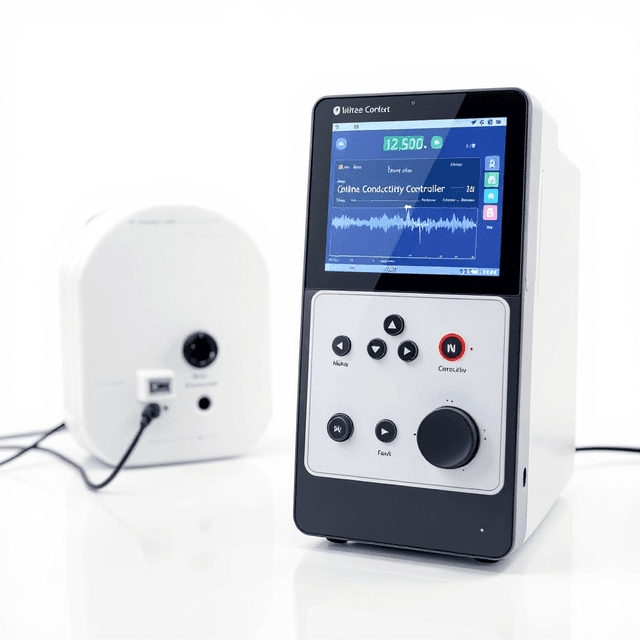
Online Conductivity Monitor
Panel-mounted conductivity monitor with three measurement ranges (0-2000 μS/cm), automatic temperature compensation, and continuous display for industrial water quality monitoring and laboratory process control.

Louise Corscadden, PhD
Director of Science · ConductScience
Ask Louise about Online Conductivity Monitor fit, setup, configuration, or quote prep.
Already working with us? Sign in to connect this with My Scientist.
Key Specifications
Full details →- Model fit
- Configured during quote
- SKU family
- CS-LH-IND012
- Shipping box
- 196.85 x 19.69 x 0.39 cm
- Ordering
- Online checkout and quote request available
- Category
- Industrial Sensors
- Build notes
- Confirm accessories, station layout, and support needs before purchase
The Online Conductivity Monitor (CS-LH-IND012) is a panel-mounted instrument designed for continuous monitoring of conductivity in industrial water systems and laboratory processes. This instrument measures conductivity across three selectable ranges (0-20, 0-200, 0-2000 μS/cm) with 1.5% full-scale accuracy and automatic temperature compensation referenced to 25°C. The system incorporates specialized signal processing technology with thick film circuitry to ensure stable operation and linearized data output.
The monitor features a plastic-bodied conductivity electrode with 1.0 cm⁻¹ cell constant and NTC temperature compensation sensor, connected via shielded quad-cable configuration. The 3.5-digit LCD display provides real-time conductivity readings, while the rear panel controls allow adjustment of range switching and calibration parameters. This instrument is particularly suited for monitoring purified water systems, process streams, and quality control applications where continuous conductivity measurement is required.
How It Works
Conductivity measurement is based on the principle that dissolved ions in solution create conductive pathways for electrical current. The instrument applies an alternating voltage between two electrodes immersed in the sample solution and measures the resulting current flow. The conductivity is calculated using Ohm's law, where conductivity equals current divided by voltage, normalized for the electrode geometry (cell constant).
This monitor employs a four-electrode configuration with a 1.0 cm⁻¹ cell constant to minimize polarization effects and ensure stable readings. The NTC temperature sensor provides automatic compensation, as conductivity varies approximately 2% per degree Celsius for most solutions. The instrument's signal processing circuitry converts the AC measurement to a linearized DC output, compensates for temperature effects using the 25°C reference, and displays the corrected conductivity value on the LCD panel.
The thick film circuit technology provides enhanced stability and noise immunity, while the shielded cable design prevents electromagnetic interference from affecting measurements. Range switching allows optimization of resolution and accuracy across the full measurement spectrum from ultrapure water (low μS/cm) to moderately conductive solutions.
Features & Benefits
Measurement range
- 0~20 0~200 0~2000μS/cm
Stability
- ±2 à 10-3(FS) / 24h
Auxiliary electrode
- Plastic structure; constant: 1.0cm-1
Temperature compensation component
- NTC
Medium temperature
- 5~50ºC
Thread dimension
- 1/2"pipe thread
Medium pressure
- 0~0.5Mpa
Cable composition
- Quad cable, copper mesh and foil shielded plastic jacket
Cable length
- 5m or on other agreement (5~30m)
Temperature compensation
- Automatic compensation, with 25ºC as the reference temperature
Environment conditions
- (1) Temperature: 5~50ºC(2) Humidity: â¤85%RH
Automation Level
- semi-automated
Brand
- ConductScience
Accuracy
- 1.5% (FS)
Display Type
- 3.5-bit LCD
Power/Voltage
- â¤1W
Research Domain
- Analytical Chemistry
- Environmental Monitoring
- Food Science
- Industrial Hygiene
- Materials Science
- Pharmaceutical QC
Shipping weight
- 11.71 lb
Shipping box
- L: 196.85 cm
- W: 19.69 cm
- H: 0.39 cm
| Feature | This Product | Typical Alternative | Advantage |
|---|---|---|---|
| Measurement Ranges | Three selectable ranges: 0-20, 0-200, 0-2000 μS/cm | Single fixed range or limited dual-range options | Allows optimization of resolution and accuracy across different sample types from ultrapure water to process streams. |
| Temperature Compensation | Automatic NTC compensation with 25°C reference | Manual temperature correction or basic compensation | Eliminates operator error and ensures consistent accuracy across varying sample temperatures. |
| Display Resolution | 3.5-digit LCD display | Basic digital displays with lower resolution | Provides sufficient precision for process monitoring and quality control applications. |
| Cable System | Shielded quad cable up to 30 meters | Standard cables with limited lengths and interference susceptibility | Enables remote electrode placement while maintaining signal integrity and reducing electromagnetic interference. |
| Accuracy Specification | 1.5% full-scale accuracy | Varies by model and price range | Provides reliable quantitative measurements suitable for process control and regulatory documentation. |
| Circuit Technology | Thick film circuit with specialized signal processing | Standard electronic circuits | Delivers enhanced stability and drift resistance for consistent long-term performance in industrial environments. |
This conductivity monitor combines three selectable measurement ranges, automatic temperature compensation, and thick film circuit technology in a panel-mounted configuration. The shielded cable system and specialized signal processing provide stable, accurate conductivity monitoring suitable for continuous process applications and quality control environments.
Practical Tips
Use certified conductivity standards that bracket your expected sample range and perform calibration at operating temperature when possible.
Why: This ensures maximum accuracy across your specific measurement conditions and accounts for any temperature effects on the electrode response.
Inspect and clean the electrode surface monthly to prevent fouling buildup that can affect response time and accuracy.
Why: Contamination on the electrode surface creates additional resistance that introduces measurement errors and slower response.
Allow adequate sample flow past the electrode to ensure representative measurements and prevent stagnant zones.
Why: Good flow conditions ensure the electrode senses bulk solution properties rather than localized concentration gradients.
If readings appear unstable, check cable connections and verify proper grounding of the shielded cable system.
Why: Poor electrical connections or compromised shielding can introduce noise and drift in conductivity measurements.
Record sample temperature alongside conductivity readings even with automatic compensation to verify system performance.
Why: Temperature logging provides quality assurance data and helps identify potential issues with the compensation system.
Ensure proper installation torque on the electrode fitting to prevent leaks while avoiding over-tightening that could damage threads.
Why: Proper sealing prevents sample leakage and contamination while preserving the integrity of the plastic electrode body.
Select the most sensitive measurement range that accommodates your sample conductivity to maximize resolution and accuracy.
Why: Using the appropriate range provides the best signal-to-noise ratio and minimizes quantization errors in the measurement.
Verify the NTC temperature sensor response periodically using known temperature references to ensure compensation accuracy.
Why: Temperature sensor drift directly affects measurement accuracy since conductivity corrections are based on temperature readings.
Setup Guide
What’s in the Box
- Online Conductivity Monitor display unit
- Conductivity electrode with plastic body (1.0 cm⁻¹ constant)
- NTC temperature compensation sensor
- 5-meter shielded quad cable
- Mounting hardware for panel installation (typical)
- User manual and calibration instructions (typical)
Warranty
ConductScience provides a one-year manufacturer warranty covering defects in materials and workmanship, with technical support for installation and operation guidance.
Compliance
References
Background reading relevant to this product:
What is the measurement principle and how does temperature compensation work?
The instrument measures conductivity using a four-electrode configuration with AC excitation to minimize polarization effects. NTC temperature compensation automatically corrects readings to 25°C reference, as conductivity typically varies ~2% per degree Celsius. The 1.0 cm⁻¹ cell constant provides standardized geometry for consistent measurements.
How do I select the appropriate measurement range for my application?
Choose based on expected sample conductivity: 0-20 μS/cm for ultrapure water and high-purity applications, 0-200 μS/cm for purified water systems, and 0-2000 μS/cm for general process water monitoring. Using the appropriate range optimizes resolution and accuracy.
What maintenance is required for long-term stability?
Regular calibration verification using standard conductivity solutions is recommended. Clean the electrode periodically to prevent fouling, inspect cable connections, and verify temperature compensation accuracy. The plastic electrode construction minimizes chemical degradation concerns.
Can this monitor be integrated with data logging or control systems?
The instrument provides continuous conductivity output suitable for integration into process control systems. Consult product datasheet for specific analog output specifications and communication protocols available for data logging applications.
What are the pressure and temperature limitations for the electrode?
The system operates with sample pressures up to 0.5 MPa and temperatures from 5-50°C. The plastic electrode construction provides chemical resistance while the automatic temperature compensation ensures accurate readings across the full temperature range.
How does cable length affect measurement accuracy?
The shielded quad cable design maintains signal integrity over the standard 5-meter length and extended lengths up to 30 meters. The thick film circuitry and specialized signal processing minimize cable length effects on measurement accuracy.
What is the typical response time and stability of readings?
The instrument provides real-time conductivity monitoring with stability specification of ±2 × 10⁻³ FS over 24 hours. Response time depends on sample flow conditions and electrode placement, typically achieving steady readings within minutes of sample changes.
Have a question about this product?
Have a question? Just ask.
Send it over and we'll email you a personalized answer — no call, no scheduling.
Prefer to talk it through?
Accessories
Enhance your setup with compatible accessories
Frequently Bought Together