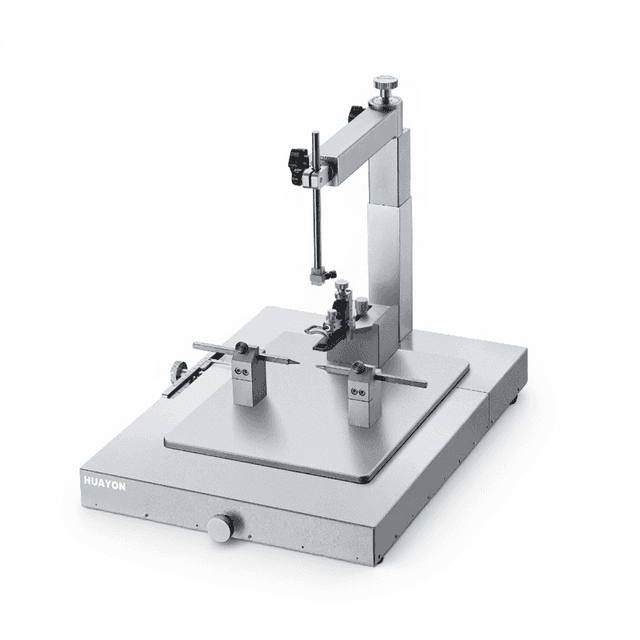
Stereotaxic Mouse Adaptors
Precision mouse head positioning adaptors for stereotaxic frames, offering micrometer-level adjustment with palate/incisor fixation or integrated gas anesthesia delivery.

Louise Corscadden, PhD
Director of Science · ConductScience
Ask Louise about Stereotaxic Mouse Adaptors fit, setup, configuration, or quote prep.
Already working with us? Sign in to connect this with My Scientist.
Key Specifications
Full details →- Model fit
- Mouse
- SKU family
- CS-MA-30- 2030/ CS-MA-30-2057
- Shipping box
- 30.0 x 25.0 x 25.0 cm
- Ordering
- Online checkout and quote request available
- Category
- Stereotaxic Accessories
- Build notes
- Confirm accessories, station layout, and support needs before purchase
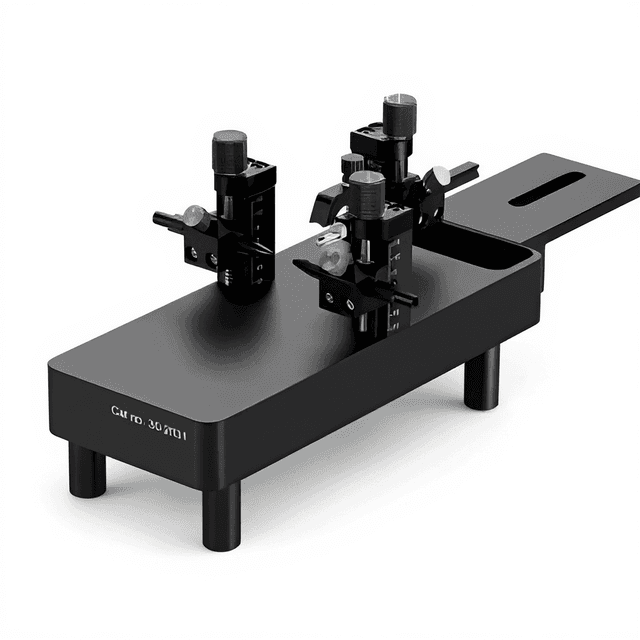
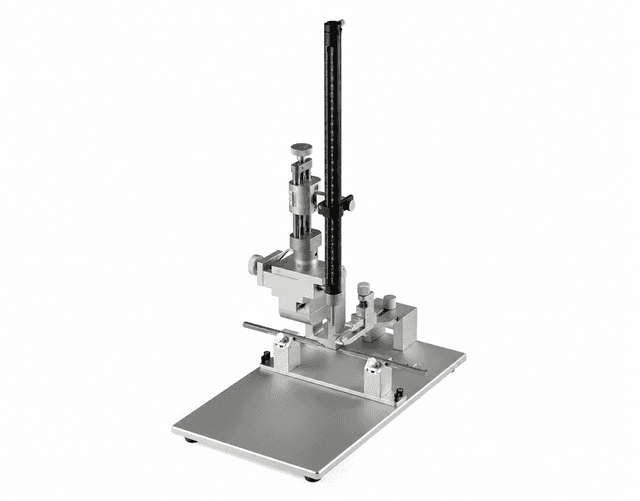
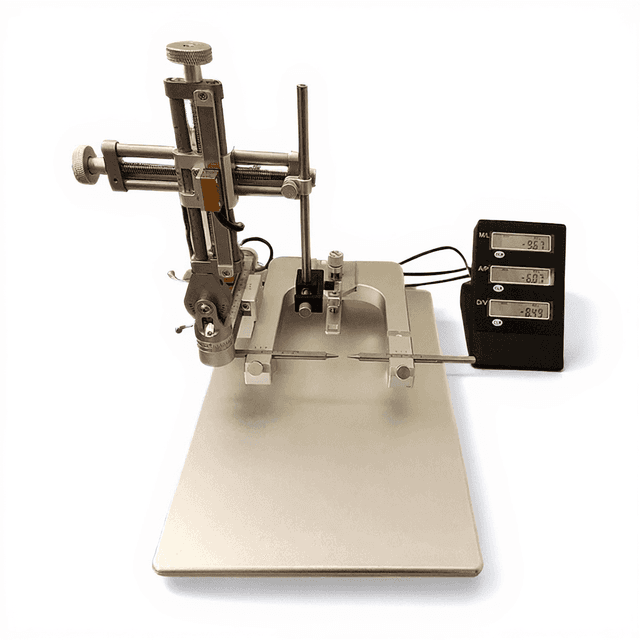
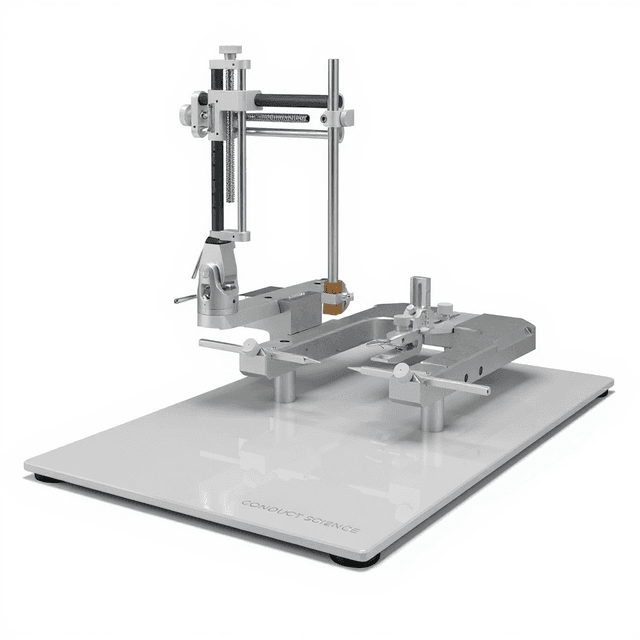
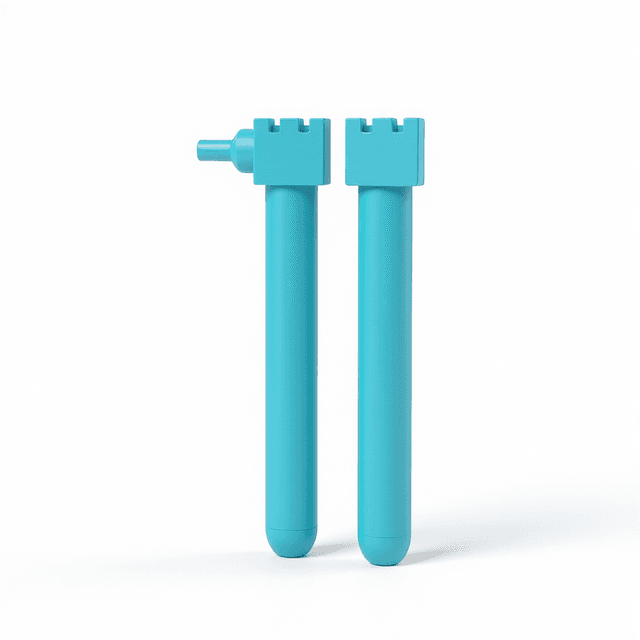
Stereotaxic mouse adaptors are precision positioning components designed for secure head fixation during neurosurgical procedures and brain mapping studies. These adaptors mount to stereotaxic frames and provide stable, reproducible positioning of the mouse head through palate and incisor bar engagement or integrated gas anesthesia delivery systems. The adaptors feature micrometer-level adjustment capabilities with 100μm resolution for precise coordinate-based positioning.
The standard model (CS-MA-30-2030) provides vertical adjustment range of 30mm (+10mm to -20mm) with horizontal adjustment of 43.5mm and 35° rotational capability. The gas anesthesia model (CS-MA-30-2057) extends positioning flexibility with 70° vertical and horizontal rotation ranges while maintaining continuous anesthetic delivery through a 2mm diameter mask interface. Both models support stereotaxic atlas-based coordinate systems for reproducible targeting of brain structures.
How It Works
Stereotaxic mouse adaptors function by providing a stable, adjustable platform that securely positions the mouse head in a standardized coordinate system. The palate and incisor bars create a rigid three-point contact system that eliminates head movement during surgical procedures. Vertical adjustment mechanisms allow precise control of the dorsal-ventral positioning, while horizontal adjustments accommodate anterior-posterior and medial-lateral coordinates.
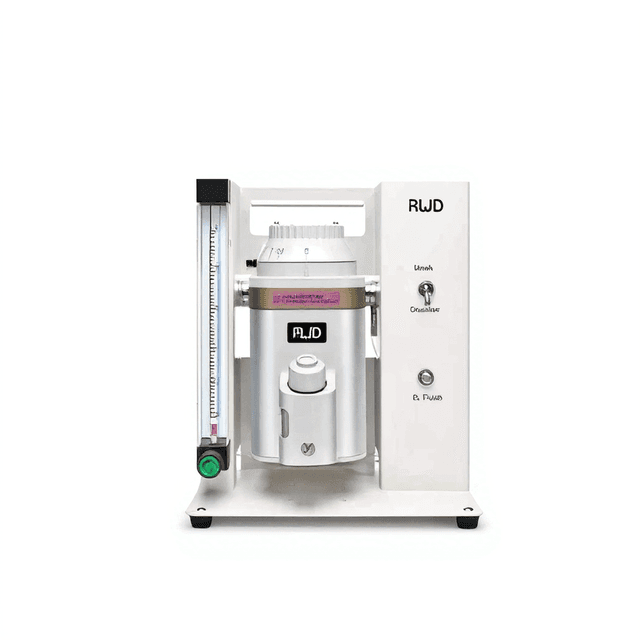
The gas anesthesia model incorporates an integrated mask system that maintains continuous anesthetic delivery while allowing multi-axis head rotation. The 2mm diameter inlet/outlet ports connect to standard anesthesia circuits, ensuring stable anesthetic depth throughout procedures. Micrometer adjustment screws provide 100μm resolution positioning, enabling researchers to target brain structures with sub-millimeter accuracy based on stereotaxic atlas coordinates.
Rotational adjustments allow orientation of the skull to achieve optimal approach angles for specific brain targets, particularly important for deep structures or when avoiding surface vasculature. The mechanical stability of the adaptor system ensures that once positioned, the head remains fixed throughout extended surgical or recording procedures.
Features & Benefits
Vertical Adjustment Range
- up to 30mm or 50mm
Horizontal Adjustment Range
- up to 30mm or 50mm
Head Positioning Methods
- palate, incisor, ear bars, nose clips
Automation Level
- manual
Accuracy
- 100µm
Research Domain
- Behavioral Pharmacology
- Learning and Memory
- Neurodegeneration
- Neuroscience
Species
- Mouse
Shipping weight
- 17.64 lb
Shipping box
- L: 30.0 cm
- W: 25.0 cm
- H: 25.0 cm
| Feature | This Product | Typical Alternative | Advantage |
|---|---|---|---|
| Positioning Resolution | 100μm resolution on all axes | Many basic adaptors offer 200-500μm resolution | Enables more precise targeting of small brain nuclei and reduces positioning variability between experiments. |
| Vertical Adjustment Range | 30mm range (+10mm to -20mm) | Entry-level models often provide 15-20mm range | Accommodates wider range of head angles and mouse sizes without requiring adaptor changes. |
| Rotational Capability | 70° rotation in both axes (gas model) | Standard models typically offer 30-45° rotation | Allows complex surgical approaches and optimal electrode trajectories for deep brain targets. |
| Anesthesia Integration | Integrated mask with 2mm ports maintaining full rotation | Separate anesthesia masks limit positioning flexibility | Maintains stable anesthetic depth while preserving complete positioning adjustability throughout procedures. |
| Fixation Method | Palate and incisor bar three-point fixation | Ear bar systems are common but less stable | Provides more secure head stabilization with reduced tissue trauma compared to ear bar penetration. |
| Horizontal Adjustment | 43.5mm horizontal range | Basic models often provide 20-30mm range | Enables targeting of multiple brain regions within single setup without repositioning animal. |
These mouse adaptors provide enhanced positioning precision with 100μm resolution and extended adjustment ranges compared to basic stereotaxic accessories. The gas anesthesia model offers unique integration of continuous anesthetic delivery with full rotational positioning capability, addressing common limitations of conventional systems.
| Model | SKU | Listed price | Status | Shipping box |
|---|---|---|---|---|
| Gas anesthesia | CS-MA-30-2057 | $785.00 | Available | 30.0 x 25.0 x 25.0 cm |
| Standard | CS-MA-30- 2030 | $490.00 | Available | 30.0 x 25.0 x 25.0 cm |
Practical Tips
Verify positioning accuracy using known anatomical landmarks like bregma and lambda before each experimental session.
Why: Ensures coordinate system alignment and maintains targeting precision across procedures.
Clean palate and incisor bars with 70% ethanol between animals and lubricate adjustment screws monthly.
Why: Prevents cross-contamination and maintains smooth micrometer adjustment operation.
Allow 5-10 minutes for head positioning stabilization before beginning precision procedures.
Why: Tissues settle into final position, reducing micro-movements that could affect targeting accuracy.
Monitor anesthesia delivery continuously and maintain backup ventilation access when using the gas model.
Why: Ensures animal welfare and provides emergency access if primary anesthesia delivery is compromised.
Record all positioning coordinates and angles in lab notebook for experimental reproducibility.
Why: Enables precise replication of positioning for follow-up procedures and cross-session comparisons.
If positioning drifts occur, verify incisor bar engagement and palate bar contact pressure.
Why: Inadequate fixation contact is the primary cause of positioning instability during procedures.
Use body temperature monitoring and warming pads during extended positioning procedures.
Why: Maintains physiological stability and prevents tissue changes that could affect positioning accuracy.
Setup Guide
What’s in the Box
- Mouse adaptor assembly (typical)
- Palate and incisor bar components (typical)
- Adjustment hardware and mounting screws (typical)
- Anesthesia mask and tubing connectors (gas model) (typical)
- Installation and positioning guide (typical)
Warranty
ConductScience provides a standard one-year manufacturer warranty covering defects in materials and workmanship, with technical support for installation and positioning optimization.
Compliance
What is the positioning accuracy achievable with these adaptors?
The adaptors provide 100μm resolution on all adjustment axes, enabling sub-millimeter targeting accuracy suitable for precise stereotaxic coordinate-based procedures in mouse brain structures.
How does the gas anesthesia model maintain anesthetic delivery during head rotation?
The integrated mask system uses flexible tubing connections through 2mm diameter ports that allow continuous gas flow throughout the full 70° rotational range in both axes.
What mouse size range do these adaptors accommodate?
The adaptors accommodate standard laboratory mouse sizes with 30mm vertical adjustment range and 43.5mm horizontal positioning capability, suitable for adult mice from 20-40g body weight range.
Are these adaptors compatible with existing stereotaxic frames?
The adaptors are designed as standard components for conventional stereotaxic frame systems and include mounting hardware for secure integration with frame positioning mechanisms.
How stable is head fixation during extended procedures?
The palate and incisor bar system creates a rigid three-point fixation that eliminates head movement throughout procedures lasting several hours without requiring readjustment.
What anesthesia systems are compatible with the gas model?
The 2mm diameter mask ports are compatible with standard isoflurane vaporizers and other volatile anesthetic delivery systems commonly used in research facilities.
How do these compare to ear bar positioning systems?
Palate and incisor bar fixation provides more stable positioning than ear bars and causes less tissue trauma, while offering equivalent coordinate system accuracy for stereotaxic procedures.
Have a question about this product?
Have a question? Just ask.
Send it over and we'll email you a personalized answer — no call, no scheduling.
Prefer to talk it through?
Accessories
Enhance your setup with compatible accessories
Frequently Bought Together