Refrigerated and Heating Circulator
Precision refrigerated and heating circulator for laboratory temperature control from −20 °C to +100 °C.
Intelligent PID control with ±0.1 °C accuracy, internal/external circulation support, and comprehensive safety protections. Available in 5 L and 10 L bath volumes.

Louise Corscadden, PhD
Director of Science · ConductScience
Ask Louise about Refrigerated and Heating Circulator fit, setup, configuration, or quote prep.
Already working with us? Sign in to connect this with My Scientist.
Key Specifications
Full details →- Model fit
- Configured during quote
- SKU family
- BIO-0837
- Shipping box
- 76.0 x 36.0 x 52.0 cm
- Ordering
- Online checkout and quote request available
- Category
- Benchtop Instruments
- Build notes
- Confirm accessories, station layout, and support needs before purchase
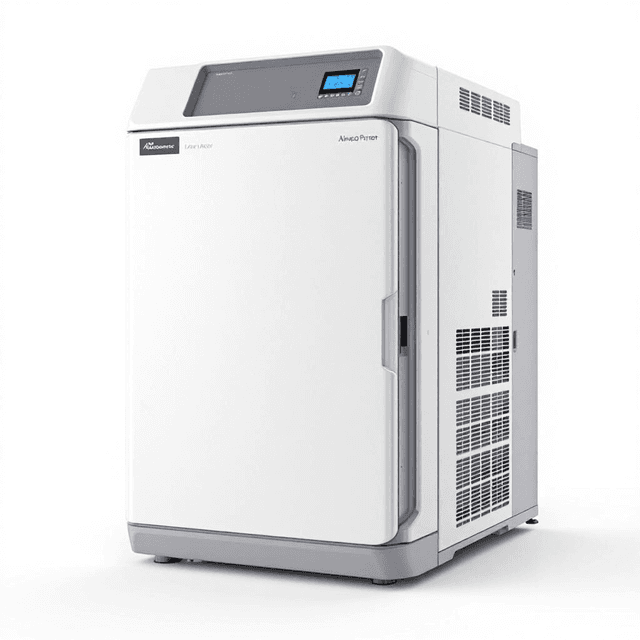
The refrigerated and heating circulator provides stable, precise temperature control for both high- and low-temperature applications in bioengineering, chemical analysis, food science, and industrial research. Intelligent digital PID temperature control with system self-tuning maintains ±0.1 °C accuracy across the full operating range. The air-cooled refrigeration system supports both internal circulation (bath mode) and external circulation (connecting to external equipment). Upper and lower temperature alarms and multiple safety protections — leakage, overload, delay, and overcurrent — ensure safe continuous operation.
Available Configurations
| Model | Temp Range | Bath Volume | Cooling Capacity | Flow Rate | Net Weight |
|---|---|---|---|---|---|
| DL5/10 | −10 to +100 °C | 5 L | 319–1328 W | 20 L/min | 38 kg |
| DL5/20 | −20 to +100 °C | 5 L | 263–1328 W | 20 L/min | 45 kg |
| DL10/10 | −10 to +100 °C | 10 L | 884–1894 W | 8 L/min | 45 kg |
| DL10/10-L | −10 to +100 °C | 10 L | 280–1100 W | 20 L/min | 45 kg |
| DL10/20 | −20 to +100 °C | 10 L | 813–2733 W | 20 L/min | 45 kg |
All models: control accuracy ±0.1 °C, refrigerant R134a, circulation pump 40 W, max lift 4–6 m, power AC 220 V 50/60 Hz.
How It Works
The refrigerated and heating circulator operates through a closed-loop thermal control system combining refrigeration and heating elements with circulating fluid for precise temperature regulation. The R134a refrigerant system provides cooling capacity through vapor-compression refrigeration, while integrated heating elements enable temperature elevation above ambient conditions. A circulation pump moves the thermal transfer fluid through internal channels and external connections to maintain uniform temperature distribution.
Temperature sensing elements continuously monitor the circulating fluid temperature, providing feedback to the intelligent PID control algorithm. This digital control system automatically adjusts heating and cooling output to maintain the setpoint temperature within ±0.1°C accuracy. The air-cooled condenser dissipates waste heat from the refrigeration cycle, while the LCD display provides real-time temperature monitoring and system status information.
The 5-liter reservoir capacity ensures adequate thermal mass for stable temperature control during extended operations. The variable cooling capacity (263W to 2733W depending on model) accommodates different thermal load requirements while maintaining precise temperature regulation across the full operating range from -20°C to 100°C.
Features & Benefits
Power Supply
- AC 220 V, 50/60 Hz
Refrigerant
- R134a
Brand
- ConductScience
Temperature Range
- −10 to +100 °C / −20 to +100 °C
Control Accuracy
- ±0.1 °C
Bath Volume Options
- 5 L, 10 L
Circulation Pump Power
- 40 W
Shipping weight
- 38.0 lb
Shipping box
- L: 76.0 cm
- W: 36.0 cm
- H: 52.0 cm
| Feature | This Product | Typical Alternative | Advantage |
|---|---|---|---|
| Temperature Range | -20°C to 100°C operating range | Many entry-level units offer 0°C to 80°C or require separate heating and cooling units | Single instrument accommodates both sub-ambient and elevated temperature protocols without equipment changes |
| Temperature Accuracy | ±0.1°C control precision | Basic circulators often provide ±0.5°C to ±1.0°C accuracy | Precise control enables temperature-sensitive analytical methods and reaction studies requiring tight thermal stability |
| Cooling Capacity | Variable cooling from 263W to 2733W | Fixed cooling capacity limits thermal load handling | Adaptable cooling power matches thermal load requirements while maintaining energy efficiency |
| Storage Capacity | 5-liter liquid reservoir | Smaller units often have 2-3 liter capacity | Larger thermal mass provides better temperature stability and longer operation between refills |
| Control System | Intelligent digital PID temperature control | Basic on-off or proportional control in lower-cost models | Advanced PID algorithm minimizes temperature overshoot and provides faster, more stable setpoint regulation |
This circulator combines wide temperature range capability with precision digital control in a single benchtop instrument. The variable cooling capacity and 5-liter reservoir provide versatility for diverse thermal applications requiring both heating and cooling functions.
Practical Tips
Verify temperature accuracy monthly using a NIST-traceable reference thermometer placed in the circulating fluid.
Why: Maintains measurement traceability and ensures continued analytical accuracy for temperature-dependent protocols.
Clean condenser coils quarterly to maintain cooling efficiency, especially in dusty laboratory environments.
Why: Dust accumulation reduces heat transfer and can cause the refrigeration system to work harder, affecting temperature stability.
Allow 15-20 minutes for thermal equilibration after reaching setpoint before starting critical measurements.
Why: Ensures the entire system has reached thermal equilibrium and eliminates transient temperature effects.
Check circulation flow if temperature control becomes unstable, as air bubbles can affect thermal transfer.
Why: Proper fluid circulation is essential for uniform temperature distribution and accurate control feedback.
Record actual fluid temperature rather than setpoint for documentation, especially during extended protocols.
Why: Provides more accurate temperature records and helps identify any drift or control issues during long experiments.
Ensure adequate ventilation around the air-cooled condenser and avoid blocking air intake vents.
Why: Proper airflow prevents overheating of the refrigeration system and maintains safe operating temperatures.
Use thermal transfer fluids appropriate for your temperature range rather than water for sub-ambient applications.
Why: Prevents freezing damage to the circulation system and ensures consistent thermal properties across the operating range.
Setup Guide
What’s in the Box
- Refrigerated and heating circulator main unit
- Power cord and electrical connections
- Circulation tubing set (typical)
- Operating manual and technical documentation
- Temperature calibration certificate (typical)
Warranty
ConductScience provides a one-year manufacturer warranty covering defects in materials and workmanship, with technical support for installation and operation guidance.
Compliance
What thermal transfer fluids are compatible with this temperature range?
For the full -20°C to 100°C range, ethylene glycol solutions or specialized heat transfer fluids are recommended. Water can be used for positive temperature applications only. Consult product datasheet for complete fluid compatibility specifications.
How quickly does the system reach setpoint temperature?
Temperature ramp rates depend on thermal load and ambient conditions. The variable cooling capacity (263W to 2733W) enables different ramp performance across models. Consult product specifications for heating and cooling rate data.
Can this circulator handle external thermal loads?
Yes, the system includes circulation connections for external applications. The 5-liter capacity and variable cooling power accommodate moderate external thermal loads, though specific load capacity depends on operating temperature and ambient conditions.
What maintenance is required for the refrigeration system?
The air-cooled R134a refrigeration system requires periodic cleaning of condenser coils and verification of refrigerant charge. Annual professional maintenance is recommended for optimal cooling performance.
How accurate is the temperature control across the full range?
The system maintains ±0.1°C control accuracy across the entire -20°C to 100°C operating range through digital PID control. Temperature uniformity may vary with circulation flow rate and external load.
Is external temperature monitoring possible?
The LCD display shows internal fluid temperature. For external temperature monitoring, consult product datasheet regarding probe inputs or data logging capabilities.
Have a question about this product?
Have a question? Just ask.
Send it over and we'll email you a personalized answer — no call, no scheduling.
Prefer to talk it through?