Remote Camera Pest Forecast Light Trap
Automated light trap with 1,200- or 2,000-MP camera, auto image upload, AC or solar power.
Continuous pest monitoring for field and crop research. Request a quote.

Louise Corscadden, PhD
Director of Science · ConductScience
Ask Louise about Remote Camera Pest Forecast Light Trap fit, setup, configuration, or quote prep.
Already working with us? Sign in to connect this with My Scientist.
Key Specifications
Full details →- Model fit
- Configured during quote
- SKU family
- AGR-0039
- Sizing
- Model-specific dimensions confirmed from the selected configuration
- Ordering
- Quote-reviewed before fulfillment
- Category
- Agriculture & Food Science
- Build notes
- Confirm accessories, station layout, and support needs before purchase
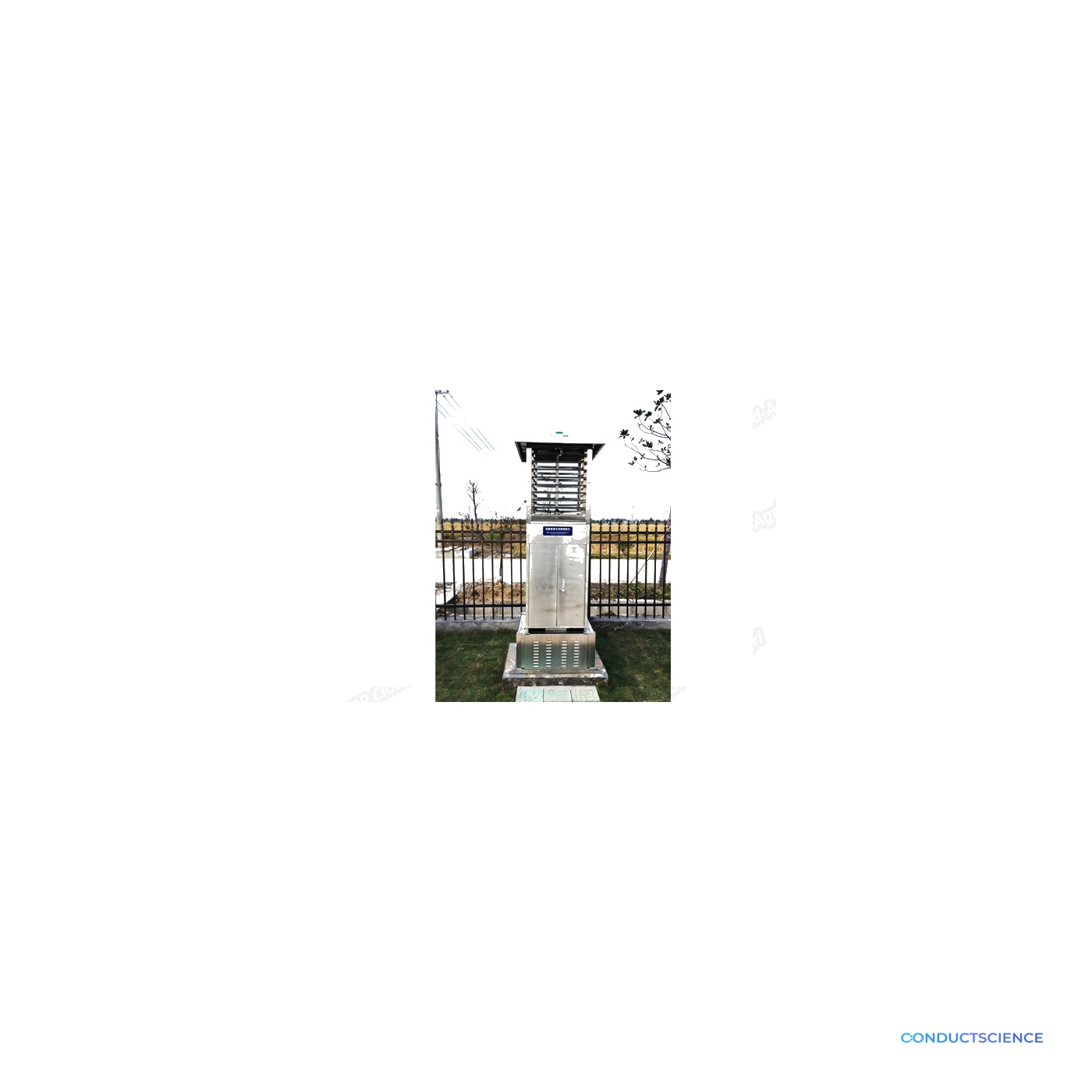
The Remote Camera Type Pest Forecast Light Trap is an automated pest detection and population-monitoring system designed for unattended field deployment. Using light to attract insects, the trap then disperses, photographs, and collects specimens without requiring an operator on site — making it practical for continuous monitoring across crops, orchards, forests, and research plots where round-the-clock human observation is not feasible.
At the core of the system is an industrial camera that captures high-resolution images of attracted insects, which are automatically transmitted for review. Researchers and agronomists examine the uploaded images and perform manual counts, enabling population trend analysis and early pest-pressure forecasting. A 7-inch capacitive touchscreen provides on-device control, and connectivity is supported via wired fiber, wireless bridge, or 4G router to suit a range of remote environments.
The trap family spans several configurations distinguished by two key comparison qualifiers: camera resolution (1,200-megapixel or 2,000-megapixel industrial camera) and power source (AC mains or solar). Higher-resolution models and select configurations also ship with both large and small insect body filters as standard equipment, extending the range of pest species that can be cleanly separated and imaged. The system operates across a wide temperature range (0–70 °C) and tolerates relative humidity up to 90%, supporting deployment in humid subtropical and tropical agricultural zones.
Because the right configuration depends on site connectivity, target pest species, and available power infrastructure, the Remote Camera Type Pest Forecast Light Trap is available through a tailored quote. Contact ConductScience to discuss your monitoring protocol and receive a configuration matched to your study requirements.
Camera (base configuration)
- 1,200-megapixel industrial camera
Display
- 7-inch capacitive touchscreen
Connectivity
- Wired fiber / wireless bridge / 4G router
Power options
- AC mains or solar (model-dependent)
Image capture & upload
- Automatic photo capture and upload; manual count by reviewer
Insect body filters
- Large-size and small-size filters (standard on 7.0 PLUS models)
Device dimensions
- 800 × 800 × 2,009 mm
Operating temperature
- 0–70 °C
Operating humidity
- ≤ 90% RH
Insulation resistance
- < 2.5 Ω
Available configurations
- 6.0 PLUS (1,200 MP, AC or solar); 6.5 PLUS (2,000 MP, AC or solar); 7.0 PLUS (2,000 MP, AC or solar, with large and small insect body filters)
What camera resolutions are available, and how do I choose between them?
Two camera tiers are offered: a 1,200-megapixel industrial camera and a 2,000-megapixel industrial camera. The higher-resolution option captures finer morphological detail, which can be valuable when distinguishing visually similar pest species from uploaded images. If your monitoring program covers a broad range of insect sizes or requires high-confidence visual identification, the 2,000-megapixel models are worth specifying in your quote request.
Can the trap operate at sites without mains electricity?
Yes. Each resolution tier is available in either an AC-powered variant or a solar-powered variant, so the trap can be deployed in remote fields, orchards, or forest plots where grid power is unavailable. When requesting a quote, indicate whether mains power is accessible at your intended monitoring site so the appropriate power configuration can be selected.
How does the trap transmit images, and what connectivity options are supported?
Images are captured automatically and uploaded without manual intervention. The system supports three connectivity methods: wired fiber, wireless bridge, and 4G router. This flexibility means the trap can be integrated into existing farm network infrastructure or deployed independently using a cellular connection.
What is included as standard equipment, and does it vary by model?
All configurations include the camera, 7-inch capacitive touchscreen display, and connectivity hardware. The higher-tier models (the 7.0 PLUS variants) additionally ship with both a large-size and a small-size insect body filter as standard equipment. These filters help separate pest specimens by size before imaging, improving image clarity and count accuracy across different insect species.
What environmental conditions can the trap withstand in the field?
The trap is rated for an operating temperature range of 0–70 °C and a relative humidity of up to 90%, making it suitable for deployment in warm, humid agricultural and horticultural environments. The physical footprint of the unit is 800 × 800 × 2,009 mm, so site preparation should account for its standing height.
Have a question about this product?
Have a question? Just ask.
Send it over and we'll email you a personalized answer — no call, no scheduling.
Prefer to talk it through?
Frequently Bought Together