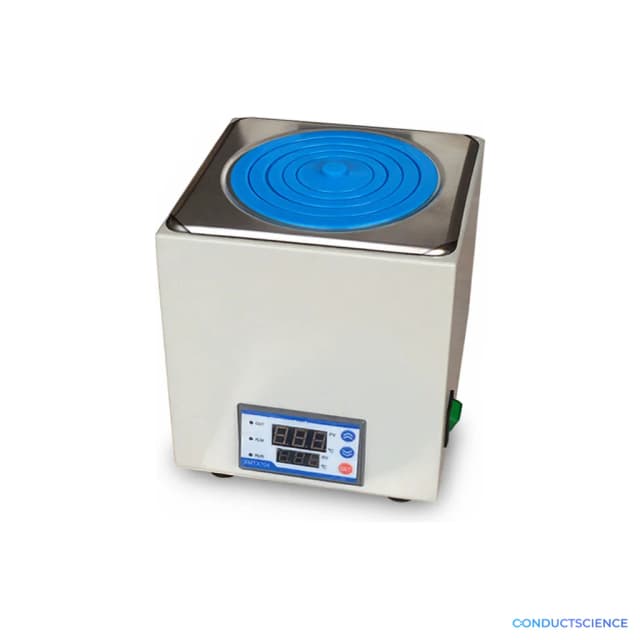
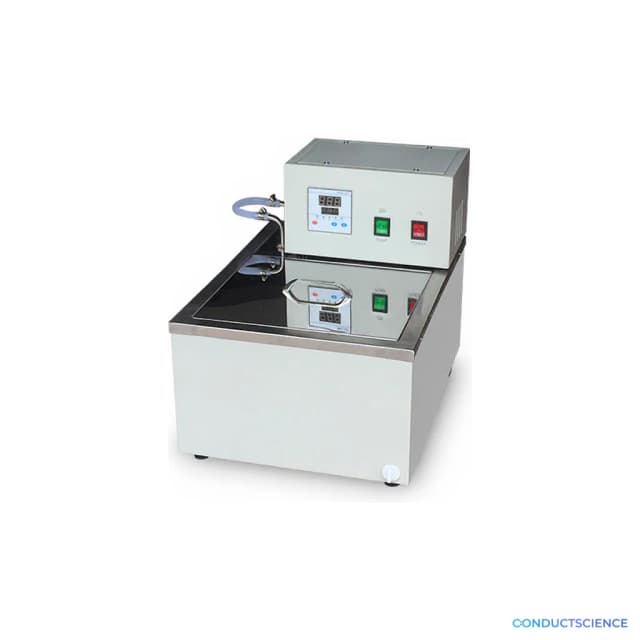
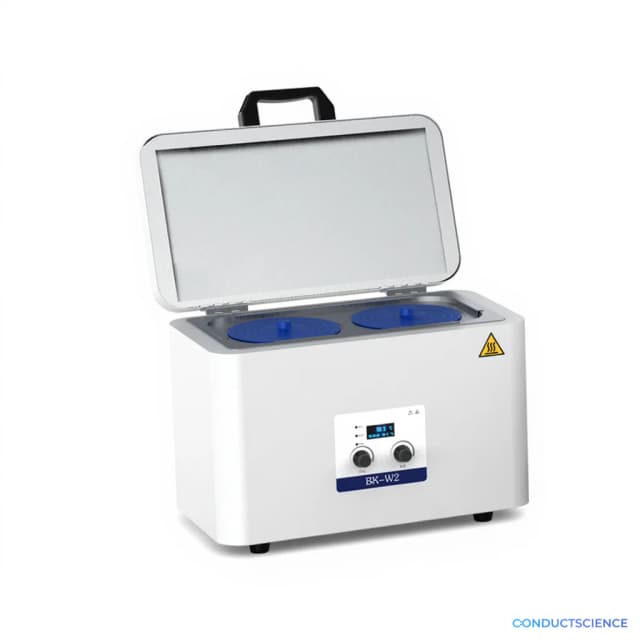
Three-well Thermostatic Water Bath
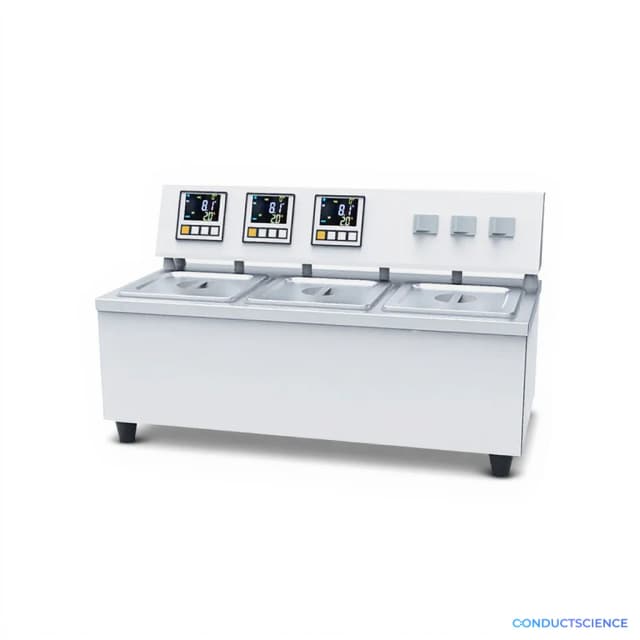
Three-well thermostatic water bath (BK-DS3) with 7.56 L total capacity across three independent chambers (300 W each).
Each well maintains RT+5–100 °C with ±0.3 °C fluctuation and ±0.5 °C uniformity at 37 °C. Includes automatic sensor-fault, over-temperature, and deviation alarms.

Louise Corscadden, PhD
Director of Science · ConductScience
Ask Louise about Three-well Thermostatic Water Bath fit, setup, configuration, or quote prep.
Already working with us? Sign in to connect this with My Scientist.
Key Specifications
Full details →- Model fit
- Configured during quote
- SKU family
- BIO-0674
- Shipping box
- 12.0 x 15.0 x 14.0 cm
- Ordering
- Online checkout and quote request available
- Category
- Water Baths
- Build notes
- Stainless steel
The Three-well Thermostatic Water Bath (BK-DS3) provides three independently controlled thermal chambers for simultaneous multi-sample processing in medical, healthcare, research, and industrial laboratory settings. Applications include precision constant-temperature incubation, auxiliary heating, and gene amplification. Each well operates autonomously with 300 W heating and a programmable 0–999 min timer. An automatic alarm system monitors for sensor faults, over-temperature events, and temperature deviation.
Technical Specifications
| Parameter | BK-DS3 |
|---|---|
| Total Capacity | 7.56 L (3 independent wells) |
| Temperature Range | RT+5–100 °C |
| Temperature Precision | 0.1 °C |
| Temperature Fluctuation | ±0.3 °C |
| Temperature Uniformity | ±0.5 °C (at 37 °C) |
| Timing Range | 0–999 min |
| Opening Size (per well) | 150×136 mm |
| Internal Dimensions (per well) | 150×140×120 mm |
| Power Consumption | 300 W × 3 |
| Power Supply | AC 220 V or 110 V, 50/60 Hz |
| Top Cover Material | Stainless steel |
| External Dimensions | 660×220×250 mm |
| Packing Dimensions | 700×320×295 mm |
| Net Weight | 7.62 kg |
| Gross Weight | 9 kg |
Key Features
- Three independent wells with separate temperature controls
- ±0.3 °C temperature fluctuation for high-precision incubation
- Automatic alarm system: sensor fault, over-temperature, and deviation alerts
- Rapid heating capability
- Compact benchtop design (660×220 mm footprint)
- Dual-voltage compatible (110/220 V)
How It Works
The thermostatic water bath operates through resistive heating elements that warm the water medium to the desired temperature setpoint. Each of the three chambers contains an independent 300W heating element controlled by a digital thermostat that monitors water temperature via integrated sensors. The system maintains thermal equilibrium through continuous feedback control, activating heating elements when temperature drops below the setpoint.
Water circulation within each chamber ensures uniform heat distribution, achieving temperature uniformity of ±0.5°C throughout the bath volume. The stainless steel construction provides efficient heat transfer while preventing chemical corrosion. Digital timing control allows for automated operation cycles, automatically maintaining temperature for predetermined durations up to 999 minutes per chamber.
Features & Benefits
Automation Level
- semi-automated
Temp. Range
- RT+5°C~100°C
Temp. Precision
- 0.1℃
Temp. Fluctuation
- ±0.3°C
Temp. Uniformity
- ±0.5°C(At 37°C)
Top Cover Inner Liner Material
- Stainless steel
Timing Range
- 0~999min
Opening Size
- (150*136mm)*3
Consumption
- 300W*3
Internal Size(L*W*H)
- (150*140*120mm)*3
External Size(L*W*H)
- 660*220*250mm
Packing Size(L*W*H)
- 700*320*295mm
Brand
- ConductScience
Research Domain
- Analytical Chemistry
- Cell Biology
- Histopathology
- Materials Science
- Microbiology
- Pharmaceutical QC
Capacity
- 7.56L
Power/Voltage
- AC220V, 50/60Hz; 110V, 50/60Hz
Weight
- 7.62kg
Shipping weight
- 7.62 lb
Shipping box
- L: 12.0 cm
- W: 15.0 cm
- H: 14.0 cm
| Feature | This Product | Typical Alternative | Advantage |
|---|---|---|---|
| Chamber Configuration | Three independent chambers with separate controls | Single chamber or dual-chamber configurations | Enables simultaneous processing at different temperatures or parallel batch processing of similar samples. |
| Temperature Stability | ±0.3°C fluctuation, ±0.5°C uniformity at 37°C | Entry-level models often provide ±0.5-1.0°C stability | Tighter temperature control improves reproducibility in temperature-sensitive protocols. |
| Heating Capacity | 300W per chamber (900W total) | Single chamber units typically offer 500-1000W total | Independent heating prevents temperature cross-interference between chambers during different thermal protocols. |
| Chamber Volume | 7.56L capacity per chamber | Varies by model, often 5-20L for single chambers | Balanced capacity allows multiple samples per chamber while maintaining temperature uniformity. |
| Timing Control | Digital timing 0-999 minutes per chamber | Basic models may lack timing or offer shorter ranges | Extended timing range supports long incubation protocols without manual intervention. |
This three-well configuration offers enhanced laboratory workflow efficiency through independent temperature control and timing for each 7.56L chamber. The ±0.3°C stability and 300W heating per chamber provide reliable thermal conditions for diverse sample processing requirements.
Practical Tips
Verify temperature accuracy monthly using a calibrated thermometer placed at the center and corners of each chamber.
Why: Temperature gradients can develop over time, affecting experimental reproducibility.
Clean chambers weekly with mild detergent and descale heating elements quarterly to prevent mineral buildup.
Why: Mineral deposits reduce heating efficiency and can cause temperature irregularities.
Allow 15-20 minutes for temperature stabilization before adding samples, especially when switching between temperature setpoints.
Why: Thermal equilibration ensures uniform temperature distribution throughout the chamber volume.
Use tongs or insulated gloves when removing containers from chambers above 60°C to prevent thermal injury.
Why: High temperature containers and splash hazards pose burn risks during sample handling.
Document chamber identification and temperature verification in laboratory records for each experimental session.
Why: Temperature traceability supports data integrity and protocol reproducibility requirements.
If temperature overshoots occur, check water level and ensure adequate clearance around heating elements.
Why: Low water levels or blocked circulation can cause uneven heating and temperature control problems.
Position sample containers to avoid blocking water circulation patterns within each chamber.
Why: Proper circulation maintains temperature uniformity and prevents hot spots around samples.
Setup Guide
What’s in the Box
- Three-well thermostatic water bath unit
- Power cord
- User manual and operating instructions
- Temperature calibration certificate (typical)
- Chamber drain plugs (typical)
Warranty
ConductScience provides a standard one-year manufacturer warranty covering defects in materials and workmanship, with technical support for operational guidance and troubleshooting assistance.
Compliance
What is the temperature accuracy and how quickly does each chamber reach setpoint?
Temperature precision is 0.1°C with ±0.3°C fluctuation and ±0.5°C uniformity at 37°C. Each 300W chamber typically reaches setpoint within 15-20 minutes depending on target temperature and ambient conditions.
Can different temperatures be set for each chamber simultaneously?
Yes, each of the three chambers operates independently with separate digital temperature and timing controls, allowing simultaneous operation at different setpoints.
What type of containers fit in each chamber?
Each chamber accommodates vessels within 150×136mm opening size and 150×140×120mm internal dimensions, suitable for standard beakers, flasks, and sample tubes.
How should the unit be calibrated and what maintenance is required?
Temperature calibration should be verified annually using certified thermometers. Regular maintenance includes cleaning stainless steel chambers, checking water levels, and ensuring heating elements remain free of mineral deposits.
What safety features are included for unattended operation?
Digital timing control automatically maintains temperature for set durations up to 999 minutes. Consult product datasheet for additional safety features and over-temperature protection specifications.
Can this unit replace a traditional single-chamber water bath?
The three-chamber design offers greater flexibility for simultaneous multi-temperature processing or sample batching, though single chambers may offer larger individual capacity for very large vessels.
What water quality should be used and how often should it be changed?
Distilled or deionized water is recommended to prevent mineral buildup on heating elements. Water should be changed regularly based on usage frequency and visible contamination.
Have a question about this product?
Have a question? Just ask.
Send it over and we'll email you a personalized answer — no call, no scheduling.
Prefer to talk it through?