ConductVision Enterprise

Thermal Imaging

ConductVision finds people, vehicles and animals in thermal and infrared camera views after dark, and logs each detection by class, zone and time for security and site teams.

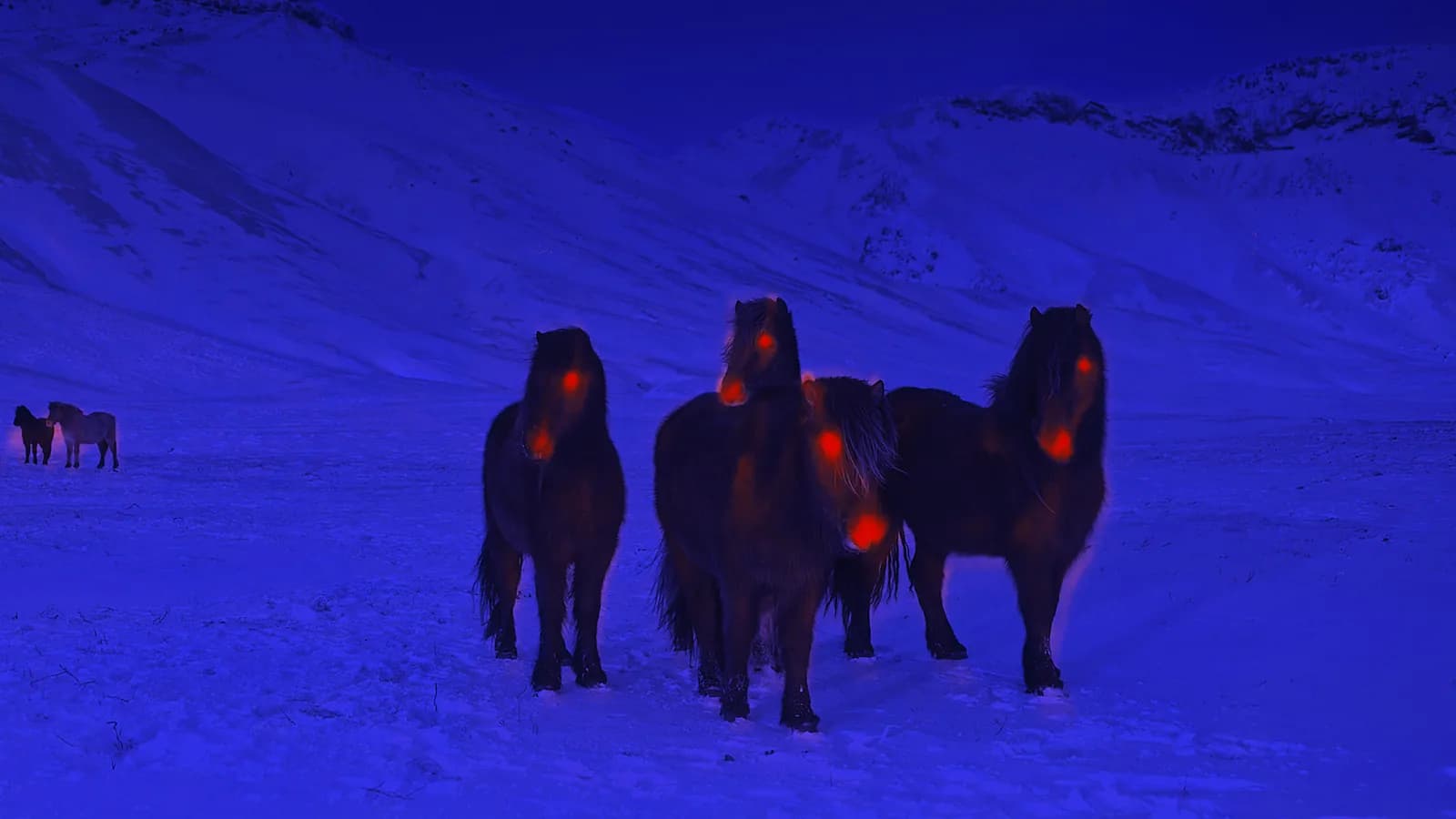
Icelandic horses stand in snow, colored by temperature from a long-wave infrared camera, with heat showing only at their eyes and noses; boxes mark five horses.5 detections
Winter pasture in Iceland
  • Horse5

ConductVision detections on this photo. Photo: Dheera Venkatraman, CC BY 2.0, cropped.

Thermal Imaging analytics process feeds from LWIR (long-wave infrared) cameras to detect people, vehicles, and anomalies in darkness, through smoke, and in adverse weather. The platform is camera-agnostic, it works with any thermal camera that outputs a standard video stream, freeing you from proprietary analytics ecosystems. Applications range from perimeter security and elevated body temperature screening to industrial equipment monitoring and energy auditing. The system is designed to provide a layer of detection that visible-light cameras simply cannot match.

Outcomes

What your team gets

Night alarms sorted by cause

Motion alarms at night go off for swaying branches, headlight sweeps, rain and passing animals.

Staff who check every alarm lose sleep and patrol time, and they start to tune alarms out.

How
In a pilot, ConductVision checks the thermal or infrared frame behind each alarm for people, vehicles and animals.
You get
An alarm log that names the cause of each alarm, with the frame that set it off.

Animal activity after dark

Livestock and wildlife move, feed and cross roads at dusk and through the night.

Counts made in daylight miss the hours when much of that movement happens.

How
ConductVision counts the animals by type in each night frame, from horses and cattle to bears and coyotes.
You get
Night counts by animal type, camera and hour, ready to set beside daytime counts.

Coverage without floodlights

Lighting a long fence line or storage yard all night costs power and still leaves dark corners.

A person in a dark corner can be missed by a standard camera, so the yard looks clear on screen.

How
In a pilot, ConductVision runs on thermal or infrared views of the unlit areas and flags people and vehicles by zone.
You get
A log of people and vehicles in unlit zones by hour, with a still of each detection.

Nights a supervisor can review

A night alarm with only a time stamp is hard to act on the next morning.

Supervisors replay hours of dark footage to find the few seconds that matter.

How
Each detection keeps its thermal or infrared frame, box, class and time.
You get
A morning list of the night detections, with a still and a short clip for each one.

What the model sees

Detections in two more settings

An infrared survey camera photographs a black bear at night as it walks between trees on a forested slope in Oregon's Wild Rogue Wilderness; one box marks the bear.
Night survey camera, Oregon
  • Bear1

ConductVision detections on this photo.

Two coyotes stand in front of an infrared wildlife camera at night in Saguaro National Park, Arizona, one of them calling; boxes mark both coyotes.
Night camera, Saguaro National Park
  • Coyote2

ConductVision detections on this photo.

Endpoints

What a pilot measures

Each endpoint is defined before the pilot starts, with what is counted, its unit and how the results are broken down.

What a pilot measures
PrimaryNight alarm loadAlarms that reach staff between dusk and dawn, counted per camera per night after ConductVision sorts them by cause.Unit:alarms per camera-nightBy:Camera, cause
SecondaryAlarm causesShare of night alarms in which ConductVision finds a person, a vehicle, an animal or nothing.Unit:%By:Camera, week
Night animal countAnimals counted in each sampled night frame, reported by type as the nightly peak.Unit:animalsBy:Camera, animal type, hour
Unlit-zone entriesPeople and vehicles detected inside unlit zones, counted once per entry.Unit:entries per weekBy:Zone, hour
Morning review timeMinutes a supervisor takes to review all detections from one night at one site.Unit:minutes per site-nightBy:Site, reviewer

How we check the model

Each pilot measures ConductVision on your own footage against a sample checked by hand, before anyone relies on its numbers.

  • Alert precision

    Share of night alerts for people and vehicles that a reviewer confirms in a hand-checked sample of alert stills.

    % · by camera, class

  • Missed detections

    Share of people, vehicles and animals a reviewer finds in sampled night footage that ConductVision did not detect.

    % · by camera, class, distance band

  • Class agreement

    Share of detections whose class, such as person, vehicle or animal type, matches the label a reviewer gives.

    % · by class, thermal or infrared camera

How it works

Thermal Imaging in three steps

  1. Connect

    Connect Thermal Cameras

    Integrate any thermal camera that delivers RTSP, ONVIF, or radiometric video output. The system calibrates automatically for the camera's temperature range and resolution, no proprietary software required.

  2. Analyze

    Thermal-Specific AI Processing

    Detection models trained on thermal imagery identify people, vehicles, animals, and heat anomalies. Temperature thresholds can be set on radiometric streams to flag objects above or below defined ranges.

  3. Act

    Alert on Thermal Events

    Temperature exceedance, unauthorized perimeter crossing in darkness, or equipment overheating triggers alerts. Dual-spectrum pairing with visible cameras provides contextual snapshots alongside thermal detections.

What it detects

Classes the models report

  • Person

    Each person in a thermal or infrared view, by zone

  • Car and truck

    Vehicles on access roads, yards and fence lines after dark

  • Horse

    Each animal in a paddock or pasture view, counted per frame

  • Cattle and sheep

    Each animal in a pen or field view, counted per frame

  • Bear

    Each visit to a camera view, with the frame and time

  • Coyote

    Each animal near a fence line or trail at night

Features

What the system does

Zero-Light Perimeter Security
Detects people, vehicles, and animals approaching a perimeter in darkness, fog, and rain, conditions where visible cameras are ineffective.
Elevated Temperature Screening
Screens individuals for elevated skin surface temperature at entry points. Designed as an operational screening tool, not a medical diagnostic device. Used in environments subject to health screening protocols.
Equipment Overheating Detection
Monitors electrical panels, motors, bearings, and HVAC equipment for abnormal heat signatures that may indicate impending failure.
Camera-Agnostic Architecture
Works with thermal cameras from FLIR, Hikvision, Dahua, Axis, Seek, and others. No proprietary analytics license required, bring your own cameras.
Dual-Spectrum Fusion
Pair thermal and visible cameras for combined views. Thermal provides detection; visible provides identification context. Fused output displays both layers simultaneously.
Energy Audit and Heat Loss
Process thermal imagery of buildings to identify insulation failures, HVAC inefficiencies, and heat leaks. Generate reports with annotated thermal overlays.
Radiometric Data Extraction
For cameras that output radiometric data, the system extracts per-pixel temperature values, enabling precise threshold-based alerts and trend analysis.
Use cases

Where teams put it to work

Nighttime Perimeter Security

Critical facilities need 24/7 perimeter detection regardless of lighting. Thermal cameras can detect body heat from intruders in darkness, providing reliable detection where visible cameras fail.

governmentenergycorporate

Facility Health Screening

Facilities can use thermal screening at entry points during elevated health-risk periods. The system flags individuals with elevated skin temperature for secondary screening by trained personnel.

corporatemanufacturingevents

Electrical Infrastructure Monitoring

Substations and data centers monitor critical electrical equipment continuously. Thermal detection can identify hot spots on transformers, switchgear, and bus bars before they cause outages or fires.

energyutilitiesdata centers

Marine and Port Security

Harbors and coastal facilities need to detect approaching vessels at night. Thermal cameras cut through fog and darkness, while AI detection can identify vessel types and approach vectors.

governmentshippingdefense

Building Energy Auditing

Property managers need to identify heat loss and insulation failures. Thermal drone or handheld surveys, processed by the platform, can generate annotated reports highlighting problem areas.

real estateconstructionenergy

Wildlife Monitoring at Night

Conservation researchers need to observe animal behavior without artificial light. Thermal imaging can detect and track animals based on body heat, enabling unobtrusive nocturnal observation.

conservationresearch

Technical overview

Inputs, outputs and hardware

Accuracy and speed are measured on your footage and cameras during the pilot, and reported with the conditions they were measured under.

Models
Person, vehicle and animal detectors (YOLO family) run on thermal frames, tuned to your cameras in a pilot
Input formats
RTSP, ONVIF, radiometric video streams, MP4
Output formats
JSON, MQTT, Webhooks, CSV temperature logs, annotated thermal snapshots
Hardware
NVIDIA Jetson, Intel NUC, any x86 with a CUDA-capable GPU

Pilot

Evaluate thermal imaging on your footage

A pilot takes one prioritized outcome, runs on your cameras, reports the endpoints above and ends with a results review and a decision.