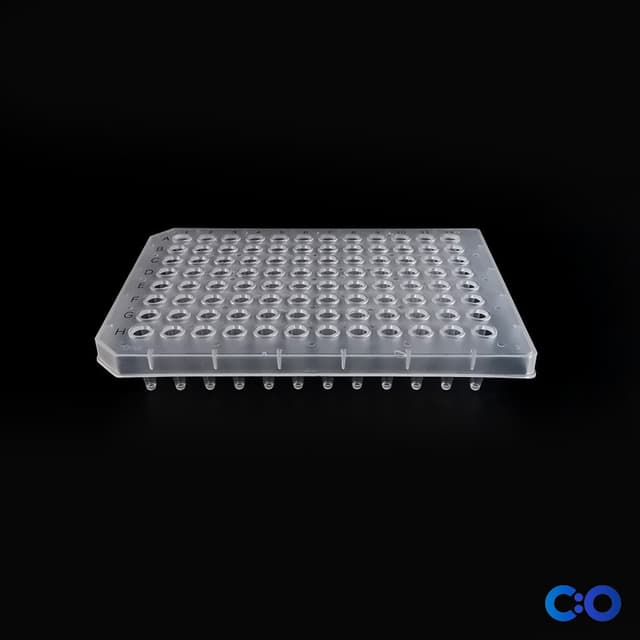
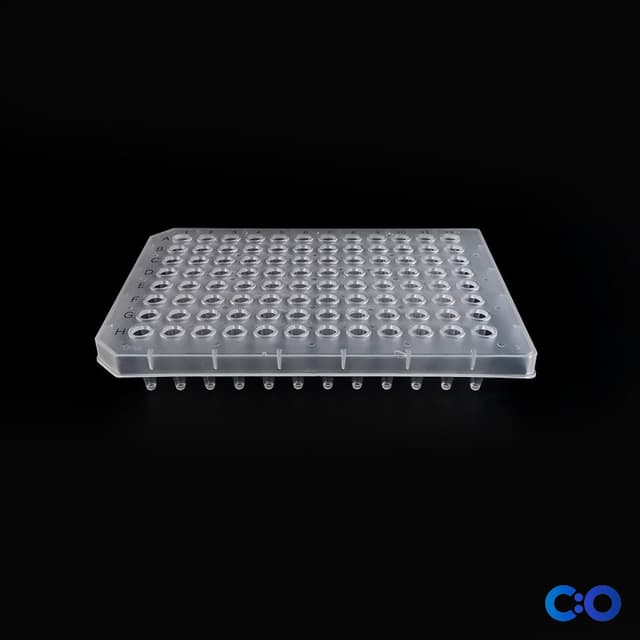
ConductScience 96-Well PCR Plates, Non-Skirted (Case of 10)
$95.00 per unit | 10 units per pack Bulk pricing: Case of 10 at $950.00 ($95.00 per unit)

Louise Corscadden, PhD
Director of Science · ConductScience
Ask Louise about ConductScience 96-Well PCR Plates, Non-Skirted (Case of 10) fit, setup, configuration, or quote prep.
Already working with us? Sign in to connect this with My Scientist.
Key Specifications
Full details →- Model fit
- Configured during quote
- SKU family
- CS-PCR-96NS-50
- Shipping box
- 83.6 x 69.7 x 55.7 cm
- Ordering
- Online checkout and quote request available
- Category
- Lab Supplies
- Build notes
- Confirm accessories, station layout, and support needs before purchase
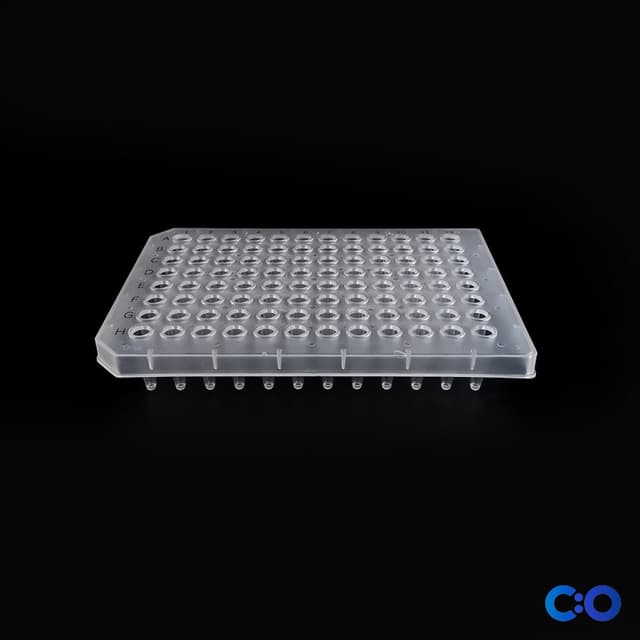
The ConductScience 96-Well PCR Plates, Non-Skirted are precision-molded polypropylene consumables designed for polymerase chain reaction applications. Each plate contains 96 individual wells with 0.2 mL working volume, fabricated from ultra-clear polypropylene that provides optimal optical clarity for fluorescence-based detection systems. The non-skirted design eliminates the continuous plastic border around the plate perimeter, reducing material usage while maintaining well integrity and thermal transfer properties essential for consistent amplification cycles.
These plates are manufactured under controlled conditions and certified DNase/RNase-free, eliminating nuclease contamination that could degrade template DNA or RNA during amplification reactions. The low-profile design ensures compatibility with standard thermal cyclers and automated liquid handling systems, while the ultra-clear polymer construction enables real-time fluorescence monitoring and post-amplification gel electrophoresis visualization. Each plate conforms to standard SBS footprint specifications for integration into high-throughput molecular biology workflows.
How It Works
PCR plates function as reaction vessels that contain template DNA, primers, DNA polymerase, and dNTPs during thermal cycling processes. The polypropylene construction provides excellent heat transfer properties, enabling rapid and uniform temperature transitions across all 96 wells during denaturation (94-96°C), annealing (50-65°C), and extension (72°C) phases. The 0.2 mL well volume accommodates standard PCR reaction volumes of 10-50 μL while minimizing evaporation and maintaining consistent reaction conditions.
The ultra-clear polymer formulation transmits light wavelengths from 340-700 nm with minimal interference, allowing fluorescence detection systems to monitor amplification in real-time. During real-time PCR, fluorescent reporters (SYBR Green, TaqMan probes, or molecular beacons) generate signals proportional to amplicon accumulation, which are detected through the plate bottom. The non-skirted design reduces plastic thickness around well perimeters, further optimizing optical clarity and thermal conductivity for sensitive detection applications.
Features & Benefits
Research Domain
- Analytical Chemistry
- Cancer Research
- Cell Biology
- Clinical Diagnostics
- Environmental Monitoring
- Microbiology
- Pharmaceutical QC
Shipping weight
- 223.66 lb
Shipping box
- L: 83.6 cm
- W: 69.7 cm
- H: 55.7 cm
| Feature | This Product | Typical Alternative | Advantage |
|---|---|---|---|
| Well Volume | 0.2 mL capacity per well | Standard volumes range from 0.1-0.5 mL depending on application requirements | Optimal volume for standard PCR reactions while minimizing reagent waste and evaporation |
| Plate Design | Non-skirted architecture | Many plates feature skirted designs with continuous borders | Reduced material thickness improves thermal conductivity and optical access |
| Optical Clarity | Ultra-clear polypropylene construction | Standard polypropylene may have lower transparency | Enhanced fluorescence detection sensitivity for real-time PCR applications |
| Contamination Control | DNase/RNase-free certified | Not all plates include nuclease-free certification | Eliminates nuclease contamination risks that could compromise sensitive amplification reactions |
| Profile Height | Low-profile design | Standard profiles vary by manufacturer | Improved compatibility with automated systems and thermal cyclers with limited clearance |
These plates combine non-skirted thermal efficiency with ultra-clear optics and certified nuclease-free manufacturing. The 0.2 mL well capacity and low-profile design optimize performance for both manual and automated PCR workflows while maintaining cost-effectiveness for high-throughput applications.
Practical Tips
Pre-cool plates to 4°C before loading temperature-sensitive enzymes or samples to maintain reagent stability during setup.
Why: Temperature control preserves enzyme activity and prevents premature reaction initiation
Use consistent pipetting techniques and check for air bubbles in wells before sealing to ensure uniform reaction conditions.
Why: Air bubbles can create hot spots during thermal cycling and interfere with optical detection
Store unused plates in original packaging at room temperature away from direct sunlight and chemical vapors.
Why: Proper storage maintains optical clarity and prevents contamination or degradation
Include appropriate positive and negative controls in each plate to validate amplification performance and detect contamination.
Why: Controls enable quality assessment and troubleshooting of failed reactions
If experiencing uneven amplification across the plate, verify thermal cycler block calibration and plate contact pressure.
Why: Poor thermal contact can create temperature gradients that affect amplification efficiency
Handle plates with powder-free gloves to prevent nucleic acid contamination and avoid skin contact with PCR reagents.
Why: Contamination prevention is critical for sensitive molecular applications
Verify plate optical properties using blank wells and known fluorescence standards when setting up new detection protocols.
Why: Baseline characterization ensures accurate fluorescence measurements and threshold settings
Setup Guide
What’s in the Box
- 50 × 96-well PCR plates, non-skirted
- Product documentation and certificates (typical)
Warranty
ConductScience provides quality assurance for manufacturing defects, with technical support available for application guidance and troubleshooting. Standard laboratory consumables warranty applies to material integrity and contamination-free performance.
Compliance
References
Background reading relevant to this product:
What sealing methods are compatible with these non-skirted plates?
Standard adhesive sealing films, heat-sealable foils, and individual tube caps are all compatible. The non-skirted design does not interfere with sealing effectiveness when proper application pressure is used.
Are these plates suitable for long-term storage of PCR products?
Yes, the polypropylene construction is chemically inert and suitable for storage at -20°C to +4°C. However, proper sealing is essential to prevent evaporation and contamination during extended storage periods.
How do these compare to skirted PCR plates for thermal cycling performance?
Non-skirted plates typically provide slightly better thermal conductivity due to reduced plastic mass around well perimeters, potentially improving temperature uniformity and ramping rates during cycling.
What is the optical clarity specification for fluorescence applications?
The ultra-clear polypropylene provides excellent transmission across visible and near-UV wavelengths (340-700 nm), suitable for most fluorescent dyes and detection systems. Consult product datasheet for specific transmission values.
Can these plates be autoclaved for sterilization?
Polypropylene plates can typically withstand autoclaving at 121°C, but this may affect optical clarity and dimensional stability. UV sterilization or gamma irradiation are preferred methods for maintaining plate integrity.
Are these plates compatible with automated liquid handling systems?
Yes, the SBS standard footprint and low-profile design ensure compatibility with most automated pipetting systems. The non-skirted design may require adjustment of gripper mechanisms compared to skirted plates.
Have a question about this product?
Have a question? Just ask.
Send it over and we'll email you a personalized answer — no call, no scheduling.
Prefer to talk it through?
Accessories
Enhance your setup with compatible accessories
Replacement Parts & Consumables
Upgrade Options