Digital Flour Quality Analyzer
Measure dough rheology with the HZF-150 flour quality analyzer.
Supports 300 g and 50 g bowls with auto-detection, electronic torque sensor, USB output.

Louise Corscadden, PhD
Director of Science · ConductScience
Ask Louise about Digital Flour Quality Analyzer fit, setup, configuration, or quote prep.
Already working with us? Sign in to connect this with My Scientist.
Key Specifications
Full details →- Model fit
- Configured during quote
- SKU family
- AGR-0048
- Sizing
- Model-specific dimensions confirmed from the selected configuration
- Ordering
- Quote-reviewed before fulfillment
- Category
- Agriculture & Food Science
- Build notes
- Confirm accessories, station layout, and support needs before purchase
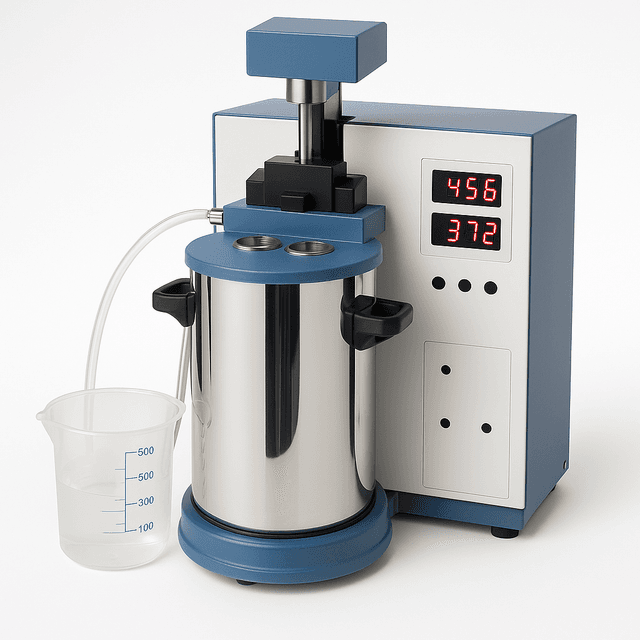
The Digital Flour Quality Analyzer (Model HZF-150) is a bench-top farinograph-type instrument designed to measure the rheological properties of flour dough—providing researchers, quality-control laboratories, and grain-processing facilities with objective, quantitative data on flour strength, water absorption, dough development time, and stability. By recording torque resistance as the dough is mixed under controlled, constant-speed conditions, it generates the curves and indices that define how a flour will perform in baking applications.
A defining feature of the HZF-150 is its interchangeable bowl system. The instrument accepts either a 300 g or a 50 g flour-rubbing bowl, and the onboard program automatically identifies which bowl is installed and adjusts to the corresponding test protocol—no manual program selection required from the operator. This makes it straightforward to switch between large-batch quality screening and smaller, high-value or limited-supply grain samples without reconfiguring the instrument.
Safety is built into the operating workflow. A dual-button start mechanism prevents accidental engagement, and the instrument halts automatically whenever the cover is opened. Intelligent motion-detection logic also allows the system to recognize when a test run begins and to initiate chart recording automatically, reducing operator error and ensuring consistent, reproducible trace capture across runs.
The HZF-150 connects to a host computer via USB for data transfer and analysis. It is available in two supply voltages (AC 220 V / 50 Hz or AC 380 V / 50 Hz) to suit different laboratory electrical standards. With a 200 W motor, an electronic torque sensor for measurement, and accuracy held to within 0.5% of measuring range, the analyzer is suited for grain-breeding programs, flour-milling quality assurance, food-science research, and standardized dough quality testing.
Model
- HZF-150
Motor Power
- 200 W
Power Supply
- AC 220 V, 50 Hz or AC 380 V, 50 Hz
Computer Interface
- USB
Torque Measurement Method
- Electronic torque sensor
Measurement Accuracy
- ≤ 0.5% of measuring range
Main Mixing Element Speed
- 63 r/min ± 2 r/min
Secondary Mixing Element Speed
- 94.5 r/min ± 3 r/min
Horizontal Axis (Chart) Speed
- 10 mm/min
Sample Weight (300 g bowl)
- 300 g
Sample Weight (50 g bowl)
- 50 g
Dimensions (L × W × H)
- 95 cm × 53 cm × 62 cm
Weight (with 300 g bowl)
- 75 kg
Weight (with 50 g bowl)
- 70 kg
Bowl Options
- 300 g and 50 g interchangeable bowls; automatic program identification and adjustment
Safety Features
- Dual-button start; automatic stop on cover open; auto-start chart recording on instrument movement
What two sample sizes does this analyzer support, and do I need to reconfigure the instrument when I switch between them?
The HZF-150 supports 300 g samples (using the 300 g bowl) and 50 g samples (using the 50 g bowl). When you swap bowls, the instrument's program automatically identifies which bowl type is installed and adjusts to the correct testing protocol—no manual selection is needed from the operator.
What physical principle does the instrument use to measure flour quality?
The analyzer measures torque resistance as dough is mixed under constant-speed conditions, using an electronic torque sensor. The main mixing element rotates at 63 r/min ± 2 r/min and the secondary element at 94.5 r/min ± 3 r/min, while the horizontal paper-feed axis advances at 10 mm/min to produce the dough resistance curve.
How accurate is the HZF-150, and what are its key physical and electrical specifications?
Measurement accuracy is no more than 0.5% of the measuring range. The motor is rated at 200 W. The unit is available in AC 220 V / 50 Hz or AC 380 V / 50 Hz versions. Dimensions are 95 cm (L) × 53 cm (W) × 62 cm (H), and weight is 75 kg with the 300 g bowl or 70 kg with the 50 g bowl.
What safety features are built into the instrument?
The HZF-150 requires a dual-button press to start, preventing accidental activation. If the cover is opened during a run, the machine stops automatically. The intelligent program also detects instrument movement at the start of a test and begins drawing the output curve automatically.
How does the instrument connect to a computer for data recording?
The HZF-150 connects to a host computer via a USB interface, allowing test curves and quality data to be transferred for storage, analysis, and reporting.
Have a question about this product?
Have a question? Just ask.
Send it over and we'll email you a personalized answer — no call, no scheduling.
Prefer to talk it through?
Frequently Bought Together